The Original Gay Porn Community - Free Gay Movies and Photos, Gay Porn Site Reviews and Adult Gay Forums

  • Welcome To Just Us Boys - The World's Largest Gay Message Board Community

    In order to comply with recent US Supreme Court rulings regarding adult content, we will be making changes in the future to require that you log into your account to view adult content on the site.
    If you do not have an account, please register.
    REGISTER HERE - 100% FREE / We Will Never Sell Your Info

    PLEASE READ: To register, turn off your VPN (iPhone users- disable iCloud); you can re-enable the VPN after registration. You must maintain an active email address on your account: disposable email addresses cannot be used to register.

I'm moving nearly the speed of light --

Kulindahr

Knox's Papa
JUB Supporter
50K Posts
Joined
Jan 15, 2006
Posts
123,005
Reaction score
4,595
Points
113
Location
on the foggy, damp, redneck Oregon coast
98.4%, to be exact. If I'm going to a star 7.5 light years away, turning around and coming back....

The people here on Earth will say I've been gone for 15 years. The question is, how much time will I have experienced?

I'm getting about three and a half years.

Anyone able to confirm or correct?
 
If you travelled at .984c for 7.5 years each way, 84 years would have passed on Earth.

And don't forget: as v->c m->∞
 
If you travelled at .984c for 7.5 years each way, 84 years would have passed on Earth.

And don't forget: as v->c m->∞

To an outside observer I will have traveled for 7.5 years each way. But because I'm close to the speed of light, my time slows down. The question is how much I slow down by, i.e. how much time I experience, because the people watching from earth will experience fifteen years, watching me go out and come back.

Well, a little more than fifteen years, because I'm not going at quite the speed of light, and it's 7.5 light years each way.
 
Since you'll be the one travelling at .984c, you'll age 15 years. 7.5 years for you at any velocity will still feel like 7.5 years. To an outside observer, each leg would take 42 years.

For only 15 years to elapse on Earth, you would need to travel about 2.5 years at .984c.
 
To me, stuck on earth, you will have been gone about 15 years, assuming you didn't decide to stop and smell the alien flowers for a few years. I don't know the formula, so I don't know how much you would age, but it wouldn't take you longer than the 15 years (and three months.) Of course, this is all assuming that Warp technology hasn't been invented yet, because the whole trip would only take you a couple of weeks at normal cruising speeds, with no time differential.

Actually it is longer, because my fictional starship is doing a tour of the planets as a shake-down cruise, then finding a planet close enough to earth-like to be worth studying as a potential colony -- the planet was found by a sky survey much earlier, which is why they picked that star.

But the relativistic cruise time is of course important, and that's what I was after.


Oh -- no warp technology; they have what they call "skim drive", which was stumbled on accidentally -- they don't know why it works, or how it works, they just tinker with it like medieval trial-and-error engineers.


BTW, anyone dropping in: if you want me to email you the first installment of the tale, holler!
 
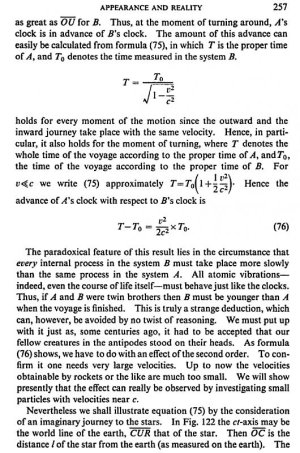
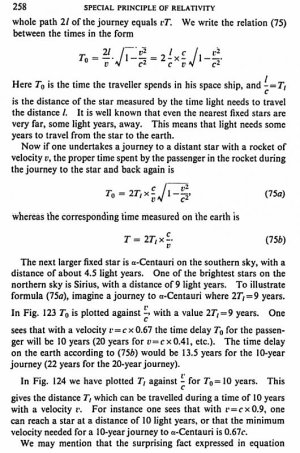
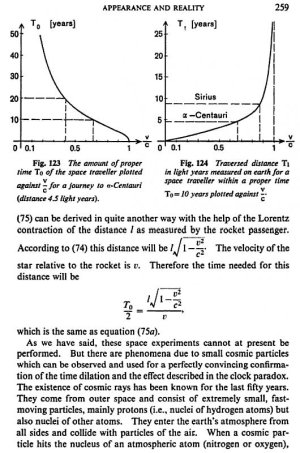
Perhaps a title might help go to your locale's Google Books and search for author Max Born "Einstein's Theory of Relativity". I gave a link to the UK Google Books and different copyright locale might be why the link isn't working.

It gives equations that might be pertinent for stationary observer and traveller. Moreover it gives an example of round trip travel to the stars.

[ame="http://www.amazon.com/Einsteins-Theory-Relativity-Max-Born/dp/0486607690"]Amazon.com: Einstein's Theory of Relativity (9780486607696): Max Born, Physics: Books[/ame]
 
Screen caps
attachment.php


attachment.php


attachment.php
 

Attachments

  • 257.jpg
    257.jpg
    121 KB · Views: 48
  • 258.jpg
    258.jpg
    105 KB · Views: 49
  • 259.jpg
    259.jpg
    95.6 KB · Views: 49
BTW, any answer arrived at will be shorter of the mark. v here is static, that is, you'll be travelling from T=0, v=0 and the next instant, with a speed of v=.984c that is, you're not accelerating at all, but from rest you will have instantaneous near light speed velocities at take-off. The G-force alone would kill everyone onboard, and the required momentum to move it with impulse power to match would recoil with the place it lauched from, and I think it'll be like setting off a gun, at least, on that scale, a nuclear warhead or two, so everyone in the near vicinity will be incinerated along with the said spaceship.

Probably.... So, are you gonna figure out the acceleration too?
 
Perhaps a title might help go to your locale's Google Books and search for author Max Born "Einstein's Theory of Relativity". I gave a link to the UK Google Books and different copyright locale might be why the link isn't working.

It gives equations that might be pertinent for stationary observer and traveller. Moreover it gives an example of round trip travel to the stars.

Amazon.com: Einstein's Theory of Relativity (9780486607696): Max Born, Physics: Books

p. 257 there is a basic discussion of geodesics on irregular surfaces.

It was interesting enough I kept reading to the end of the book. The most fascinating aspect was reading views on things which were then speculation but which we now take for granted.
 
Here's what I get for starting a post, falling asleep, then finishing and posting once I wake up....

Anyway, what you're showing as screen capture doesn't match what I'm getting when I do a google books search for Max Born, author, Einstein's Theory of Relativity. Since the text makes internal references to page numbers, I think it unlikely it was published in two different formats. More investigation is in order.


edit: I plucked two phrases, "rocket passenger" and "imagine a journey" from the text you posted. and searched for them in the book I found. Both returned results "not found".

Are there two books by the same author, with the same name????
 
p. 257 there is a basic discussion of geodesics on irregular surfaces.

It was interesting enough I kept reading to the end of the book. The most fascinating aspect was reading views on things which were then speculation but which we now take for granted.

I didn't go as far as looking at the contents in that link, only that the cover (black background with blue swirl pattern) was the same as the copy I have. I bought mine whilst an undergrad in 1990, and it is a Dover Publications with Library of Congress number 62-5801 and SBN 486-60769-0, ISBN 0-486-60769-0 and mine says

The Dover edition, first published in 1962, is a revised and enlarged version of the work published by Methuen Company in 1924.

On the back cover

This new Dover 1962 edition has been greatly revised and enlarged by Dr. Born, to cover modern developments.

The chapters have many more subsections in my copy, so it seems the one you have available locally in the Amazon look-inside scans is the older version.

HTH.
 
Okay, I found it -- but it won't give me that many pages. I had to specify Dover as the publisher before I found it -- apparently the original was republished in the same year. Google books lists it as a preview, and only give 248 pages.

So how is it you can look at the whole thing, but I can't?
 
Okay, I found it -- but it won't give me that many pages. I had to specify Dover as the publisher before I found it -- apparently the original was republished in the same year. Google books lists it as a preview, and only give 248 pages.

So how is it you can look at the whole thing, but I can't?

Amazon says I can get a used copy here in the UK for 89p. The American site says the cheapest is 27cents. Admittedly you have $3.99 for shipping... But that's cheaper than when I bought mine for £5.90 brand new twenty odd years ago.
 
Back
Top