



- Joined
- Dec 31, 2007
- Posts
- 63,464
- Reaction score
- 16,806
- Points
- 113
Press Release from the CDC.
The latest studies are that the trend in increases are largely in men who have sex with men (MSM). Syphilis case in particular is specific to MSM- about 70% of these cases are in men who reported having sex with other men.

The latest studies are that the trend in increases are largely in men who have sex with men (MSM). Syphilis case in particular is specific to MSM- about 70% of these cases are in men who reported having sex with other men.
For immediate release: August 28, 2018
Contact: National Center for HIV/AIDS, Viral Hepatitis, STD, and TB Prevention
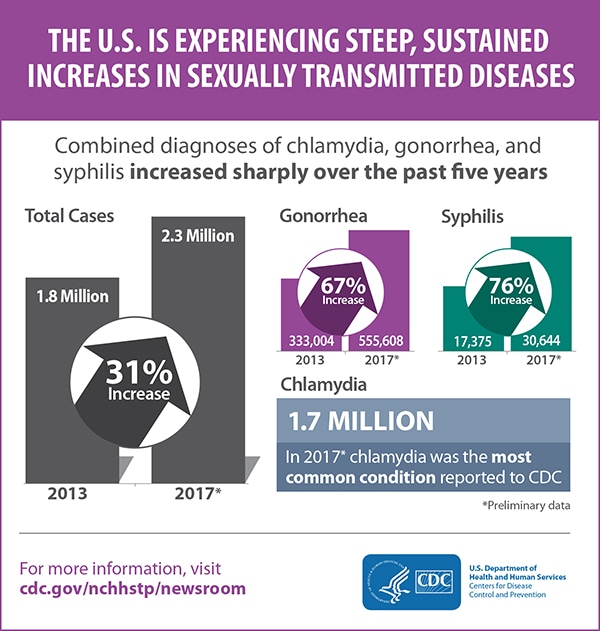
Nearly 2.3 million cases of chlamydia, gonorrhea, and syphilis were diagnosed in the United States in 2017, according to preliminary data released today by the Centers for Disease Control and Prevention (CDC) at the National STD Prevention Conference in Washington, D.C. This surpassed the previous record set in 2016 by more than 200,000 cases and marked the fourth consecutive year of sharp increases in these sexually transmitted diseases (STDs).
The CDC analysis of STD cases reported for 2013 and preliminary data for 2017 shows steep, sustained increases:
- Gonorrhea diagnoses increased 67 percent overall (from 333,004 to 555,608 cases according to preliminary 2017 data) and nearly doubled among men (from 169,130 to 322,169). Increases in diagnoses among women — and the speed with which they are increasing — are also concerning, with cases going up for the third year in a row (from 197,499 to 232,587).
- Primary and secondary syphilis diagnoses increased 76 percent (from 17,375 to 30,644 cases). Gay, bisexual and other men who have sex with men (MSM) made up almost 70 percent of primary and secondary syphilis cases where the gender of the sex partner is known in 2017. Primary and secondary syphilis are the most infectious stages of the disease.
- Chlamydia remained the most common condition reported to CDC. More than 1.7 million cases were diagnosed in 2017, with 45 percent among 15- to 24-year-old females.

