The Original Gay Porn Community - Free Gay Movies and Photos, Gay Porn Site Reviews and Adult Gay Forums

  • Welcome To Just Us Boys - The World's Largest Gay Message Board Community

    In order to comply with recent US Supreme Court rulings regarding adult content, we will be making changes in the future to require that you log into your account to view adult content on the site.
    If you do not have an account, please register.
    REGISTER HERE - 100% FREE / We Will Never Sell Your Info

    PLEASE READ: To register, turn off your VPN (iPhone users- disable iCloud); you can re-enable the VPN after registration. You must maintain an active email address on your account: disposable email addresses cannot be used to register.

Solar System Model?

Kulindahr

Knox's Papa
JUB Supporter
50K Posts
Joined
Jan 15, 2006
Posts
123,002
Reaction score
4,578
Points
113
Location
on the foggy, damp, redneck Oregon coast
I just spent over an hour using google, trying to find a solar system model such that I can put in a future date, like 10 May 2072 or something, and see where all the planets and such will be.

I can't believe there's no such thing out there; it's got to be that I'm not doing a very good search. Can anyone help?
 
Stellarium is a very good and free program available from http://www.stellarium.org there is a 'Date & Time' window where you can enter any specific date and see where all the planets and constellations will be. As far as I know there is no limit on how far into the past or future you go but I'd imagine that the further you go the more 'off' it will be.

Hope that helps :-)
 
Stellarium is a very good and free program available from http://www.stellarium.org there is a 'Date & Time' window where you can enter any specific date and see where all the planets and constellations will be. As far as I know there is no limit on how far into the past or future you go but I'd imagine that the further you go the more 'off' it will be.

Hope that helps :-)

Neat.

But I don't need a view from Earth, I need a map that shows their orbits and positions in those orbits.
 
Ah, I see what you mean, you can edit the settings in Stellarium to achieve this by setting your location as 'Solar system observer' and then switch off the atmosphere and ground effects and enable 'Show planet orbits' in the sky and viewing options. Then just play about with the view and zoom to get a perfect view.

There is another program out there that simulates views from any planet/star or point in space that perhaps gives better results but I can't for the life in me remember what it's called. I'll keep thinking and get back to you on that :-)
 
I'm pretty sure it doesn't need a connection. Did you check the requirements:

• Linux/Unix; Windows 2000/NT/XP/Vista; MacOS X 10.3.x or greater.
• A 3D graphics card with a support for OpenGL.
• A dark room for realistic rendering - details like the Milky Way or star twinkling
can’t be seen in a bright room.
• Minimum of 256 MiB RAM, 1 GiB or more required for the largest star catalogue

I use Windows 7 and it works just fine for me.
 
I'm pretty sure it doesn't need a connection. Did you check the requirements:

• Linux/Unix; Windows 2000/NT/XP/Vista; MacOS X 10.3.x or greater.
• A 3D graphics card with a support for OpenGL.
• A dark room for realistic rendering - details like the Milky Way or star twinkling
can’t be seen in a bright room.
• Minimum of 256 MiB RAM, 1 GiB or more required for the largest star catalogue

I use Windows 7 and it works just fine for me.

I'm confident of everything except the graphics card, which I confess I can't figure out how to check out.

I'm running Windows 7 on a 64-bit system.
 
All I get is an error page that tells me "Internal Server Error".

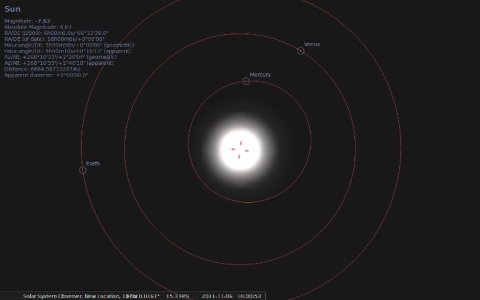
Works fine on my end. Here's an example of what you see:

attachment.php


You can change your POV to whatever you'd like. It's kinda neat, actually.
 
Works fine on my end. Here's an example of what you see:

attachment.php


You can change your POV to whatever you'd like. It's kinda neat, actually.

I'd want to be above the ecliptic in the inner solar system so I can get relative distances at a glance. The story I'm writing won't care about anything beyond the asteroids for a while yet.

I'm going to reboot and try again -- my default approach with Windows. :D
 
Ah, I see what you mean, you can edit the settings in Stellarium to achieve this by setting your location as 'Solar system observer' and then switch off the atmosphere and ground effects and enable 'Show planet orbits' in the sky and viewing options. Then just play about with the view and zoom to get a perfect view.

There is another program out there that simulates views from any planet/star or point in space that perhaps gives better results but I can't for the life in me remember what it's called. I'll keep thinking and get back to you on that :-)

I don't see any way to set my location to that. It has me in Paris seemingly no matter what I do.

Is there a manual for this thing? I'm having to learn the symbols along the bottom by trial and error, because there aren't any labels, just scattered letters. The "Help" isn't much help, and most of the control panels I can access on the left of the screen have letters do faint I can't read half of it.

Maybe I'll try downloading again.
 
I'd want to be above the ecliptic in the inner solar system so I can get relative distances at a glance. The story I'm writing won't care about anything beyond the asteroids for a while yet.

You can achieve almost any view just by playing around with the settings. In the attached image I have ground and atmosphere off, planet orbits on and my planet set as solar system observer. I then found the Sun and zoomed and panned to get the view I did.

If you're still struggling, perhaps you could give me the date & time in question and I'll take a screen cap for you?
 

Attachments

  • stellarium.jpg
    stellarium.jpg
    23.7 KB · Views: 30
You can achieve almost any view just by playing around with the settings. In the attached image I have ground and atmosphere off, planet orbits on and my planet set as solar system observer. I then found the Sun and zoomed and panned to get the view I did.

If you're still struggling, perhaps you could give me the date & time in question and I'll take a screen cap for you?

I finally found "Solar System Observer" by sheer trial and error -- there's no labels on anything, no planet names in a list. And with no instructions or explanations of what any of the controls are, I keep getting into dead ends and having to quite and start over. That's why I asked if there's a manual.

I feel like I'm trying to learn to fly when none of the controls or instruments are labeled.
 
Back
Top