The Original Gay Porn Community - Free Gay Movies and Photos, Gay Porn Site Reviews and Adult Gay Forums

  • Welcome To Just Us Boys - The World's Largest Gay Message Board Community

    In order to comply with recent US Supreme Court rulings regarding adult content, we will be making changes in the future to require that you log into your account to view adult content on the site.
    If you do not have an account, please register.
    REGISTER HERE - 100% FREE / We Will Never Sell Your Info

    PLEASE READ: To register, turn off your VPN (iPhone users- disable iCloud); you can re-enable the VPN after registration. You must maintain an active email address on your account: disposable email addresses cannot be used to register.

Any astronomy geeks? Problem in orbital dynamics

Kulindahr

Knox's Papa
JUB Supporter
50K Posts
Joined
Jan 15, 2006
Posts
123,002
Reaction score
4,576
Points
113
Location
on the foggy, damp, redneck Oregon coast
This question may seem out there, but here it comes.

Consider an observer on some planet, in the middle latitudes of the northern hemisphere. The observer has been watching the sky for two weeks, and has seen no moon.

Is there a possible orbit such that the moon has been hidden all this time?
If so, how does it go?
 
I suppose if you might theoretically have a low orbit moon in geosynchronous orbit so half the planet would never see it. Odd question! What is the reason behind it?
 
I suppose if you might theoretically have a low orbit moon in geosynchronous orbit so half the planet would never see it. Odd question! What is the reason behind it?

The latest chapter in my (sci-fi) story Fit for Life here on JUB.

Your reply makes me realize I didn't get the whole question in my post! The rest is that now the moon has shown up -- so how will it behave?

If I take your geosynch orbit and move the moon outward just a bit, it would seem to creep around the sky, right? or if I moved it inward just a bit?

Now I'm wondering: in those cases, would the apparent motion be in the same direction???
 
It could be possible that rather than the moon's orbit is centred on the planet, both planet and moon are rotating as a binary system with the locii between them around their local sun/star. The planet itself would ever so slighty rotate slightly out of geosynch.

Just a thought, please feel free to shoot me down.
 
It could be possible that rather than the moon's orbit is centred on the planet, both planet and moon are rotating as a binary system with the locii between them around their local sun/star. The planet itself would ever so slighty rotate slightly out of geosynch.

Just a thought, please feel free to shoot me down.

That would require that moon and planet have similar masses, wouldn't it? I mean, technically all two-body systems are binaries orbiting their common center of mass, it's just that in the case of what we call "moons", the common center of mass is deep within the primary.

Interesting notion though. But I don't think it will work for my story.


But a problem occurs to me: how big can a moon be at near-geosynch?
 
oh goody I love these questions...

Yes! That happens right here on Earth!!

But only under extremely rare circumstances...

It wouldn't matter which latitude you are at on Earth unless you were very far North. Our moon orbits us on the planetary ecliptic (the plane that passes through the planetary orbits), not the equatorial plane (the plane that passes through the equator) of Earth, so the moon dips below the Southern hemisphere for two weeks of the lunar month. If you were just close to the North Pole, you might lose sight of the moon for a long time while it is in the Southern portion of the ecliptic. Only when the North Pole is at winter solstice and there is a new moon, does the moon disappear from view there for two weeks. Don't ask me how often that happens, but it does happen from time to time.

Well, you've been reading Fit for Life, so you know that people have been going about naked -- so they aren't that far north...

To answer your question about other planets, yes, a moon could have such an orbit that it would be in sight for two weeks and disappear for two weeks. For this to happen in everyone's view, a moon would have to orbit on the equatorial plane. The moon would have to have an extraordinarily short orbital period that is just slightly faster or slower than the rotation of that planet. It would be nearly geosynchronous, but advance or regress in orbit 1/28th of a day.

Okay -- or slower, I suppose.

Hmmm... I wonder if I can work this into the plot? :badgrin:


On another note: just how big could a moon that close be? From another direction, if this moon subtends a smaller arc than does earth's moon, and just enough less that it's noticeable, what size does that make it, and can it be that big?

If I knew where my old HP calculator was, I work that out in a jiff.


Anyway: thanks to those who have helped thus far. I have sufficient to go on for the next chapter. ..|
 
You may know about astronomy Magnetar but your physics is shaky.

Gravity is a constant force as Galileo proved 400 years ago.


1) All other things being equal, what you want is the distance at which all satellites and moons will be geosynchronous. To do this you have to equal the centripetal acceleration to the gravitational acceleration, because the radius is a product of this equilibrium when all other values are known.

Centripetal acceleration is equal to the angular speed squared times the orbital radius.

Gravitation acceleration is equal to the gravitational constant times the Earth's mass, divided by the radius squared. Forget the mass of the moon because it cancels out in the equations of both accelerations (mass of centripetal a, and mass of gravitational a).


2) From moving these equations to one side with radius on the other you get this:
r=cubedroot(GM/w^2)

(GM) is just a known fact that can be looked up, it's the geocentric gravitational constant 398,600.

The angular velocity (w) takes a bit of geometry. Divide a whole circle, 360 degrees, by length of a sidereal day of 23 hours 56 minutes, or 86164 seconds. Now we can't calculate in degrees so we need to switch to radians, and if you remember math it's 2pi radians for a full circle. Divide 2pi by sidereal day and you get 0.000072921 rads per second.

3) Now divide GM by w^2, which gives you 74,960,428,928,358.


4) Take the cubed root of the answer [74,960,428,928,358^(1/3)] and you get:


42,164.22 km
<---This is the radius from the Earth's center to a geostationary orbit of an object of any mass that is a true satellite of Earth.


Kulindahr if you would like to play around with a different planet, you need only to insert a different value for GM.

To think I used to tutor this stuff....

You should read my story -- it's sci-fi with gay themes.

But to business: I made the solar day exactly 24 hours; I hate those fractions of days.
I've also made the year a precise 360 days. From those two items I ought to be able to calculate the sidereal day, right? That would make 361 sidereal days. So it's just algebra... 360*24 = 361x; x = 23.93 hours, = 1436 minutes; the solar day is 1440 minutes... so the difference is a lot like Earth's, at about 4 minutes.

For simplicity I suppose I ought to have the gravity be 1g. I meant to make it a bit lighter, like .97, but do I really want to play with the math?


For the moment, the distance doesn't really matter, just the apparent motion. Though the distance ought to tell me one thing, and I can't even remotely recall how to do this: I should be able to calculate the maximum mass of a satellite at that distance.
 
The Earth actually "orbits" the center of gravity between the Earth and the Moon. Since that center of gravity is within the Earth itself, it just appears to wobble. It is also so negligent we don't even have to account for it for ordinary applications. But as the mass of the moon gets theoretically bigger, the center of gravity will simply move from inside the planet to the outside, where it is called a barycenter. When the center of gravity between two objects is a barycenter, the smaller object is no longer called a moon. It is called a binary system. So then the theoretical "maximum mass" of a "moon" would be the mass it would require to move the center of gravity outside of the central body to become a binary system. It is just irrelevant what the mass of the "moon" is, it will still orbit the barycenter geosynchronously at the same distance from its partner all the same. Even if the moon were almost as big as the Earth, it would orbit the barycenter from the same geosynchronous 47,000 miles to the center of the Earth.

Most of that I know.

But if I had two earth-sized bodies 47,000 km apart, aren't tidal forces going to do nasty things to them? I seem to recall something in astronomy (Roche limit?) about how close a satellite could be to the primary before tidal forces ripped it apart, as a function of the masses of the two bodies.

Okay, off to google "Roche limit" and see if my memory is being helpful....
 
Surely the mass of the moon does make a difference but only in so far as it's mass adds to the gravitational attraction between the two bodies and therefore the centripetal force that needs to be overcome to keep it in orbit. This is the force that goes someway to driving our tidal system. Logic says that to attain geosynchronous orbit for a more massive body it will be further away than that for a body of minimal mass eg a coms satellite. You could also have a smaller moon to make the apparent size similar to that of earth's moon. Raising or lowering the orbit would make the moon appear to move backwards or forwards respectively relative to the rotation of the earth.
 
Found it!

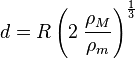
Roche limit:
a2263b8cda1335ff816c121a0fd59b29.png


where R is the radius of the primary, ρM is the density of the primary, and ρm is the density of the satellite.

R = 12,742 km/2 = 6,371

ρM = 5.5153 g/cm^3

ρm = 4.5678 g/cm^3 (arbitrarily decided)


What I notice is that the mass doesn't come into play, just the density.

So . . . .

d = (6,371 km)(2*5.5153 g/cm^3 / 4.5678 g/cm^3)^1/3

d = (6371 km)(50.3856)^1/3

d = (6371 km)(3.693)

d = 23,531 km

From the inclusion of R, I assume that d is distance from the surface of the primary. That would make the distance from the center R + d, or 29,902.

That's well within the geosynch orbit, so my weird moon is safe from tidal forces. :D
 
Surely the mass of the moon does make a difference but only in so far as it's mass adds to the gravitational attraction between the two bodies and therefore the centripetal force that needs to be overcome to keep it in orbit. This is the force that goes someway to driving our tidal system. Logic says that to attain geosynchronous orbit for a more massive body it will be further away than that for a body of minimal mass eg a coms satellite. You could also have a smaller moon to make the apparent size similar to that of earth's moon. Raising or lowering the orbit would make the moon appear to move backwards or forwards respectively relative to the rotation of the earth.

Orbital distance doesn't depend on the mass of the satellite -- that much I know.

But you remind me: no one has addressed my question about the apparent direction of motion WRT orbit lower than geosynch vs. orbit higher. My intuition is that a lower orbit would mean the moon is losing ground each day, but something about that seems fishy.
 
If the moon orbited from 47,000 km, yes it would get very weird.

A moon with the density of ours would be very close to its Roche limit.

Neptune's moon triton will eventually decay close the planet and break apart.

I recall that... I wanna watch! :D

A sub-synch orbit would gain, advancing west each night, and a super-synch would lose, regressing east each night.

Yeah, I just figured that out. Thanks for confirming it, though.

So I guess my story's moon is sub-synch; it came up in the east and moved about four degrees across the sky.
 
Just to expand a bit on this statement since it may not appear obvious. This is what makes sense to me:

The Moon takes longer to go around its orbit than the time it takes for the Earth to rotate. So by the time the Earth has made a full rotation, the Moon is further East a bit, making the Earth spin a little bit more to make it rise. That is why it appears to rise later every night.

A sub-synch satellite that is also orbiting in the same direction as the Moon, eastward, will nevertheless complete an orbit faster than an Earth rotation. Therefore it will rise in the west a little earlier every day, not in the east, because it does not have to wait for the Earth to turn into its view. It's faster so it rises all by itself. Like the moon, it will advance eastwards as well for every sidereal rotation, not because it is slower, but because it is faster than a sidereal rotation, so it will have gained some more eastward movement than a full earth rotation. But unlike the Moon, it will appear in the west and move east even though the earth is rotating because remember that a subsynch object is moving faster than an earth rotation, whereas the moon appears in the east and moves west while advancing a little bit east every night.

You may be the physics guru Jockboy, but your astronomy is a little bit, what was the word you used?

shaky... :lol:

So the apparent motion of a sub-synch satellite will be retrograde?

Okay... I've committed myself to this much in :


So it's arrived from the east, and hardly seemed to move across the sky.

What does that tell us?
 
Okay, now I'm confused -- you say it rises in the west, but doesn't have retrograde apparent motion? :confused: We're used to things rising in the east, so something rising in the west would be backwards, i.e. apparently retrograde.


As far as it breaking up, I assigned it an arbitrary average density and did the Roche limit calculation, and it's well outside the Roche limit.

Now I just have to calculate its actual size from the apparent size....
 
We are used to things rising in the East because those things are slow, while the Earth is faster. So when the Earth rotates, those objects pop up in the East.

However, something that is moving slightly faster than the Earth's rotation will swing around the Earth slowly, be gone for a few weeks, and rise in the west. It may take several weeks to move its position in the sky, but it moves across the background of the stars very quickly. This is the opposition of what our Moon does.

When I say that the subsynch object drifts east, I mean only from time to time. At 12 PM tonight a subsynch object can appear in the constellation Pisces, at 12 PM tomorrow night it will be further east, perhaps in the constellation Cetus.


As you can probably tell, I'm not good at the physics and math part. !oops! Just the observation stuff, explaining phenomena, that sort of thing.
So if my moon is coming up in the east, it has to be moving faster than geosynch? Or going in retrograde motion?

I like to get all of a phenomenon down when I use it in a story; one never know what use the information may have, or what glaring "oops!" its lack may cause.
 
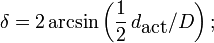
If I use:

441218a17341290bb2cd4a35afac2ad9.png


and take the angular diameter as 80% of our moon's, with the moon in a not-quite geosynch orbit, I get an actual radius of about 240 kilometers.

I was thinking bigger.....

I don't think I've committed myself; I could have it look bigger than our moon.
 
If your moon is coming up in the east, it has to be supersynch and therefore moving slower than the planet's rotation, otherwise it would be subsynch and outrun your planet.


If it rises in the east anyway, and it is subsynch, it must be in retrograde orbit, correct.


Never forget that for a moon to orbit faster than a geosynchronous orbit, it must be closer than a geosynchronous orbit. That's basic Kepler right there.

Okay.

Kepler -- are you referring to the square of the orbital period of a secondary being proportional to the cube of the radius?


At any rate, I don't think I want a retrograde orbit -- I'd have to come up with a reason for that.....
 
You could have a moon that takes 1,000,000 years to appear if you really wanted to...

I was thinking along those lines.

Kind of, what if someone towed a moon to geosynch, but something perturbed it a little -- if no one put it back, what kind of orbit would it have, say 1,000 years later.

For the story, though, it might be fun to have two moons moving in opposite directions across the sky... and a stationary one somewhere for kicks and grins.
 
Back
Top