The Original Gay Porn Community - Free Gay Movies and Photos, Gay Porn Site Reviews and Adult Gay Forums

  • Welcome To Just Us Boys - The World's Largest Gay Message Board Community

    In order to comply with recent US Supreme Court rulings regarding adult content, we will be making changes in the future to require that you log into your account to view adult content on the site.
    If you do not have an account, please register.
    REGISTER HERE - 100% FREE / We Will Never Sell Your Info

    PLEASE READ: To register, turn off your VPN (iPhone users- disable iCloud); you can re-enable the VPN after registration. You must maintain an active email address on your account: disposable email addresses cannot be used to register.

  • Hi Guest - Did you know?
    Hot Topics is a Safe for Work (SFW) forum.

Anybody know anything about antique radios?

gsdx

Festina lente
JUB Supporter
50K Posts
Joined
Oct 10, 2003
Posts
57,249
Reaction score
1,622
Points
113
Location
Peterborough Ontario
I don't know much about them, either, but when I think of an antique radio, I think of the table-top one from The Waltons.

attachment.php


The Walton radio as it is called today was a 1937 Zenith Tombstone Model 12-S-232. This is the 12 tube model, it also came with 7 and 9 tubes. All the cabinets were the same and some came with batteries. It's difficult to find one of these radios with everything original such as knobs, grill cloth, speaker and finish. One with original parts in playing condition will sell for around $3200.00 or more. It is common for one of these radios to be put together from more than one radio with new grill cloth, new knobs and even speakers that did not come with this model radio. Radios put together like this sell for $1800.00 to $2200.00.

http://www.the-waltons.com/faq.html

The left button was the On/Off button. The right button was the Volume Control. The lower, middle button was the station tuner.

My grandparents had one similar when I was a kid. I can't remember what it looked like, but I remember you could bake a cake before it 'warmed up'. ;)

I don't think there was an antenna attached, though, but I'm sure it would have benefited from it if one was attached.
 
That's my actual, working radio (posted it some time ago in an other thread already):

attachment.php


I have a FM transmitter attached to my mp3 player and play my mp3s over that radio :)
 
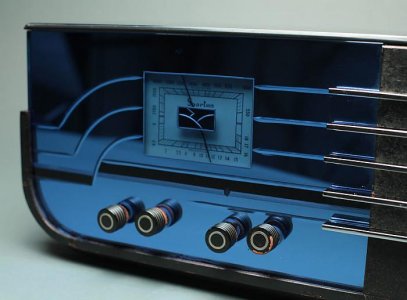
My aunt used to work in the Sparton Radio factory in Jackson, Michigan - and she PROBABLY helped assemble one of these gems:
attachment.php

Some of these radios are worth $5-10K nowadays.

Back in the old 'antique" days, and including the days of the early television sets, these were not only manufactured to perform a function, but also to be a piece of furniture.

Somewhere on the back of your radio there should be an antenna terminal/screw or something. Hooking up a long wire to it, and the wire needn't be anything fancy at all, can do wonders. However, many households nowadays can generate so much noise that it might be hard to receive anything. Fluorescent light bulbs (including the compact ones which are ubiquitous in the USA nowadays), a computer's wireless component, various other electronics, etc. can wash the entire radio dial under a blanket of noise.
 

Attachments

  • sparton.jpg
    sparton.jpg
    41.2 KB · Views: 249
i love old radios too, i bought an old floor model Zenith and though it still has the tubes i put a working radio/cd player in the inside and sometimes listen to old radio shows.
 
I have a few, & collect & restore them. The tube count doesn't tell you that much. Normal for an AM table top is 5 or 6. More for FM. Hi-fi tuners will have more, for better sensitivity.

Be careful inside, there are deadly voltages inside tube circuits. Also be wary of ones that have been stored unused - the high voltage capacitors can literally explode when they are powered up for the first time after say 50 or 60 years of being idle.
Some cheaper models used a live chassis, i.e., no transformer, so any metalwork of the chassis is directly connected to mains voltage. These are supposed to be totally enclosed in a plastic cabinet, but after so many years things like the back or plastic knobs go missing, making the whole thing dangerous.
 
One thing about the radios puzzles me: sometimes, you see a 5 or 6-tube table radio, such as the one I posted above, that's very sensitive and will pick up stations from 100s of miles away.

But then, you'll see a 10 or 12tube console, that won't pick up very much at all.

Why?

My own favorite is the Zenith Robot Dial Console from 1938, but I'd also be very happy with the Walton that GDSX posted above. How does a guy know how sensitive the radios are going to be?

Good reception requires a good antenna. For AM a long piece of plastic-coated wire is ideal. Long... like 10 feet AT LEAST for local, several hundred feet if you want overseas broadcasts to come in. Reception is also better at night because of atmospheric changes.

Basic AM or shortwave requires 5 tubes minimum, maybe 4 if they combine two into one glass envelope (that is common on european sets because the sales tax was determined by the number of actual tubes, not their function).

If FM is added that a whole lot more tubes required, but to economise, they often used a few of the same tubes for both AM and FM, by switching the connections around.

Basic audio can be got from a single amplifying tube, but for better fidelity they might have used two (in what is called a push-pull amplifier). In consoles they put in two amplifiers for stereo playback of records or tapes, even though the radio section was only mono. Stereo amplification means more tubes obviously.

An easy check on the sensitivity is to count the number of sections on the tuning capacitor (that thing with many closely spaced, half-moon shaped metal vanes). Two sections is essential for any superheterodyne receiver (superhet = almost all commercial radios). Better sensitivity and selectivity can be got from 3 sections. Top end hi-fi tuners may have up to 5 sections.

FM stereo - usually only on hi-fi separate tuners, means another 2 or three tubes.

Old radios go out of alignment - or they are put out of alignment by unskilled technicians or DIYers. For good sensitivity, all the tuning coils (the aluminium cans with screws on top and underneath) have to be accurately aligned together. Knock out any single one and the whole radio sensitivity falls very short of what it is capable of. Sadly, realigning a radio is quite a tricky process and needs some special test gear.

The tubes themselves wear out with prolonged use. There is no visible degradation, they just fail to amplify as much as they ought to when new. Up until the 70s you could test yours and buy new ones in supermarkets, but now you have to go to specialist suppliers. Most types can still be bought if you need a replacement though.
Other components - mainly capacitors - age too, making the radio less sensitive than it would have been when new. Happily, capacitors are cheap, and easy to source. Any capacitor with a value of more than 1uF (microfarad) is probably failed are failing now. Smaller ones last better, but there is no guarantee they are all still good.
 
Tell me: I see that many of the radios in the 1930s aren't superhets. Which do you think would be a better buy? A five-tube superhet, or a nine- or ten-tube "non" superhet?

Non-superhet is almost always a "TRF" (tuned radio frequency) type of circuit. Superhet is pretty much always more sensitive and more selective, which is why it is a configuration used in just about every radio and TV ever built the 40s.
(TRF technology is making a bit of a comeback in high frequency digital comms like cellular phones, but it is different application entirely).

TRF radios are fun from a historical point, but if you actually want to listen to stations with minimal hassle, superhet is best. Some TRF sets have a 'regeneration' control, that is a bonus - it is a circuit that improves TRF reception drastically, but it's still more of a hassle to tune & operate.

That's a pretty tombstone! Pity no photos of the inside. It has a 'magic eye', a very nice visual indicator of the station strength (it's actually a very simple cathode ray tube). They are generally short lived and dim at even a modest age. New ones are rather costly compared to other tubes, so check that the 'eye' is good and bright. They do say its a new one!

You can buy low power AM transmitters, to plug into your music server or satellite radio receiver, etc. Then you can use an old AM radio anywhere in your house to pick up your own choice of music or programming. I like this arrangement better than adding a modern 'ipod' socket. Yet, many old radios already have a 'gram' or 'phono' socket on the back originally for plugging in a record player, and that socket is entirely compatible with any moderm music player.
 
Ahh.. found the pictures of the inside.
I'm not sure what info is telling you it isn't superhet; I suspect it IS - looks like it is from the photo. It looks similar to this Goldentone G9
goldentone3b.jpg

only this Goldentone G9 is a live chassis - no power transformer, whereas 'yours' is isolated chassis.

Yours has a 3 section tuning capacitor, so it is better than 'average'.
It also looks like it has two audio output tubes (push pull), and other Goldentones of the period used two 6V6 tubes in that role. That means it is going to sound damn loud and powerful! People like Bell & Howell were using twin 6V6 amplifiers for small cinema applications!
 
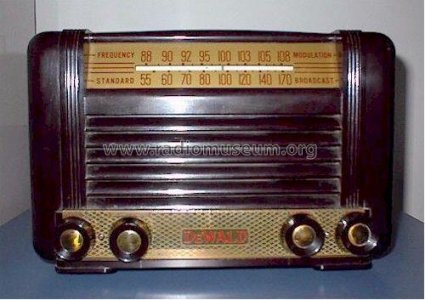
This post got me thinking about this old DeWald C800 radio that my parents had. It's been a closet for a while. I looked it up and it looks like it was made in 1949.

I'd like to see it it still works, but it hasn't been powered up for a least 10 years. After reading one of the posts above, I'm afraid to plug it in.

c_800_56751.jpg
 
I could get the long wire, plastic coated, and wrap it around the corners of my room. The room is 12 X 12. That's 48 feet, wrapped around the circumference.
Even better if you can somehow put a lot of wire outdoors, especially if stuff in your room and nearby generates a lot of noise. (Some COMPUTERS are notorious for generating noise, especially Wireless/WiFi...also satellite TV tends to generate noise!) Inside your room, 100% of the antenna would be receiving from a noisy location. If you were able to string out 100 or 200 feet outdoors, only a small percentage of the antenna is receiving its signals from a noisy location.
 
that looks similar to the one i found in an old junk shop and bought.
i wish the lighte dial worked but it is still a nice piece of furniture.
 
A long-wire AM antenna needs to be in a straight line more of less. Any sharp bends, or curves and it acts as if it is only as long as the longest 'straight' portion.
If you could ask a neighbor if you could attach one end to their house roof, that is the best sort of plan. But be careful to detach the antenna from your radio during thunderstorms - it makes a great lightning conductor too. Tying it into trees is not a great idea - it requires careful insulation, and the tree would be a lightning target.

Most hardware store should sell PVC insulated hookup wire. Otherwise, buy half the length of 'zip-cord' and split it in two all along its length. Something like USTP Ethernet cable will work fine too, or telephone wire. But if you untwist the separate pairs in that sort of wire it is a bit thin to support its own weight when strung out - twisting it losely with a nylon clothes-line would help. Here you can buy steel-strand, plastic coated clothes line wire, at supermarkets etc. - that makes a perfect antenna.

The wire doesn't HAVE to be plastic coated, but where it comes in contact with the anchor points it must be insulated with plastic or ceramic, otherwise the radio signal just flows away to earth, rather than into the radio. Steel fencing wire or binding wire is fine then, if you insulate the anchor points.

NEVER string the antenna under or over power lines!!! If either should break & fall, you could or would get tens of kilovolts in contact with your antenna! Hopefully the police would visit you first and make you undo it though.

Most radios have an 'earth' or 'ground' connector too. Than can be connected by similar insulated wire to a metal cold water pipe, or a metal spike hammered into moist earth (flower bed is ideal). Never attach to a gas pipe! Usually the earth connection is only required to get that last tiny scrap of sensitivity beyond what a good antenna gives, if you really HAVE to have far away stations.

As for old radios and bits exploding, The safest way is to get a 'variac' - Zeniths trade-name for a variable auto-transformer. This lets you gradually increase the AC power voltage to the radio over several hours, which (i) helps the aged components recover and regenerate, if they have any life left in them, and (ii) if their is any potential fire or explosion risk, with a Variac, you will get a burning smell warning and maybe smoke, but it is gradual and calm, rather than an instant bang & flames.
 
I bought one when I was a teenager. It looks the same as that Zenith Robot Dial except it has a flat top. Unfortunately I ripped out the electrics, turned it back to front and made it into a bookcase. :(
 
^I know; I'm kind of angry with myself that I discarded the speaker cloth and all the internal stuff. I retained the 3 dials and re-varnished the beautiful woodwork.
 
it might interfere with the integrity of the radio. (I can just imagine somebody, 50 years from now, asking,"Who the hell put this jack in the radio, and what is it for?")

Pigface, I have the overly romantic idea that I'm not really buying a radio, I'm merely adopting it so that I can care for it, for as long as I live.

I really like both those sentiments. These old things are designed and built with a craftsmanship and pride that puts to shame the crappy chinese made junk like ipods that everybody so repugnantly 'desires' nowadays. And this radio, when set up well will give you a sound quality that will be rich, mellow & pleasant, which very few table-top playback systems made recently can match.
 
Johann, I have a couple antique radios I'll pull out of the basement and take a few photos of for you. One is very old.


CB
 
Finally did it.


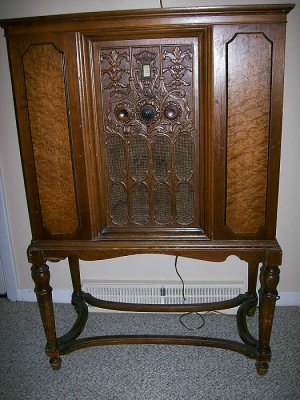
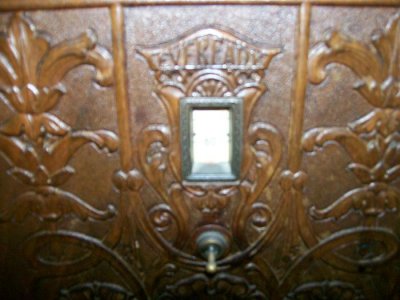
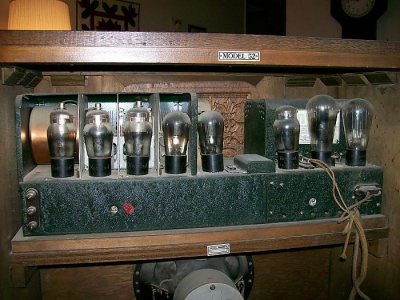
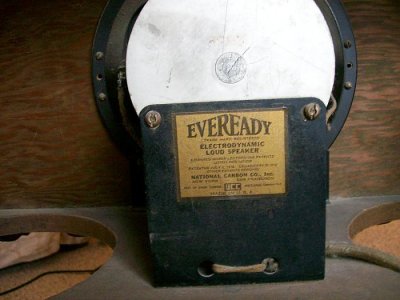
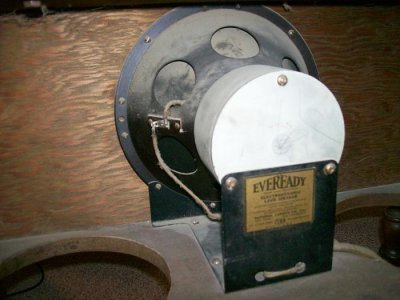
The first one is a console radio made by Eveready. I don't know that much about it but I think it's from the 1920's. It worked find up until about 10 years ago when one of the tubes went. It weight a ton! It has very rich tones. It's in my living room and haven't done much with it other than dust it off when it need be.

I'll make another post for the second radio.

attachment.php

attachment.php

attachment.php

attachment.php

attachment.php
 

Attachments

  • 100_1799.jpg
    100_1799.jpg
    90.7 KB · Views: 116
  • 100_1800.jpg
    100_1800.jpg
    51 KB · Views: 116
  • 100_1802.jpg
    100_1802.jpg
    83 KB · Views: 118
  • 100_1804.jpg
    100_1804.jpg
    49.5 KB · Views: 116
  • 100_1805.jpg
    100_1805.jpg
    48.3 KB · Views: 118
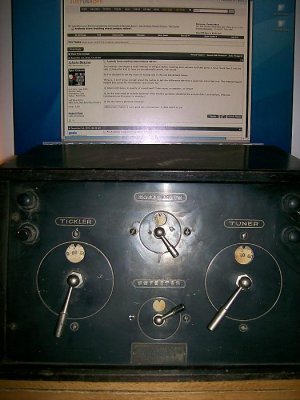
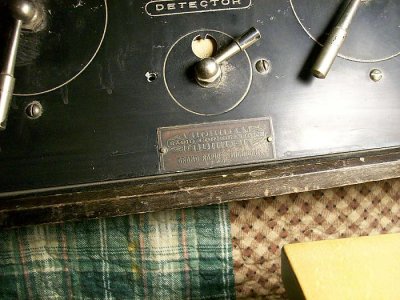
Here's another radio I have sitting in a corner of the basement. It's ancient. Tis one doesn't have a speaker, you use headphones (I was fgoing to take a pic of the headphones but forgot, it you're interested I can.

This is one made by Michigan Radio Corporation in 1922. You needed a separate antenna wire and a ground wire and a special battery pack.

This one doesn't work anymore as it was damaged by water in the late 1990's. My Grandfather gave it to me years ago. As you can see it has a tuner and a tickler... whatever that it. I don't know that much about this one either.

I have a couple old transistor radios too if you're interested.

CB


attachment.php


attachment.php
 

Attachments

  • 100_1808.jpg
    100_1808.jpg
    57.5 KB · Views: 115
  • 100_1810.jpg
    100_1810.jpg
    82.6 KB · Views: 116
Thanks for your comments.

As I said, I don't know that much about these radios. I got both from my Grandfather and they've been sitting in the house for several years. The Eveready is HEAVY! Where do you get tubes for these things and are they expensive?

Years ago a local electronics store had a vintage electronics show and I entered the Michigan Radio and I won for having the oldest radio entered.

I'll keep them around since they are hand me downs and my nephew will probably inherit them if he is interested in them.

(Wow, just noticed I made a lot of typos in my two posts, sorry! Typing too fast....)
 
Thanks for the advice Keeland. I wouldn't have known any of that. I'm going to print out your posts and put them in the back of the radio for future reference.
 
Back
Top