The Original Gay Porn Community - Free Gay Movies and Photos, Gay Porn Site Reviews and Adult Gay Forums

  • Welcome To Just Us Boys - The World's Largest Gay Message Board Community

    In order to comply with recent US Supreme Court rulings regarding adult content, we will be making changes in the future to require that you log into your account to view adult content on the site.
    If you do not have an account, please register.
    REGISTER HERE - 100% FREE / We Will Never Sell Your Info

    PLEASE READ: To register, turn off your VPN (iPhone users- disable iCloud); you can re-enable the VPN after registration. You must maintain an active email address on your account: disposable email addresses cannot be used to register.

  • Hi Guest - Did you know?
    Hot Topics is a Safe for Work (SFW) forum.

Discussion Thread from the Funny Anti-Religious Pictures thread.

Evaluating the text by modern standards is generally a fundamentalist-style cop-out, especially when it's a text with an arc toward improvement. The problem, though, in the FARIP thread is that generally the step of understanding the ancient text at all is skipped, so all that gets examined is the individual's preconceptions and prejudices.

Yet once again, I have never made the point that a text should be evaluated by modern standards until it is fully understood in its own terms, genre, etc. This is not Vatican II. You indulge your preconceptions and prejudices. Why should anyone else, who wants to?

No claims to that hold up, unless you're talking about the bad examples that are given -- but then those aren't flaws because they're given as bad examples.

You know as well as I that that isn't a universally accepted position and is the subject of endless debate, conflicting interpretations, etc.

Any sense of humor that includes insulting others without basis is not a civilized one --it belongs in the trash bin of history. It's the sort of thing relied on by demagogues inciting unthinking masses.

I think you've got that wrong also. Comedy can incite unthinking masses, but it can also puncture despotic illusions. Obviously, not everyone finds the same thing funny, but, as you've seen, arguing about the premises of jokes is a bottomless pit.
 
The Bible's definition of faith requires evidence -- Paul says so, the Prophets say so.

Even all Christians don't agree with that assertion. Faith is a gift of God (2:8-9). Faith is a gift of God, a supernatural virtue infused by him. (The Catholic Catechism), etc., etc. Mother Theresa had doubts. Shame she died before you could direct her to the evidence that would have removed them. No true faith without skepticism and doubt.
 
Yes, people were illiterate -- and that's one of the facts that stands in the corner of the reliability of the Gospels: people knew they couldn't read or write, so they depended on everyone who told a story to get it right, and they learned the stories well enough to call out anyone who got it wrong. Texts that didn't measure up were excluded from being read in the churches, which is why they didn't make it into the canon. False Pauline letters vanished pretty quickly, because the churches were full of people who knew Paul -- and his actual letters were being read in the churches during his life.

No -- I am describing the certainty that arises by treating the texts according to standard principles of historical analysis. You're putting the cart before the horse.

It's no different than when someone here dismissed the author of Cold Case Christianity as unobjective because he became a Christian due to applying modern rules of evidence. If that is to be followed, then no one who has been convinced of something can be trusted, because they obviously believe that thing.

You must be joking. You need only look at the plethora of modern day congregants to see how almost any interpretation or version can be promoted. The idea that it would be the norm for an ancient congregant to correct a errant priest is naive. The growing hierarchy spun the orthodoxy to fit its temporal ambitions. Even if the texts are largely accurate, they may still be mistaken or manipulated as to the facts reported. Whether someone becomes a believer as a result of his research is irrelevant. It's what he relies on that matters and, as I say, I believe that to be a function of grace rather than evidence.

 
Even all Christians don't agree with that assertion. Faith is a gift of God (2:8-9). Faith is a gift of God, a supernatural virtue infused by him. (The Catholic Catechism), etc., etc. Mother Theresa had doubts. Shame she died before you could direct her to the evidence that would have removed them. No true faith without skepticism and doubt.

This statement doesn't disagree with my statement of what the Bible has to say.
 
You must be joking. You need only look at the plethora of modern day congregants to see how almost any interpretation or version can be promoted. The idea that it would be the norm for an ancient congregant to correct a errant priest is naive. The growing hierarchy spun the orthodoxy to fit its temporal ambitions. Even if the texts are largely accurate, they may still be mistaken or manipulated as to the facts reported. Whether someone becomes a believer as a result of his research is irrelevant. It's what he relies on that matters and, as I say, I believe that to be a function of grace rather than evidence.


What "ancient priest"? There wasn't any authoritarian hierarchy until after the text was settled.

And no, that hierarchy, when it finally existed, didn't "spin the orthodoxy to fit its temporal ambitions' -- the texts were already there, and either accepted or rejected. If anything, the hierarchy to which you refer accepted more than might have been the case, not less -- the Eastern canon demonstrates that, since it developed without any imperial meddling and is smaller than the Western.

No account can be manipulated when there are hundreds of people interested in keeping them accurate who are there to note any alterations. You're arguing against the existing evidence.

That someone becomes a believer due to research is hardly irrelevant -- it demonstrates that the evidence is strong enough to withstand an assault by the methods used. The intent of the author of Cold Case Christianity (and dozens of other authors and their books) was to prove the Gospels wrong; instead he discovered that on the basis of modern rules of evidence, they stand up strongly. Thaat cancels your argument about bias, because his bias was against the Gospels.

BTW, your final statement fails due to false dichotomy.
 
This statement doesn't disagree with my statement of what the Bible has to say.

Sure it does. You're arguing that faith is dependent on evidence. My Biblical, Christian and anecdotal references show that faith is, ultimately at least, a gift from God and in his disposition.
 
What "ancient priest"? There wasn't any authoritarian hierarchy until after the text was settled.

St Peter & Co and their successors.

And no, that hierarchy, when it finally existed, didn't "spin the orthodoxy to fit its temporal ambitions' -- the texts were already there, and either accepted or rejected. If anything, the hierarchy to which you refer accepted more than might have been the case, not less -- the Eastern canon demonstrates that, since it developed without any imperial meddling and is smaller than the Western.

On your own case, the texts were "either accepted or rejected." In other words, the source material (itself set down in writing decades after the event) was further compromised to reflect the editors' views. That's the point being made to you.

No account can be manipulated when there are hundreds of people interested in keeping them accurate who are there to note any alterations. You're arguing against the existing evidence.

Accounts get manipulated by mass hysteria and manipulated evidence all the time. Plus, as I say, even if you are right, who's to say that the original accounts were accurate or not spun or altered in the first place. Take Scientology and test your assertions against that and you'll see the problem.

That someone becomes a believer due to research is hardly irrelevant -- it demonstrates that the evidence is strong enough to withstand an assault by the methods used. The intent of the author of Cold Case Christianity (and dozens of other authors and their books) was to prove the Gospels wrong; instead he discovered that on the basis of modern rules of evidence, they stand up strongly. Thaat cancels your argument about bias, because his bias was against the Gospels.

And many others in the field have come to different conclusions. So what?

BTW, your final statement fails due to false dichotomy.

If faith is a gift from God, it can be bestowed without any evidence or in spite of the evidence. One can work at making oneself willing to accept the gift. But it's inconsistent to think that you can get to faith by evidence, if God doesn't grant or sustain his gift.
 
St Peter & Co and their successors.

Had nothing to do with it -- by the time Rome weighed in, the issue was settled.

On your own case, the texts were "either accepted or rejected." In other words, the source material (itself set down in writing decades after the event) was further compromised to reflect the editors' views. That's the point being made to you.

No, "either accepted or rejected" means no editing, nothing compromised -- it was either accepted or rejected.

Accounts get manipulated by mass hysteria and manipulated evidence all the time. Plus, as I say, even if you are right, who's to say that the original accounts were accurate or not spun or altered in the first place. Take Scientology and test your assertions against that and you'll see the problem.

Scientology doesn't match up in the least. It has no eyewitnesses, indeed doesn't make any claim to having anything to have eyewitnesses to.

How do we know the original accounts were accurate in the first place? By using the historical authenticity guideline that there were hundreds of people who knew what had really happened, and hundreds of more whom they told, in a culture where getting it 100% correct was a very high value.

And many others in the field have come to different conclusions. So what?

Really?

If faith is a gift from God, it can be bestowed without any evidence or in spite of the evidence. One can work at making oneself willing to accept the gift. But it's inconsistent to think that you can get to faith by evidence, if God doesn't grant or sustain his gift.

"Can be." That argument is only sustainable if you propose a different God than the one of the Bible, because it would require one who says one thing and does another.
 
Had nothing to do with it -- by the time Rome weighed in, the issue was settled.

No, "either accepted or rejected" means no editing, nothing compromised -- it was either accepted or rejected.

By the time Rome weighed in...!? Even on your own case, accepting or rejecting is making a judgment on what gets accepted or rejected. That edits the totality of text. That editing like that occurred is the point being made to you.

Scientology doesn't match up in the least. It has no eyewitnesses, indeed doesn't make any claim to having anything to have eyewitnesses to.

The cult pattern is similar. Veneration of the founder and the texts. Eyewitness accounts of the event of Hubbard's life. And, of course, the determination of the believers to believe.

How do we know the original accounts were accurate in the first place? By using the historical authenticity guideline that there were hundreds of people who knew what had really happened, and hundreds of more whom they told, in a culture where getting it 100% correct was a very high value.

Wishful thinking, I assume based on perhaps some historical fact. For example, hundreds of people did not witness the resurrection. If those hundreds then told hundreds more, then you have mass belief rather than any real indication of what actually happened. As for "a culture where getting it 100% correct was a very high value", that sound wholly fanciful. Prophets and magicians were a dime as dozen. Judaism and Islam see Jesus differently than your 100% correct view.


"Can be." That argument is only sustainable if you propose a different God than the one of the Bible, because it would require one who says one thing and does another.

Seems to me that the Biblical God clearly says one thing and does another. Thou shalt not kill, etc., etc. Hence, the endless word games to explain the contradictions and inconsistencies. The Biblical God says faith is a gift. If faith is a gift of God, it does not require evidence. That's the clear message from the St Thomas story. Let the word games continue.
 
A, the fallacy of assuming that the way YOU would do things is the only way to do things.

If you're trying to show the intellectual failings of the FARIP thread, then this was definitely worth reposting.

The other way around.

All gods in all religions seem to do things in human ways. Except there's never a trace of said gods.
 
By the time Rome weighed in...!? Even on your own case, accepting or rejecting is making a judgment on what gets accepted or rejected. That edits the totality of text. That editing like that occurred is the point being made to you.

But Rome had nothing to do with it -- no authoritarian heirarchy did. The canon was approved by people on the ground, often people who had known Jesus, who knew the Apostles, weighing in on what fit with what the eyewitnesses had handed down. The Gospel writers didn't get to spin anything; they could only write what was validated by the combined witness of those who had also been there. The standard by which anything was accepted or rejected was whether it held to what was known to be true. So what you're stretching the term "editing" to cover was edited in favor of truth, not of any agenda.

The cult pattern is similar. Veneration of the founder and the texts. Eyewitness accounts of the event of Hubbard's life. And, of course, the determination of the believers to believe.

No, it's opposite. In Scientology the texts were handed down from on high, they didn't arise from the community who had been there. Further, they have to ignore much of Hubbard's life, so they can avoid the fact that his real skill lay in making up stories and risking concluding that Scientology was just one more.

Wishful thinking, I assume based on perhaps some historical fact. For example, hundreds of people did not witness the resurrection. If those hundreds then told hundreds more, then you have mass belief rather than any real indication of what actually happened. As for "a culture where getting it 100% correct was a very high value", that sound wholly fanciful. Prophets and magicians were a dime as dozen. Judaism and Islam see Jesus differently than your 100% correct view.

No wishful thinking involved -- that was a value of the culture; you didn't change things, you passed it on accurately. As for witnesses to the resurrection, Paul would not have claimed hundreds if there hadn't been hundreds, or people would have called BS -- and there's no indication that anyone did, just as there's no indication that anyone claimed the tomb wasn't empty. If there had been such challenges, the early community would have recorded them, as that's the pattern: they reported challenges and addressed them.

Seems to me that the Biblical God clearly says one thing and does another. Thou shalt not kill, etc., etc. Hence, the endless word games to explain the contradictions and inconsistencies. The Biblical God says faith is a gift. If faith is a gift of God, it does not require evidence. That's the clear message from the St Thomas story. Let the word games continue.

"Thou shat not kill" is a superb example of God being consistent, not inconsistent. It only appears inconsistent due to the ignorance propagated by the choice of word in translation. The only "word games" are from people who assume they know what they're talking about without having bothered to actually learn anything -- the most prominent example being young-earth Creationists who never bothered to understand what the opening chapters of Genesis are in the first place and so just read them as though they were addressed to twentieth-century materialist-literalists, just in quaint language.

"If faith is a gift of God, it does not require evidence" is just a restatement of a false dichotomy. It's a statement made, in fact, on the same basis that young-earth Creationists make theirs: it assumes a materialist-literalist interpretation rather than bothering to take into consideration that the text wasn't written for materialists or literalists or, for that matter, modern linear thinkers. So you're engaging again in the fallacy of trying to interpret something without asking what it actually says, imposing outside definitions rather than doing the thinking to understand it.

If the Thomas story supported the "no evidence" position, Jesus wouldn't have offered any -- He would have just told Thomas to believe because it was a gift. Instead, He offered evidence. And what was the result of that evidence? It was faith. So plainly evidence and faith are not in conflict.

A grasp of the Bible would show that dichotomy to be empty in the first place: one of the unstated themes is that God works through means. He used a wind to part the Red/Reed Sea, a wooden boat to save Noah & Co., etc. This is why the Psalmist can say "You are a God who hides Yourself": God consistently uses intermediaries or means to accomplish things, a pattern only broken when Jesus is on the scene and does things directly -- yet even there God is hidden in/as a man. So the use of means -- in this case, evidence -- does not contradict that it is the action of God.

 
The other way around.

All gods in all religions seem to do things in human ways. Except there's never a trace of said gods.

No. An assertion was made about how things would be if God existed. But nothing was referenced from any claimed revelation about God; the "conclusion" is thus based solely on how the author of the assumption thinks God should behave.

As for all deities doing things in human ways, right there is one reason I came to the Bible: the God of the Bible does things in very non-human ways. What human would think that being killed with the cruelest form of torture known constitutes a victory? The core of the Bible is utterly contrary to the way that humans think (which explains just about every heresy over the centuries; they're attempts to make God think and act in more human ways -- something illustrated in widespread fashion about this time every year as preachers claim that rising from the dead was the victory, when the Bible plainly says that being crucified was the victory).
 
Re: Funny anti-religious Internet pics

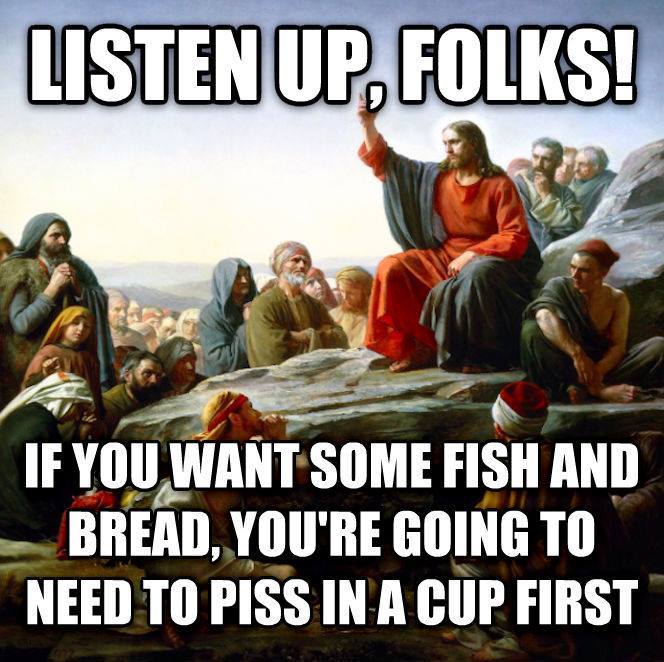
listen-up-folks-if-you-want-some-fish-and-bread-youre-going-to-have-to-piss-in-a-cup-first-what-would-jesus-do-1437017501.jpg

I don't get it?
 
Re: Funny anti-religious Internet pics

I don't get it?

A lot of conservative Christians in America think that the poor should be drug tested prior to receiving any help
 
No. An assertion was made about how things would be if God existed. But nothing was referenced from any claimed revelation about God; the "conclusion" is thus based solely on how the author of the assumption thinks God should behave.

As for all deities doing things in human ways, right there is one reason I came to the Bible: the God of the Bible does things in very non-human ways. What human would think that being killed with the cruelest form of torture known constitutes a victory? The core of the Bible is utterly contrary to the way that humans think (which explains just about every heresy over the centuries; they're attempts to make God think and act in more human ways -- something illustrated in widespread fashion about this time every year as preachers claim that rising from the dead was the victory, when the Bible plainly says that being crucified was the victory).


Countless religions have gone before. The surviving ones don't mean their any more right that those which have passed us by. I'd say the Ancient Egyptians had one of the longest religious cultures on the planet, four thousand or so years long, and their gods are not worshipped anymore. One would think therefore that that in future times, the religions of the world today will be consigned to the dustbin of history too.

From wikipedia on blashemy law
"Internationally, blasphemy laws are considered to be incompatible with the protection of the safety and wellbeing of individuals and freedom of expression..."

Incompatible with the safety and wellbeing of individuals and freedom of expression. That is damning for all it's simplicity.
 
Back
Top