The Original Gay Porn Community - Free Gay Movies and Photos, Gay Porn Site Reviews and Adult Gay Forums

  • Welcome To Just Us Boys - The World's Largest Gay Message Board Community

    In order to comply with recent US Supreme Court rulings regarding adult content, we will be making changes in the future to require that you log into your account to view adult content on the site.
    If you do not have an account, please register.
    REGISTER HERE - 100% FREE / We Will Never Sell Your Info

    PLEASE READ: To register, turn off your VPN (iPhone users- disable iCloud); you can re-enable the VPN after registration. You must maintain an active email address on your account: disposable email addresses cannot be used to register.

Great Recession

MoltenRock III

JUB Addict
Banned
Joined
Jul 28, 2010
Posts
4,569
Reaction score
1
Points
0
Location
Singapore / Minneapolis
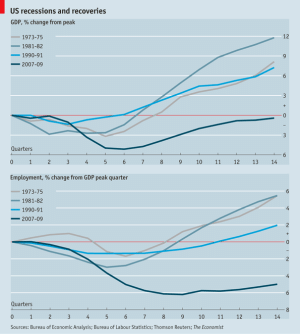
I think there is a large misnomer out in America, especially by the "we must cut all government to the bone, yesterday" people. Since major recessions are relatively few and far between most people don't have much contemporary comparisons to make of how much worse this "Great Recession" is compared to other serious recessions.

Even now for 2011, the US will have not regained the ground it lost to the recession in its total GDP. Here's a look at just how bad this recession has been:

attachment.php


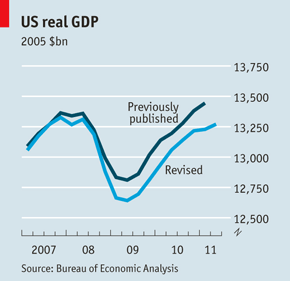
The recession that the US had was even deeper than it was first reported, by the recently released final adjustments:

attachment.php
 

Attachments

  • 20110730_WOC311.gif
    20110730_WOC311.gif
    66.4 KB · Views: 264
  • 20110806_WOC317.gif
    20110806_WOC317.gif
    28.2 KB · Views: 260
The Economist magazine, a conservative financial, said they felt the fastest, best, medicine for America's economy to begin moving is a 3% to 4% inflation factor. Given the large % of Americans underwater in their mortgages, and the national debt, it also seems the least painful.

The dollar has continued its descent against other major currencies. Eventually, this should help the manufacturing sector of America, but this only represents 9% of GDP vs. 25% to 30% for most other developed economies. This means the consumer needs to feel flusher, and less burdened by debt.
 
So I'm curious from my conservative friends here at JUB, where are the Republican promised jobs that Mr. Boehner talked so much about?

Most conservatives complained the stimulus did nothing, and was a complete waste of money. Given the stimulus funds ran out at the end of last year by-in-large, why then is the economic expansion coming to a halt?

The Social Security tax break workers got for 2011 too will be ending at the end of this year, with no plans for any more stimulus spending moving forward, but rather more cuts. What are Republican's plans for avoiding a repeat of 1937 or the "lost decade" that Japan went through?

What plans do you or any of your politicians have for the US economy moving forward?
 
All I know is that the markets haven't liked what they've seen today as the US has floundered and stumbled to the finish line without having accomplished much of anything except destabilizing confidence.

Well done ALL!!!!
 
I don't know why everyone is so afraid to call this depression a depression.

You don't lose your entire banking industry in a recession.

You don't lose General Motors and Chrysler in a recession.

You don't have almost 10% unemployment for two years running in a recession.

You don't have one quarter of all homes for sale in the USA the result of foreclosure actions in a recession.

This is the second Great Depression in eighty years. It would have been far worse than the 1930s version, had not GWB and Barack Obama acted to mitigate it as they have.

But, it has the potential to get much, much worse as a result of the Tea Party's misdirection of Pres. Obama and the nation, generally.
 
^^^ This.

However I feel that until severe pain of loss is felt by many the change will not occurr. The sad truth to me is that AMerica is addicted to easy success and will have to pull her bootstraps up. This most recent generation wondered what they should have as a purpose. Well here.....

A_man_in_a_gas_mash_holding_out_a_smelly_diaper_110214-214782-419009.jpg


Is our economy......
 
What plans do you or any of your politicians have for the US economy moving forward?

What a second, politicians represent people of a country? I thought the capitalists I mean politicians worshiped the all mighty dollar?

I really don't think there is a viable fix at this point in time. I don't like doom-and-gloom scenarios but sometimes it takes a big scare to get everything back in shape like a heart attack. I almost feel it would be healthy for the US to actually receive a downgrade. Most of the US people realize that America needs lose some, well a lot of fat but Congress is blind on the hill.
 
I don't think there is a viable fix either.

The only viable fix would be a Logan's Run world, with the maximum allowable age at, perhaps, 50. Of course this is no more viable than the Final Solution was, three generations ago.

I've been thinking all along, something like "OK, why not go back to a budget as it was in Fiscal Year 2000, which showed a SURPLUS?"

But this morning I suddenly realized that a "2000 budget" (adjusted to real 2011 dollars all around) with the precise mix of spending priorities, peacetime, etc., COULDN'T BE A SURPLUS BUDGET ANYMORE.

There are quite a few more Trillions of dollars of debt that needs to be serviced now. What would that 2000 "surplus" budget be now, with all the added debt that is being serviced? A $300 Billion deficit, or what???

To a lot of people, the national deficit/debt is still something theoretical, but it definitely impacts the economy, and even with the agreed-to rise in the Debt Ceiling now, it only pushes the entire wealth of the U. S. economy closer to the precipice which is featured in the "big picture" of it all.

Of course the people on the top with the privilege, the media, and the legislative pens, the corporate positions, etc., will find their own ways out of this and escape with trillions, while the rest of us lose even more.
 
usa gotta grow up?

it not news fa eons ans lot da sisters of so countrys same

just sayin
 
I don't know why everyone is so afraid to call this depression a depression.

You don't lose your entire banking industry in a recession.

We didn't. Our banking industry is intact. The casualties were smaller banks, and most were lost because of their own poor practices, not because of the recession alone.

You don't lose General Motors and Chrysler in a recession.

We didn't. They're here. If you knew anything about GM and Chrysler in the years leading up to the recession, it would be clear that their implosion was going to happen sooner or later. They used the crisis, as did many other big businesses, as a way out of their own self-created destruction.

You don't have almost 10% unemployment for two years running in a recession.
Arguable. Economists and analysts have been saying since the beginning that it would take years before jobs came back. Further, many of the jobs lost in the recession are simply gone, never to return. Part of this recession was a market correction; the jobs aren't ever coming back.

You don't have one quarter of all homes for sale in the USA the result of foreclosure actions in a recession.

You do when your recession is caused by a collapse of the housing market and a severe contraction of credit. Considering the integral role that housing played in the recession, we're lucky its not worse.

This is the second Great Depression in eighty years. It would have been far worse than the 1930s version, had not GWB and Barack Obama acted to mitigate it as they have.

But, it has the potential to get much, much worse as a result of the Tea Party's misdirection of Pres. Obama and the nation, generally.
Bullshit. We're nowhere near a depression. Things are bad, sure. But they're not remotely in the same league as that of a depression.
 
seven-biggest-downturn.jpg


I dont wanna quote the entire article here but it is a damn good read. I also dont know enough to make a quality judgement of the info on the page but it appears very reasonably stated...

gross-domestic-product.jpg


That last one is very telling.......IMHO

The website is wealthvest


SO BP is this for real?

And if it is why are so many folks determined to make the current recession the end of the US? Hopeful thinking?
 
Hmmm maybe there is a point there by scale alone?

Great-Depression-vs.-Great-Recession.png

Your chart misses a few important points.

Our banking industry was saved by a $1 Trillion bailout in 2008 by GWB. That didn't happen in 1930 - it was allowed to collapse. Also, the bank information is not correct. There have been 61 bank failures to date in 2011 alone.

The unemployment rate is now calculated differently than in the 1930's. Now, after you've been out of work for a long time and your unemployment compensation has expired, you are no longer considered unemployed - even though you're still unemployed.

The economy was artificially propped up in 2009 by another $1 Trillion bailout to the auto industry and others. That didn't happen in the 1930s. So the "economic decline," and the stock market decline have been (temporarily) mitigated this time.

The remainder of your table details mitigation measures. Which, the table clearly indicates, have been substantial in recent times, especially in comparison to the 1930s (when government intervention in economies was a novel idea).

That is why the current depression has not (yet) been manifest as dramatically as the 1930s depression. But make no mistake. The underlying economic conditions are the same. And, if nothing is done to fix those conditions, this depression will not resolve. Ever.
 
We didn't. Our banking industry is intact.

We'll have to disagree. I think the banking industry could not have survived without the $1 Trillion bailout they got. Without that, we would have seen a repeat of the 1930s banking collapse.


We didn't. They're here. If you knew anything about GM and Chrysler in the years leading up to the recession, it would be clear that their implosion was going to happen sooner or later. They used the crisis, as did many other big businesses, as a way out of their own self-created destruction.

Your point is that much of American industry was going to collapse, anyway, because they were all are simultaneously incompetent at conducting business? :confused: Really?

We'll have to disagree on that, too. I think they got caught in a severe economic downturn - otherwise known as a depression.

And I don't think they could have survived without their $1 Trillion bailout. Of course, during the 1930s, the major automakers survived. This time, the major automakers (save Ford) would have collapsed.


You do when your recession is caused by a collapse of the housing market and a severe contraction of credit. Considering the integral role that housing played in the recession, we're lucky its not worse.

And what caused the housing crisis? Was it not the middle class attempting to maintain its standard of living (in the face of declining wealth) by leveraging the value in their homes? Is that not exactly what happened during the 1920s, when America experienced a similar transfer of wealth from the middle class to the wealthy?

And do we not still suffer from that same inequality of wealth which caused the housing crisis? Is it not true that absolutely nothing has been done to fix this fundamental, structural problem with American society today?


Bullshit. We're nowhere near a depression. Things are bad, sure. But they're not remotely in the same league as that of a depression.

I say again, you don't lose most of your banking industry, most of your auto industry, and so many home mortgages in a "recession." Unemployment in recessions does not persist over several years.

This is a depression. The underlying structural problems which caused it have yet to be addressed. And it's going to get worse, unless we do something.
 
Your chart misses a few important points.

Our banking industry was saved by a $1 Trillion bailout in 2008 by GWB. That didn't happen in 1930 - it was allowed to collapse. Also, the bank information is not correct. There have been 61 bank failures to date in 2011 alone.

The unemployment rate is now calculated differently than in the 1930's. Now, after you've been out of work for a long time and your unemployment compensation has expired, you are no longer considered unemployed - even though you're still unemployed.

The economy was artificially propped up in 2009 by another $1 Trillion bailout to the auto industry and others. That didn't happen in the 1930s. So the "economic decline," and the stock market decline have been (temporarily) mitigated this time.

The remainder of your table details mitigation measures. Which, the table clearly indicates, have been substantial in recent times, especially in comparison to the 1930s (when government intervention in economies was a novel idea).

That is why the current depression has not (yet) been manifest as dramatically as the 1930s depression. But make no mistake. The underlying economic conditions are the same. And, if nothing is done to fix those conditions, this depression will not resolve. Ever.

So in missing those items what does it mean when it estimated 2.5% GDP spending for emergency spending? Out of curiosity?
 
So in missing those items what does it mean when it estimated 2.5% GDP spending for emergency spending? Out of curiosity?


My interpretation of the table is that FDR sunk into emergency recovery programs an amount equal to 1.5% of the GDP in 1934. Obama sunk 2.5% of GDP into emergency recovery programs, but this was spread out over two years (apparently 2009 and 2010) instead of one (The 2009 "American Reinvestment and Recovery Act").

So, it would seem that Obama spent a little more than FDR for recovery, but still a rather paltry amount (1.25% of GDP per year for two years).

Historians, you will recall, often point out that FDR did not spend nearly enough to provide an adequate recovery from the Great Depression. In 1934, the idea that a government could intervene to change the direction of an economy was a novel idea, and many economists (J. M. Keynes excepted) were extremely vocal about how foolhardy such an approach would be. FDR was lobbied hard by economists not to allow the government to run up a big deficit during "tough times" - that seemed like the opposite of what was necessary (you can't spend when nobody had any money). Hoover, in fact, had been adamant that a balanced federal budget was necessary to recovery. FDR was therefore very cautious with his experimental recovery programs.

When WWII began, the government had no choice but to run up what was at the time an unbelievably massive deficit. Nobody could imagine how that debt could ever be paid back. But, a strange thing happened. The huge government spending exerted a significant stimulatory effect on the economy, and the depression abated. The federal spending poured money into the middle class factory workers, and the middle class used its new-found wealth to buy things. John Maynard Keynes (a gay man, BTW) was vindicated.

Obama has offered a similarly tiny stimulus package for the economy. In Obama's case, he has the benefit of history on his side. We now know that an adequate stimulus can, in fact, pull a nation out of a depression, if it is aimed at putting money into the middle class. But, Obama's political opposition will not allow adequate stimulus spending. The Republicans today insist that Herbert Hoover's balanced budget approach is the only sensible way to deal with a depressed economy. In fact, the Republicans insist that federal spending must decrease, which is the opposite of what we Keynesians believe needs to happen. That is why I have called the debt ceiling agreement a disaster. It virtually guarantees that the USA will plunge deeper into depression in the next few years.

History repeats itself.

Those who do not learn from history are doomed to repeat it.
 
I agree with your point on history BUT while many people are suffering FAR fewer are impacted this time around due to restraints placed upon the markets (I am not disregarding those situations).

So with market controls the huge slide was averted. I hear ya that it could still come without proper actions and it may very well be that we see something greater than the great depression. However I don't think so.

While the rich may be getting richer and the poor getting screwed I dont see bread lines and massive famine. I don't see families choosing to throw their sons out at 12 because 'a boy can make it' and the family cant feed them. I dont see bands of people roving through the wasteland of america living in camps of destitution.

Is it bad? Yes. But let me ask this simple question. Nothing goes on forever right? SO how can we continue to constantly grow and increase output and wealth as a nation? That is the definition of this slow down. Not as much growth. SO since nothing goes on forever does anyone on these boards believe that growth can continue for infinity?
 
Jay, come on. The main reason you don't see those things are because of the very programs we put in place so this things would never, ever, happen again. Programs like unemployment insurance, Medicaid, Aid For Dependent Children, School Lunch Program, WIC, Food Stamps, etc...
 
Right. The system is working. So your point again?

The market still didnt crash NO WHERE NEAR as far would you agree?

I am not arguing for or against any specific solution. BUT it is not as bad. No way.

I would prefer to have seen massive stimulus spending on a job corps and infrastructure. ...... (just as I said prior to the election)

They could have expanded the Civil Engineering Corps in both the Army and the Navy to provide a proven mgt system and then put people to work as labor.

Plus... PLUS
 
While the rich may be getting richer and the poor getting screwed I dont see bread lines and massive famine. I don't see families choosing to throw their sons out at 12 because 'a boy can make it' and the family cant feed them. I dont see bands of people roving through the wasteland of america living in camps of destitution.

As MoltenRock has pointed out, today we have unemployment compensation, welfare, Social Security, and Medicaid. These programs were developed during/after the Great Depression precisely so the destitution of the 1930s would never happen again to Americans. Yes, these programs seem to be working. The Republican Party notwithstanding, government actually works! :eek:

Curiously, these are the very programs that Republicans want to cut! It is as if the Republican Party is determined to bring about another great depression, with all the suffering that was attendant during the 1930s!

I don't know if they're doing this because they want Obama to fail so they can win the next election, or because they are too stupid to understand what is happening. Neither possibility speaks very highly of the Republican Party.


Is it bad? Yes. But let me ask this simple question. Nothing goes on forever right? SO how can we continue to constantly grow and increase output and wealth as a nation? That is the definition of this slow down. Not as much growth. SO since nothing goes on forever does anyone on these boards believe that growth can continue for infinity?

Whether or not an economy can continue to expand forever is a complex question. It depends on a lot of unknowables like population density, education, and availability of natural resources. It may be that the American dream cannot be sustained forever. But we know that there are places on Earth where economies have been thriving for thousands of years. Consider Italy, for example. While Italy has had lots of ups and downs over the years, there has not been a single year in the last 2,700 years during which time Italy has not been among the wealthiest places on the planet. Not once.

But, wealth is not automatically self-sustaining. There are plenty of historical examples of wealthy societies which collapsed into oblivion, never to be seen again.

Economists during the 1930s believed that modern economies were, indeed, self-correcting. All the economic theories of the time predicted that the depression would resolve itself, without any help from the government. When prices went down, spending was supposed to go up (how could that not happen?). Herbert Hoover was convinced that the depression would resolve itself, given enough time. And Hoover was being advised by the top academics of his day. But somehow, that didn't happen. Prices collapsed, but still nobody was buying. When the depression dragged on for year after year after year, none of the schools of economic thought could explain what was going on. Only John Maynard Keynes had a reasonable explanation.

We now know that economies are not automatically self-correcting. The model of economy that Republicans advocate for America is very typical of third world republics: a tiny upper class of fabulously wealthy people with lots and lots of poor and permanently high unemployment. Those nations have been stuck, in most cases, in conditions of permanent depression for many decades.

If the USA does not act to resolve the phenomenally disproportionate distribution of wealth it now has, the USA will suffer the same fate.

 
Back
Top