The Original Gay Porn Community - Free Gay Movies and Photos, Gay Porn Site Reviews and Adult Gay Forums

  • Welcome To Just Us Boys - The World's Largest Gay Message Board Community

    In order to comply with recent US Supreme Court rulings regarding adult content, we will be making changes in the future to require that you log into your account to view adult content on the site.
    If you do not have an account, please register.
    REGISTER HERE - 100% FREE / We Will Never Sell Your Info

    PLEASE READ: To register, turn off your VPN (iPhone users- disable iCloud); you can re-enable the VPN after registration. You must maintain an active email address on your account: disposable email addresses cannot be used to register.

  • Hi Guest - Did you know?
    Hot Topics is a Safe for Work (SFW) forum.

Have you ever learnt the Lattice Method of multiplication?

star-warrior

JUB 10k Club
JUB Supporter
Joined
Jul 6, 2005
Posts
41,663
Reaction score
14
Points
0
Location
Home is where the heart is
Website
www.myspace.com
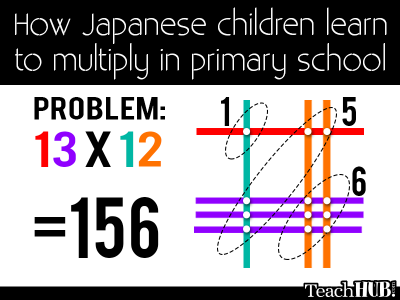
I'd like to thank Mikey one of our resident teachers for a link that lead to this indirectly. Here's the example I saw

attachment.php

554550_10151259310008481_432578708_n.png


If you've followed the example, you draw the number as lines, so the example 13 x 12 shows the digits in different colours, 13 is represented by the horizontal lines, and 12 by the vertical ones. At each intersection, the product of the intersections are summed across a diagonal at 45 degrees.

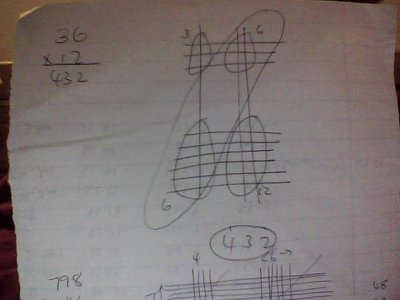
Here's my first attempt at 36 x 12. You still have to do some carrying over.

attachment.php

IMG000063.jpg

and now a more complicated 798 x 46, now you need to maintain the 10's, 100's etc placings as you add these up.

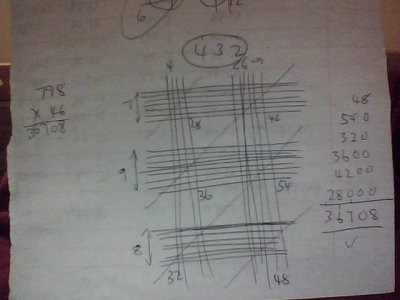
attachment.php

IMG000062.jpg

I think it could be quite tedious with larger multipliers. However, it looks like a neat way of doing them. As mentioned, it's called the Lattice Method.
 
I never did. My 2nd grade teacher taught me how to multiply 6 thru 10 numbers on my fingers, though.

Lex
 
We had a maths teaching seminar for parents a few months ago, and they stressed that we support our kids by helping them at home to understand and use place values. So when adding up 25 and 13 say, you have to say "add two tens and five" to "one ten and three", for young learners in year 1 (aged 5-6) they often see numbers as digits without any relation to powers of ten.
 
I dun learnt the smart phone method.... using voice recognition I say multiply 12 time 1,345,189,784.... and it does....

:p
 
The latest rage in education is a program called Math Investigations. Their aim is to help children become better problem solvers by helping therm to understand how to break down a problem and explain their mathematical reasoning rather than learn a "meaningless" algorithm.

This method is called decomposition...


For example, take the problem 13 X 12 (since that's what was used above).

First, you break down the numbers into their place values.....

13 = 10 + 3

12 = 10 + 2

Then you cross multiply the numbers, as well as multiplying up and down.......

10 X 10 = 100
10 X 2 = 20
10 X 3 = 30
3 X 2 = 6

Finally, you find the sum of the products to find the final answer.....

100
30
20
6
156 final answer.....

Personally, I think the old algorithm is actually faster and easier, but if I do not teach this way, it will be held against me in my evaluation.

(EDIT Please ignore how the sums lined up. I did it correctly, but the JUB software does its own thing...)
 
Personally, I think the old algorithm is actually faster and easier

I do hope nobody minds if I use that one. I'm too old to learn another 'new' way. I was at the age where the new math followed me through school. I never learned how to do it.
 
I remember seeing a report on students in Asia (don't remember where) who were trained on an abacus. After a number of years, they were able to do these lightning fast calculations and they didn't even need to use the abacus. They just moved their fingers in mid-air to simulate the abacus.
 
The latest rage in education is a program called Math Investigations. Their aim is to help children become better problem solvers by helping therm to understand how to break down a problem and explain their mathematical reasoning rather than learn a "meaningless" algorithm.

This method is called decomposition...


For example, take the problem 13 X 12 (since that's what was used above).

First, you break down the numbers into their place values.....

13 = 10 + 3

12 = 10 + 2

Then you cross multiply the numbers, as well as multiplying up and down.......

10 X 10 = 100
10 X 2 = 20
10 X 3 = 30
3 X 2 = 6

Finally, you find the sum of the products to find the final answer.....

100
30
20
6
156 final answer.....

Personally, I think the old algorithm is actually faster and easier, but if I do not teach this way, it will be held against me in my evaluation.

(EDIT Please ignore how the sums lined up. I did it correctly, but the JUB software does its own thing...)

I learned the factor method which is a combo of the lattice method and the regular way.

For 13*12. I would do 13*10 + 13*2 = 130+26=156

Going larger with someone else's example of 798*46

700*40=28000
90*40= 3600
8*40=320
700*6= 4200
90*6=540
8*6=48

Add them up and you get the correct answer.

I would suck at explaining it [again, I'm not a teacher for a reason] but the logic and reasoning makes perfect sense and this method is much cleaner on paper. There isn't even much thinking with all those zeros. Just multiply the whole numbers and tack on the zeros to the simple multiplication of course adding them down is a much different story.
 
I were not taught of the lattice method but I learnt about it when I was 15 from a (advanced) mathematical puzzle book. The method is surprisingly accurate.

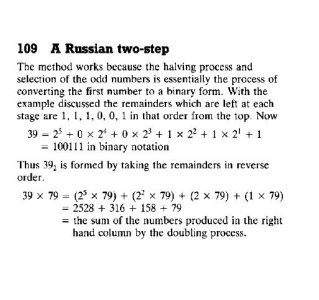
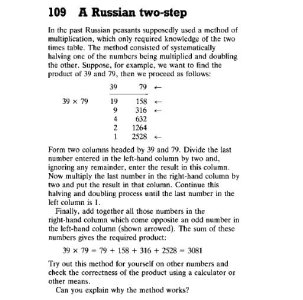
There's another one, more complicated, named Russian two-steps. It was supposedly used by Russian farmers back in the old age though I find it rather complex instead of easy...still interesting for mathematic addicts nevertheless.

attachment.php


attachment.php
 

Attachments

  • untitled1.JPG
    untitled1.JPG
    43.6 KB · Views: 75
  • untitled.JPG
    untitled.JPG
    52.8 KB · Views: 77
I learned the factor method which is a combo of the lattice method and the regular way.

For 13*12. I would do 13*10 + 13*2 = 130+26=156

Going larger with someone else's example of 798*46

700*40=28000
90*40= 3600
8*40=320
700*6= 4200
90*6=540
8*6=48

Add them up and you get the correct answer.

I would suck at explaining it [again, I'm not a teacher for a reason] but the logic and reasoning makes perfect sense and this method is much cleaner on paper. There isn't even much thinking with all those zeros. Just multiply the whole numbers and tack on the zeros to the simple multiplication of course adding them down is a much different story.

Max, what you are describing is also known as the distributive property of multiplication. It is related to the decomposition method that I described above. With the trend to differentiate everything in schools today, there are a zillion different ways that are acceptable to solve the problem.

HOWEVER...please note that having the correct answer does not guarantee you will receive full credit on the New York State Mathematics Tests for grades 3-8. Many of the items require you to explain your mathematical reasoning using words and pictures. If you do not do this step (as many 8, 9 and 10 year old kids tend to skip) you do not receive full credit for the question, no matter how correct your answer is. Which raises the question....Are we testing mathematical ability, or language arts?
 
My god those are a lot of work.
 
13x10(130) + 13x2(26) = 156

Easier, faster and you don't need to draw or write anything
Because life is complicated enough.............
 
The latest rage in education is a program called Math Investigations. Their aim is to help children become better problem solvers by helping therm to understand how to break down a problem and explain their mathematical reasoning rather than learn a "meaningless" algorithm.

This method is called decomposition...


For example, take the problem 13 X 12 (since that's what was used above).

First, you break down the numbers into their place values.....

13 = 10 + 3

12 = 10 + 2

Then you cross multiply the numbers, as well as multiplying up and down.......

10 X 10 = 100
10 X 2 = 20
10 X 3 = 30
3 X 2 = 6

Finally, you find the sum of the products to find the final answer.....

100
30
20
6
156 final answer.....

Personally, I think the old algorithm is actually faster and easier, but if I do not teach this way, it will be held against me in my evaluation.

(EDIT Please ignore how the sums lined up. I did it correctly, but the JUB software does its own thing...)

The way I was taught seems to make more sense and is quicker.
It involves being taught and knowing times tables

13 x 12 = 12 twelves are 144 plus 12 equals 156

I have noticed in recent years that many youngsters are completely incapable of working anything out without a calculator of some sort, whether it is a moble phone or till.
Try it for yourself. Buy a coffee and then, after they have rung the till up, say 'Oh I have the odd 5p or 10 cents. They won't be able to work it out without starting again
 
Thanks guys for the commentary in this thread. I love finding out about the Russian two step method and how they've used a method of indirect binary representation to find the answer.

WRT the pocket calculator, these things have only been around for the last four or five decades. Granted they're cheap as dirt nowadays to get ones with advanced functions such as hyperbolic sines and cosines and statistical functions, or as an app on your pc or whatever, but I find that sometimes I have none of these to hand sometimes. I find these methods refreshing, if a lot of work seems to be involved, but, it's also a testament to human ingenuity. To head for an electronic device as your port of call would be a let down for all the work you've put in or a complete waste of money invested in your education if you don't use it. Keeping those grey cells working I think helps you keeps you young.
 
what is this, the 18th century?

90142016.jpg

Hun, you have never taken the GMATs before where they don't allow a calculator on the exam. Good fucking luck solving 2^15.

2^15 = 2^5^3 = 8^5 = 64*64*8 = 64*512

500*60 = 30000
12*60 = 720
500*4 = 2000
12* 4 = 48

The answer is 32768.
 
Back
Top