

The Original Gay Porn Community - Free Gay Movies and Photos, Gay Porn Site Reviews and Adult Gay Forums

  • Welcome To Just Us Boys - The World's Largest Gay Message Board Community

    In order to comply with recent US Supreme Court rulings regarding adult content, we will be making changes in the future to require that you log into your account to view adult content on the site.
    If you do not have an account, please register.
    REGISTER HERE - 100% FREE / We Will Never Sell Your Info

    PLEASE READ: To register, turn off your VPN (iPhone users- disable iCloud); you can re-enable the VPN after registration. You must maintain an active email address on your account: disposable email addresses cannot be used to register.

Health News that Trump Doesn't Want You To Know

This is what happens when you put stupid people in charge.

The 13 colonies nearly lost the American Revolution. One of the factors that affected troop readiness was disease in the military camps. Fortunately, George Washington had the good sense to fix the issues that were causing so many of his soldiers to be ill. Since then, the US military has always prioritized health as a component of military readiness. Most of the US public health system since WWII came out of the military's desire to have a healthy, ready population of citizens who were able to protect the nation in the event of a war.

During WWI, an outbreak of the "Spanish flu" killed millions of people worldwide. The flu didn't begin in Spain, it likely began in a US military camp in the midwest. Because US troops were being mobilized across Europe during the war, the flu quickly spread across the globe. There were so many Europeans sick and dying with the flu from 1918-1919 that some experts believe that the outbreak may have affected the outcome of the war.

The DUI hire, Pete Hegseth, just got rid of mandatory flu vaccination for the military. This ends an 80 year old policy that required all active duty military to get the annual flu shot. The unqualified drunkard cited "religious freedom" as the reason for eliminating the mandate. Active duty military provide the perfect vector for respiratory illnesses- they are in close quarters with each other, they are very mobile, with frequent relocations and duty assignments across the globe.

Kegseth had previously eliminated the COVID-19 vaccination for military members.

Hegseth ends mandatory flu vaccine for service members

The Pentagon is ending mandatory flu vaccines for service members, phrasing the change as giving troops “medical autonomy” and “freedom to express their religious convictions,” Defense Secretary Pete Hegseth announced Tuesday.

“Our new policy is simple. If you, an American warrior entrusted to defend this nation, believe that the flu vaccine is in your best interest, then you’re free to take it. You should. But we will not force you. Because your body, your faith are not negotiable,” Hegseth said in a video message posted to social media.

He called the flu shot requirement part of “absurd, overreaching mandates that only weaken our warfighting capabilities.”
 
And even the Republicans aren't buying into it...

GOP Armed Services chair warns ending mandatory military flu shots ‘a mistake’

Senate Armed Services Committee Chairman Roger Wicker (R-Miss.) said the Pentagon’s policy change to no longer require all U.S. troops to get flu shots is a “mistake,” drawing a contrast between flu vaccines and more controversial COVID-19 vaccines.
 
Medicare Advantage: throwing good money after bad.

I probably wouldn't have asked RFK Jr the question because he lacks knowledge of the details but AOC is making a very good point about how much waste their is in the Medicare Advantage program and how the insurance companies are getting away with wasting billions of dollars.

 
Medicare Advantage: throwing good money after bad.

I probably wouldn't have asked RFK Jr the question because he lacks knowledge of the details but AOC is making a very good point about how much waste their is in the Medicare Advantage program and how the insurance companies are getting away with wasting billions of dollars.


I’m glad to hear that AOC is concerned about fraud in the Medicare Advantage program and would hope that she expands that concern to original Medicare as there is plenty of fraud there too as Senator Scott well knows. What I hope she does not do is to propose legislation that would in any way curtail the Medicare Advantage program as its popular with those enrolled and why mess with a popular government program just because you dislike insurance companies.

I’m inclined to believe that the real fraud in these programs is not from insurance companies but from the medical community producing the bills which the insurance companies mostly have to pay. Additionally I believe that the program will eventually die a death of its own as when it began 20 or so yrs ago it was far far more generous than Medicare and that gap has consistently narrowed over the yrs and will someday disappear and at that point it’s either Medicare with the freedom to choose or an HMO with lower costs but possibly worse actual care.

And KB you can tell that Kennedy didn’t know much about the subject by how quickly he agreed with her, such agreement avoids a display of ignorance.
 
I’m glad to hear that AOC is concerned about fraud in the Medicare Advantage program and would hope that she expands that concern to original Medicare as there is plenty of fraud there too as Senator Scott well knows. What I hope she does not do is to propose legislation that would in any way curtail the Medicare Advantage program as its popular with those enrolled and why mess with a popular government program just because you dislike insurance companies.

I’m inclined to believe that the real fraud in these programs is not from insurance companies but from the medical community producing the bills which the insurance companies mostly have to pay. Additionally I believe that the program will eventually die a death of its own as when it began 20 or so yrs ago it was far far more generous than Medicare and that gap has consistently narrowed over the yrs and will someday disappear and at that point it’s either Medicare with the freedom to choose or an HMO with lower costs but possibly worse actual care.

And KB you can tell that Kennedy didn’t know much about the subject by how quickly he agreed with her, such agreement avoids a display of ignorance.
Medicare Advantage is either going to need to be discontinued or it will need to be restructured to discourage the fraud that is being committed.

Medicare Advantage reimburses based upon diagnoses. The sicker that the provider can make you look, the more they get paid.

The Wall Street Journal did a study of patients who moved from traditional Medicare to Medicare Advantage. Miraculously, within a year of changing to Advantage, the patients got "sicker" according to their diagnosis codes and problem lists. Often the same providers "upcoded" the acuity of patients once they moved to Advantage, in order to get higher reimbursement.

Medicare Advantage carriers can use medical necessity pre-authorizations to deny treatments. The more treatments they deny, the higher their profits. The same insurance companies get a per-patient allotment that is designed to cover the much higher administrative costs, so companies like United Healthcare can run millions of dollars in ads during open enrollment and still make record profits off Medicare Advantage patients.

The guy who Trump nominated to head the Centers for Medicare and Medicaid Services (CMS), Mehmet Oz, who was confirmed on a party line vote (R-53. D-45) is the same guy who was shilling Medicare Advantage programs back when he was the host of a talk show. Oz also owns $600,000 in United Healthcare stock.

WSJ's investigation is an interesting read (firewalled):
 
Remember all those hearings about the Veteran's Administration system and Defense Department health information systems? How the VA and DoD project to replace their old ViSTA system with Cerner's electronic health record had been disastrous- with the projects behind schedule, over budget and with poor user satisfaction scores? Remember that Congress was threatening to put the Cerner projects on hold until the VA got its act together? As a compromise, in 2023 Congress changed the Cerner contract from a 5 year contract to 1 year contracts so that they could have better oversight into the billions of taxpayer dollars being spent on a project that was floundering.

After nearly a decade, the Cerner system has been implemented at fewer than a dozen sites- less than 10% of all VA facilities.

Well, since then, Cerner was purchased by the Ellison family. Cerner is now called "OracleHealth". And the funding tap has been turned back on.

VA EHR rollout resumes after three-year pause

he Department of Veterans Affairs is moving ahead with the rollout of a new, multi-billion-dollar Electronic Health Record at its health care facilities, after a three-year pause to address longstanding issues with the system.

Over the weekend, the VA rolled out the Oracle-Cerner system to four VA health care systems in Michigan ― Ann Arbor, Battle Creek, Detroit and Saginaw.

This is the first wave of EHR deployments the VA has planned for this year under an accelerated schedule. Unlike previous deployments, which occurred one site at a time, the EHR go-lives in Michigan all took place on the same day.

VA’s new EHR is currently running at 10 sites. Full deployment would bring the EHR to 170 sites. The department currently expects to complete the deployment as soon as 2031. The Defense Department completed its transition to the same EHR platform in March 2024.

VA continues partnership with Oracle Health to deploy Federal Electronic Health Record

Last week, VA awarded the third option period for its contract with Oracle Health to support its Federal Electronic Health Record (EHR) modernization, building on the improved fiscal and performance accountability established in previous option periods.

In line with the Trump administration’s vision for improved efficiency, accountability and innovation across government, this award supports Secretary Doug Collin’s efforts to get VA’s EHR modernization back on track and accelerate Federal EHR deployments across the enterprise.
 
Medicare Advantage is either going to need to be discontinued or it will need to be restructured to discourage the fraud that is being committed.

Medicare Advantage reimburses based upon diagnoses. The sicker that the provider can make you look, the more they get paid.

The Wall Street Journal did a study of patients who moved from traditional Medicare to Medicare Advantage. Miraculously, within a year of changing to Advantage, the patients got "sicker" according to their diagnosis codes and problem lists. Often the same providers "upcoded" the acuity of patients once they moved to Advantage, in order to get higher reimbursement.

Medicare Advantage carriers can use medical necessity pre-authorizations to deny treatments. The more treatments they deny, the higher their profits. The same insurance companies get a per-patient allotment that is designed to cover the much higher administrative costs, so companies like United Healthcare can run millions of dollars in ads during open enrollment and still make record profits off Medicare Advantage patients.

The guy who Trump nominated to head the Centers for Medicare and Medicaid Services (CMS), Mehmet Oz, who was confirmed on a party line vote (R-53. D-45) is the same guy who was shilling Medicare Advantage programs back when he was the host of a talk show. Oz also owns $600,000 in United Healthcare stock.

WSJ's investigation is an interesting read (firewalled):

Well I can’t get past the firewall so I won’t comment on that and I get that you, and I’m guessing AOC, don’t like the Medicare Advantage but as I said it’s a popular program so getting rid of it is bad politics and no way to win an election. The way you win elections is by giving people what they want not what you believe they should want.

Nothing you have described above constitutes insurance fraud, what you have described is medical fraud and as I said above those generating the bills is where the fraud starts not with the insurance company.

“Medicare Advantage reimburses based on diagnosis” isn’t that how Original Medicare reimburses too? And if so aren’t they just as susceptible to getting ripped off?

What I see here is AOC going after a program she disapproves of claiming insurance fraud instead of medical fraud because insurance fraud would only apply to the Advantage plan while medical fraud applies to both and even if both are suffering from the same fraud that’s not the story she wants to tell.

Finally the Wall Street Journal article says that patients who switch from Original Medicare to the Advantage plans got sicker within a year and the insurance company denied those claims…..anyone got a problem with that? And yes it’s true insurance companies do have higher overhead costs than Medicare does and some of that extra overhead goes to combating fraud and I’d bet they are better at it than Medicare is if for no other reason than they get to keep the money which we call an incentive something Medicare lacks.
 
Well I can’t get past the firewall so I won’t comment on that and I get that you, and I’m guessing AOC, don’t like the Medicare Advantage but as I said it’s a popular program so getting rid of it is bad politics and no way to win an election. The way you win elections is by giving people what they want not what you believe they should want.

Nothing you have described above constitutes insurance fraud, what you have described is medical fraud and as I said above those generating the bills is where the fraud starts not with the insurance company.
Let's back up and talk about what Medicare Advantage is.

Medicare is actually 5 different programs. When you are admitted to a hospital or a surgery center, you are covered by Medicare part A. The payer for Medicare part A is always the US government.

When you are seen as an outpatient in a doctor's office or at an outpatient testing center, you are covered by Medicare part B. The payer for Medicare part B is the US government.

Medicare C (also known as Medicare Advantage) is a replacement for Medicare part B and it covers only outpatient services. Medicare Advantage is private insurance that the government pays to for-profit insurance companies on your behalf for outpatient services. That payment is about 23% higher than what is paid for the same services covered under Medicare part B. Just like in private insurance, Medicare Advantage is subject to contracts between providers and the insurance companies, which means that you must select an in-network provider who accepts that insurance. In contrast, almost all providers accept Medicare B.

I hear patients say they like Medicare Advantage when a) they live in an urban area where there are lots of doctors and hospitals who accept Medicare Advantage plans and b) they like the addition benefits, particularly dental coverage, that is offered in Medicare Advantage that Medicare B does not cover. Some Medicare Advantage plans also offer partial payments toward the cost of eyeglasses, eye exams and hearing aids.

Patients who live in rural areas may have trouble finding a doctor who accepts their Medicare Advantage plan. They may only be able to chose an HMO Advantage plan. They may have to travel to a big city to find a hospital or outpatient testing center that accepts their Medicare Advantage plan.

Important: even if you are on Medicare Advantage, Medicare A (aka the US government) covers the cost of your inpatient stay.


“Medicare Advantage reimburses based on diagnosis” isn’t that how Original Medicare reimburses too? And if so aren’t they just as susceptible to getting ripped off?
No. Medicare A pays based upon diagnosis.

Medicare B is fee-for-service. When you go to you doctor, Medicare B pays based upon the amount of time your physician spends with you and for specific services that they provide.

What I see here is AOC going after a program she disapproves of claiming insurance fraud instead of medical fraud because insurance fraud would only apply to the Advantage plan while medical fraud applies to both and even if both are suffering from the same fraud that’s not the story she wants to tell.
She's going after Medicare Advantage because they get an additional $88 billion dollars in payments that would not be made if the same patients were on Medicare B. It also costs Medicare recipients an additional $13 billion in premium payments. That's $1.1 trillion dollars that could be used toward improving the Medicare part B offerings.

And that is the problem with Medicare Advantage. It's not better care. It's not more efficient care. It is more expensive care. Instead of Congress fixing Medicare B to emphasize preventative care services (like hearing aids, dental care, et al), it has chosen to subsidize the private insurance companies to provide services that Medicare B doesn't cover.

Finally the Wall Street Journal article says that patients who switch from Original Medicare to the Advantage plans got sicker within a year and the insurance company denied those claims…..anyone got a problem with that? And yes it’s true insurance companies do have higher overhead costs than Medicare does and some of that extra overhead goes to combating fraud and I’d bet they are better at it than Medicare is if for no other reason than they get to keep the money which we call an incentive something Medicare lacks.
They patients don't get sicker. The providers know that the insurance companies will pay them more when they "upcode" a patient to a diagnosis code that pays more. For example, if you have diabetes, your doctor can code your case as "diabetes" but under Medicare B, he gets paid for a 15 minute office visit (typically about $35 to $50) and you pay about $7-10.

Under Medicare Advantage, the doctor can say you have diabetes, then they can start looking for additional complications - vision changes, neuropathy, renal insufficiency, cardiac complications, arteriosclerosis. They can refer you to their nurse practitioner for additional services to teach you about managing your diet and to discuss your blood sugar home testing. By the time you leave the doctor's office, the cost may be $150-250. Depending on which plan you have, you might have a $30-50 copayment or a 20% coinsurance. If the doctor performed a procedure while you were in the office, you may be expected to pay 20% coinsurance on the cost of that service, unless you have reached your out of pocket maximum or deductible for the year.

In other words, Medicare Advantage plans can be much like the employer-based insurance that most people are unhappy with. The only difference is that instead of your employer covering about 70% of the cost of the insurance premium (leaving you to pay 30% from a pre-tax payroll deduction), it's the US taxpayers who are covering the cost of the Medicare Advantage premiums, which is why it is costing $88 billion more than Medicare Part B.
 
I hear patients say they like Medicare Advantage when

c) Advantage plans are for me much cheaper. I, fortunately, do not have any chronic health issues. I go to the doctor once a year for a check-up, and that's it. I don't take any regular prescriptions. At first, I had a gap plan that cost a big premium. You have to have Part D coverage, but I rarely used it, which also cost a big premium. I decided, why am I paying for something I don't need and switched. The only time I really used the Advantage insurance was for cataract surgery, but that's just a one-time thing. So now I have no premium other than regular Medicare that comes out of Social Security, and the plan pays for dental and vision. I have a couple of friends who got an Advantage plan for the same reasons. It would be nice to just have Medicare cover everything and not worry about it, but it doesn't. I think that's one reason why many people choose the Advantage plan. It personally costs you less if you're basically healthy. If not real healthy, and need a lot of care, then getting a gap plan is probably good idea.
 
Last edited:
c) Advantage plans are for me much cheaper. I, fortunately, do not have any chronic health issues. I go to the doctor once a year for a check-up, and that's it. I don't take any regular prescriptions. At first, I had a gap plan that cost a big premium. You have to have Part D coverage, but I rarely used it, which also cost a big premium. I decided, why am I paying for something I don't need and switched. The only time I really used the Advantage insurance was for cataract surgery, but that's just a one-time thing. So now I have no premium other than regular Medicare that comes out of Social Security, and the plan pays for dental and vision. I have a couple of friends who got an Advantage plan for the same reasons. It would be nice to just have Medicare cover everything and not worry about it, but it doesn't. I think that's one reason why many people choose the Advantage plan. It personally costs you less if you're basically healthy. If not real healthy, and need a lot of care, then getting a gap plan is probably good idea.
And this connects back to my comment about people in urban areas vs rural areas. The plans available in cities are more robust with vision and dental options (which is not guaranteed by Medicare C) and are likely to have in-network options and, because the plans are heavily subsidized by the government, they appear to cost less to the subscriber.

One of the idea behind the Affordable Care Act is that insurance plans should cover preventative services at 100% exempt from deductibles. Unfortunately, the ACA didn't include Medicare B or Tricare in that mandate. If it did, it would added coverage for hearing aids, vision and dental services. It would have also helped with some of the nearly exclusive control that companies in the vision and hearing aid market have and might have helped bring down the cost for glasses and hearing aids. Eventually, Congress did make cheaper hearing aids available and there are multiple bipartisan bills that have been introduced in the current session to try to get both Tricare and Medicare updated to cover audiology and hearing aid services, for example. Those bills have been languishing in committee, mostly because of Republican leadership's opposition to expanding government insurance coverage.

 
Let's back up and talk about what Medicare Advantage is.

Medicare is actually 5 different programs. When you are admitted to a hospital or a surgery center, you are covered by Medicare part A. The payer for Medicare part A is always the US government.

When you are seen as an outpatient in a doctor's office or at an outpatient testing center, you are covered by Medicare part B. The payer for Medicare part B is the US government.

Medicare C (also known as Medicare Advantage) is a replacement for Medicare part B and it covers only outpatient services. Medicare Advantage is private insurance that the government pays to for-profit insurance companies on your behalf for outpatient services. That payment is about 23% higher than what is paid for the same services covered under Medicare part B. Just like in private insurance, Medicare Advantage is subject to contracts between providers and the insurance companies, which means that you must select an in-network provider who accepts that insurance. In contrast, almost all providers accept Medicare B.

I hear patients say they like Medicare Advantage when a) they live in an urban area where there are lots of doctors and hospitals who accept Medicare Advantage plans and b) they like the addition benefits, particularly dental coverage, that is offered in Medicare Advantage that Medicare B does not cover. Some Medicare Advantage plans also offer partial payments toward the cost of eyeglasses, eye exams and hearing aids.

Patients who live in rural areas may have trouble finding a doctor who accepts their Medicare Advantage plan. They may only be able to chose an HMO Advantage plan. They may have to travel to a big city to find a hospital or outpatient testing center that accepts their Medicare Advantage plan.

Important: even if you are on Medicare Advantage, Medicare A (aka the US government) covers the cost of your inpatient stay.


No. Medicare A pays based upon diagnosis.

Medicare B is fee-for-service. When you go to you doctor, Medicare B pays based upon the amount of time your physician spends with you and for specific services that they provide.


She's going after Medicare Advantage because they get an additional $88 billion dollars in payments that would not be made if the same patients were on Medicare B. It also costs Medicare recipients an additional $13 billion in premium payments. That's $1.1 trillion dollars that could be used toward improving the Medicare part B offerings.

And that is the problem with Medicare Advantage. It's not better care. It's not more efficient care. It is more expensive care. Instead of Congress fixing Medicare B to emphasize preventative care services (like hearing aids, dental care, et al), it has chosen to subsidize the private insurance companies to provide services that Medicare B doesn't cover.


They patients don't get sicker. The providers know that the insurance companies will pay them more when they "upcode" a patient to a diagnosis code that pays more. For example, if you have diabetes, your doctor can code your case as "diabetes" but under Medicare B, he gets paid for a 15 minute office visit (typically about $35 to $50) and you pay about $7-10.

Under Medicare Advantage, the doctor can say you have diabetes, then they can start looking for additional complications - vision changes, neuropathy, renal insufficiency, cardiac complications, arteriosclerosis. They can refer you to their nurse practitioner for additional services to teach you about managing your diet and to discuss your blood sugar home testing. By the time you leave the doctor's office, the cost may be $150-250. Depending on which plan you have, you might have a $30-50 copayment or a 20% coinsurance. If the doctor performed a procedure while you were in the office, you may be expected to pay 20% coinsurance on the cost of that service, unless you have reached your out of pocket maximum or deductible for the year.

In other words, Medicare Advantage plans can be much like the employer-based insurance that most people are unhappy with. The only difference is that instead of your employer covering about 70% of the cost of the insurance premium (leaving you to pay 30% from a pre-tax payroll deduction), it's the US taxpayers who are covering the cost of the Medicare Advantage premiums, which is why it is costing $88 billion more than Medicare Part B.

You might consider I have some knowledge of how those programs work since I am on one of them which means I had to choose which program better fit my needs. I believe AOC, and you KB, like the idea of government helping people but you’re fussy about how it’s done.As I have said it’s bad politics to attempt to eliminate a popular government program and I have noticed that you haven’t rebutted.

I am curious though when you talk about the extra $88 billion Congress gave those insurance companies is that the insurance fraud you are referring to?

And you are aware that Medicare suffers from fraud too right? It happens every day and wasted tax dollars matter no matter the program wasting them right?
 
You might consider I have some knowledge of how those programs work since I am on one of them which means I had to choose which program better fit my needs. I believe AOC, and you KB, like the idea of government helping people but you’re fussy about how it’s done.As I have said it’s bad politics to attempt to eliminate a popular government program and I have noticed that you haven’t rebutted.
You know the program from the subscriber side. I know the programs from the provider and payer side. I covered why Medicare Advantage has expanded and is favored by subscribers.

Reread the statement above:
Karabulut said:
Medicare B is fee-for-service. When you go to you doctor, Medicare B pays based upon the amount of time your physician spends with you and for specific services that they provide.
I've been trying to simply the explanation but Medicare C is a capitated plan where Medicare B is a fee-for service system. Capitated plans pay a flat amount to the insurance company per patient- like a employer pays for group insurance or like a patient on an ACA plan pays for their monthly premium. Under capitation, the insurance company gets paid whether the patient actually uses any medical services or incurs any insurance claims.

Here's examples of how this works:

Patient A has diabetes and is struggling to maintain their A1C and blood sugar levels and is covered under Medicare B. The doctor sees the patient in an office visit and recommends that the patient increase their exercise to bring their weight down. They discuss whether to change to a more expensive medication. The patient demures because of the increased cost. The doctor keeps the patient on the generic medication that they current use and suggests meeting with a nutritionist and a diabetes educator, which are also covered under the fee for service model. The doctor gets about $50 for the office visit. The nutritionist and diabetes educator also would get a similar fee, if the patient sees them. Note: the payments are only made if the patient goes to the doctor. Total cost to the US government is $150 for physician services and $75 for lab testing covered by Medicare B.

Patient B has the same conditions as Patient A but is on Medicare Advantage. The insurance company has a contract with the government that says that CMS pays the insurance company $1,000 per month uncomplicated diabetic patient. On the other hand, a complicated diabetic patient would result in a $1,200 per month payment from CMS to the insurance company. The doctor codes patient B with the same diagnosis codes as patient A. The insurance company sees these codes and sees the referral to the nutritionist and diabetes educator and says, "Oh, we can change Patient B from "uncomplicated" to "complicated" and we will make $200 more per month. The insurance company pays the doctor, the nutritionist and the diabetes educator $150 and the lab $75; the insurance company nets $975 that month in profit.

That is the problem with Medicare Advantage: the insurance company makes money from two groups of patients. The first group (which cityboy-stl would fall into) is the patient who doesn't use a lot of services. The second group are the patients who are sicker and would be more profitable because they can be upcoded.


I am curious though when you talk about the extra $88 billion Congress gave those insurance companies is that the insurance fraud you are referring to?
No. The government pays higher payments per enrollee to Medicare Advantage payers. It was part of the Medicare C legislation. Because of this, Medicare Advantage is the most profitable product line in the insurance industry.

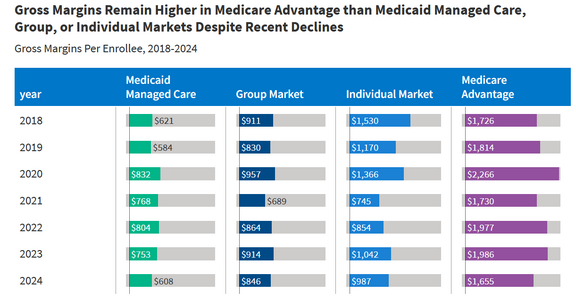
For example, in 2024 insurance carriers raked in about $846 in profit per enrollee in the group insurance market (i.e. employer-based health insurance). In the Medicare Advantage market, they raked in $1,655 per enrollee in the same year.
1777152934564.png

Medicare patients are either aged or disabled. They are the sickest patients and consume the highest amount of services. Yet, the insurance companies make double the amount in profit per enrollee compared to group insurance and the individual market. This is a massive transfer of taxpayer money to private insurance companies, to the tune of $500 BILLION each year. It is money that could be used to provide healthcare to millions of people who are not insured.


And you are aware that Medicare suffers from fraud too right? It happens every day and wasted tax dollars matter no matter the program wasting them right?
The higher cost is separate from the fraud issue. Medicare fraud is the same percentage across all programs - between 5% to 10% of all claims are estimated to be fraudulent. Fraud takes multiple formats- from billing for services that were never delivered to upcoding/unbundling services.

Here's just one example from last month:


Aetna got caught "upcoding" capitated patients to make them look sicker so that the insurance company got paid more.
 
Back
Top