The Original Gay Porn Community - Free Gay Movies and Photos, Gay Porn Site Reviews and Adult Gay Forums



-
Welcome To Just Us Boys - The World's Largest Gay Message Board Community
In order to comply with recent US Supreme Court rulings regarding adult content, we will be making changes in the future to require that you log into your account to view adult content on the site.
If you do not have an account, please register.
REGISTER HERE - 100% FREE / We Will Never Sell Your InfoPLEASE READ: To register, turn off your VPN (iPhone users- disable iCloud); you can re-enable the VPN after registration. You must maintain an active email address on your account: disposable email addresses cannot be used to register.
You are using an out of date browser. It may not display this or other websites correctly.
You should upgrade or use an alternative browser.
You should upgrade or use an alternative browser.
Hotrich Appreciation Thread
- Thread starter dynk
- Start date





- Joined
- Dec 3, 2005
- Posts
- 47,425
- Reaction score
- 602
- Points
- 113

 For you, Rob. You know I am fascinated with the Big Boy. Maybe you are also.
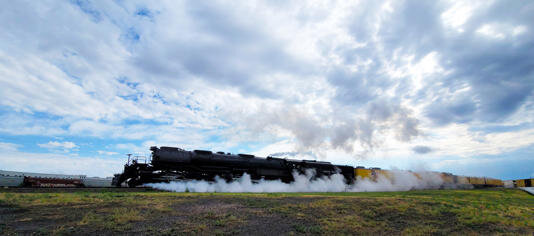
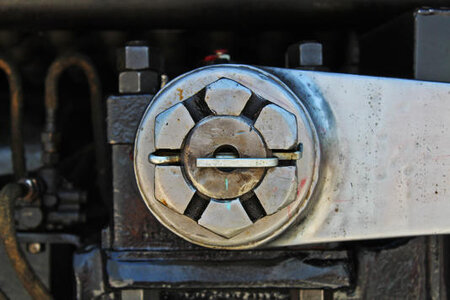
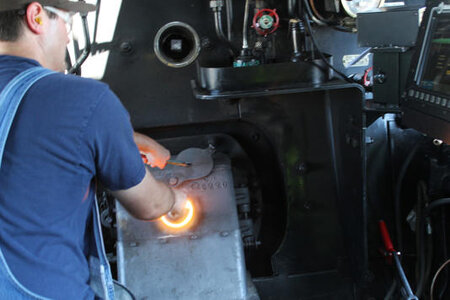
M ind-blowing Big Boy facts Five mind-blowing Big Boy facts: The sheer size of a Union Pacific Railroad Big Boy makes one stand in awe. To see No. 4014 run adds another dimension to the legendary story behind these mechanical wonders. Digging deeper into the Big Boy story and studying the little-known aspects of this steam locomotive will exponentially enhance your appreciation of what it represents. Cate Kratville-Wrinn © Provided by Trains.com In the 1959 Union Pacific movie Last of the Giants the narrator comments, " … There are no small parts on a Big Boy." This is also true of the story that accompanies this colossus of the rails. As one digs into Big Boy's details, everything - measurements, operating statistics, even the people involved - are large and, in some cases, larger than life. Come along and be amazed by five mind-blowing Big Boy facts. No. 1: How about a dip in the pool? As another of the 4000's comes together on the erecting floor, the boiler-smokebox-firebox assembly is lowered onto the driving wheels. When assembly is completed and the locomotive delivered to the Union Pacific, the boiler will be filled with 10,500 gallons of water. A gallon of water weighs about 8.3 pounds. That's 87,150 pounds or 43 ½ tons of liquid. Trains collection © Provided by Trains.com There is enough water in Big Boy's boiler to fill a swimming pool measuring 14-feet wide by 28-feet long by 3 ½-feet deep. If you have grabbed your calculator - or slide rule, back in Big Boy's time - to figure this out, let me save you the math. 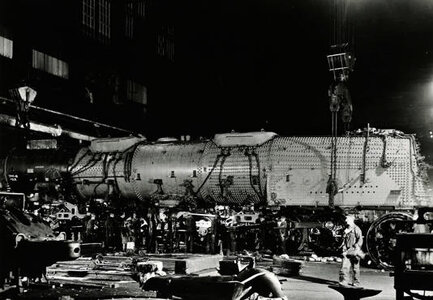 The boiler holds 10,500 gallons of water. Big Boy's boiler, the part under pressure where water changes state from a liquid to a gas, is 45 feet long. It is made from three courses of cold-rolled, stress-relieved steel. Course one, the closest to the front, has an outside diameter of 97 11/16 inches. The steel is 1 11/32 inches thick. The steel thickness of course two increases to 1 3/8 inches. By the time we reach the third course, the outside diameter has been expanded to 106 9/16 inches with 1 3/8-inch steel. The boiler operates with a pressure of 300 pounds per square inch. No. 2: I'd like to buy a Big Boy, but I'm concerned about fuel economy. Union Pacific fireman Austin Barker feeds sand into Big Boy No. 4014's firebox. The draft will pull the sand through the flues to clean out any oil residue that has built up. This is a standard procedure for oil-burning steam locomotives. Bob Lettenberger © Provided by Trains.com How many miles can I get out of a tank? Are you ready for some sticker shock? Big Boy's fuel economy is measured in gallons to the mile not miles to the gallon. No. 4014 began life as a coal burning locomotive, like all the other Big Boys. During restoration, it was converted to an oil burner. On the road, No. 4014 will consume 20 to 25 gallons of oil per mile depending on load, grade, and conditions. If you're looking for something a bit more economical, could I show you a nice 0-6-0? No. 3: William Jeffers, the Union Pacific Railroad president who ordered the Big Boys built, began working for the railroad at age 14. William Jeffers, the Czar, loved a good party and could appear happy, jolly and fun loving. He was, however, a no-nonsense railroader who would unleash his temper on anyone that crossed him. Jeffers' career with the Union Pacific began in 1890 as a janitor and concluded in 1953 as vice chairman of the board of directors. Trains collection © Provided by Trains.com Why start a railroad career at such a young age? Jeffers was born January 2, 1876, in North Platte, Neb. His father, an Irish immigrant, was a laborer for the Union Pacific Railroad. Jeffers signed on with the Union Pacific as custodian for the North Platte depot. This career moved was necessitated by his expulsion from school after punching out his teacher. Jeffers had a hot temper that stayed with him his entire railroad career. At times, his angry, firm stance was useful, but generally created challenges. When he entered Union Pacific's executive ranks in 1928, Jeffers was branded with a nickname: The Czar, in reference to the Russian leaders. It was said that when summoned to his office one did not know if you were about to be praised or fired. No. 4: Virtually every number used to quantify Big Boy is impressive. Every part on a Big Boy is specified somewhere in the 2,000-plus drawings that make up the blueprints. Items like this nut and cotter pin - part of the reversing gear - are called out in the drawings. Bob Lettenberger © Provided by Trains.com This includes the source of the numbers - the blueprints used to construct the locomotive. The set of plans developed to build the 4000-class tallied a little over 2,000 individual drawings. Everything on the locomotive is accounted for in one of these plans. The erecting diagram for the locomotive is the largest drawing in the set, measuring 12 ¾-feet long by 1 ½-feet wide. Remember, all of these plans were drawn by hand on a drafting table. When the Big Boys were designed there were no computers to assist with the math and no CAD systems to plot out the drawings. No. 5: Diesel locomotives carry along dried sand, which is applied to the rails in front of the wheels helping gain traction when starting or in slippery situations. Big Boy's sand domes are visible atop the boiler of No. 4000. The locomotive would have been serviced - which included topping off the sand domes - before beginning this trip. The white patches on the domes are sand that spilled over the top. Trains collection © Provided by Trains.com Steam locomotives did so as well. Don't think for a minute that the amount of sand carried by a Big Boy is any less impressive than the rest of the locomotive. Remember the engineer had to maintain control of 16 driving wheels on a locomotive weighing 1.18 million pounds plus the tonnage of the train. The 4000s were rated for 7,000 tons in some parts of their territory. Sitting atop the boiler, are two sand bunkers, one for each set of driving wheels. Each bunker holds 2 tons of sand.
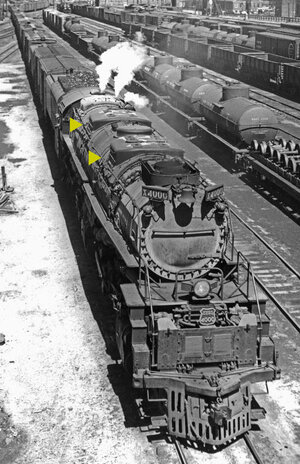
Sand bunkers

Araucaria
JUB 10k Club
Good Wednesday afternoon, Rob!
Gary, in reading all this about the Big Boy locomotive, I started to wonder how practical it was. I'd think its services would have been limited to hauling only the longest trains. And even at that, would it be better than hooking up two or three regular-sized engines for a long train? But then again, I think I've only seen that done with diesel locomotives, I've never seen pictures of steam locomotives hauling trains in tandem. Is there a reason that couldn't be done?
Gary, in reading all this about the Big Boy locomotive, I started to wonder how practical it was. I'd think its services would have been limited to hauling only the longest trains. And even at that, would it be better than hooking up two or three regular-sized engines for a long train? But then again, I think I've only seen that done with diesel locomotives, I've never seen pictures of steam locomotives hauling trains in tandem. Is there a reason that couldn't be done?
- Joined
- Dec 3, 2005
- Posts
- 47,425
- Reaction score
- 602
- Points
- 113
Hi, John
To answer your question:
Twenty-five Big Boys were built exclusively for Union Pacific Railroad, the first of which was delivered in 1941. The locomotives were 132 feet long and weighed 1.2 million pounds. Because of their great length, the frames of the Big Boys were "hinged," or articulated, to allow them to negotiate curves. They had a 4-8-8-4 wheel arrangement, which meant they had four wheels on the leading set of "pilot" wheels which guided the engine, eight drivers, another set of eight drivers, and four wheels following which supported the rear of the locomotive. The massive engines normally operated between Ogden, Utah, and Cheyenne, Wyo.
There are seven Big Boys on public display in various cities around the country. They can be found in St. Louis, Missouri; Dallas, Texas; Omaha, Nebraska; Denver, Colorado; Scranton, Pennsylvania; Green Bay, Wisconsin; and Cheyenne, Wyoming.
Big Boy No. 4014 was delivered to Union Pacific in December 1941. The locomotive was retired in December 1961, having traveled 1,031,205 miles in its 20 years in service. Union Pacific reacquired No. 4014 from the RailGiants Museum in Pomona, California, in 2013, and relocated it back to Cheyenne to begin a multi-year restoration process. It returned to service in May 2019 to celebrate the 150th Anniversary of the Transcontinental Railroad's Completion.
The route was over the Cascade Mountains. I have driven over those mountains and the Snoqualmie Pass is a brutal trip.
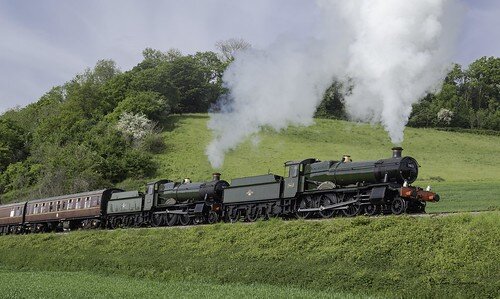
I have seen photos of trains being double and tripled headed with steam locos.
To answer your question:
Big Boy No. 4014
Twenty-five Big Boys were built exclusively for Union Pacific Railroad, the first of which was delivered in 1941. The locomotives were 132 feet long and weighed 1.2 million pounds. Because of their great length, the frames of the Big Boys were "hinged," or articulated, to allow them to negotiate curves. They had a 4-8-8-4 wheel arrangement, which meant they had four wheels on the leading set of "pilot" wheels which guided the engine, eight drivers, another set of eight drivers, and four wheels following which supported the rear of the locomotive. The massive engines normally operated between Ogden, Utah, and Cheyenne, Wyo.
There are seven Big Boys on public display in various cities around the country. They can be found in St. Louis, Missouri; Dallas, Texas; Omaha, Nebraska; Denver, Colorado; Scranton, Pennsylvania; Green Bay, Wisconsin; and Cheyenne, Wyoming.
Big Boy No. 4014 was delivered to Union Pacific in December 1941. The locomotive was retired in December 1961, having traveled 1,031,205 miles in its 20 years in service. Union Pacific reacquired No. 4014 from the RailGiants Museum in Pomona, California, in 2013, and relocated it back to Cheyenne to begin a multi-year restoration process. It returned to service in May 2019 to celebrate the 150th Anniversary of the Transcontinental Railroad's Completion.
The route was over the Cascade Mountains. I have driven over those mountains and the Snoqualmie Pass is a brutal trip.
I have seen photos of trains being double and tripled headed with steam locos.
Double heading
In railroad terminology, double heading indicates the use of two locomotives at the front of a train, each operated individually by its own crew. The practice of triple-heading involves the use of three locomotives. The practice of multi-heading involves the use of multiple locomotives and so on. Wikipedia

Hi, Gary and Araucaria.
That’s absolutely fascinating about the Big Boy locomotives. I have always wanted a model of one, but it might foul the loading gauge on my model railway! Anyway, thank you for posting all that information and photos about the fabulous locomotives.
Double heading is a subject all of it’s own. You would often get the exhaust beats somewhat out of sync adding to the effect as two steam engines worked a heavy train.
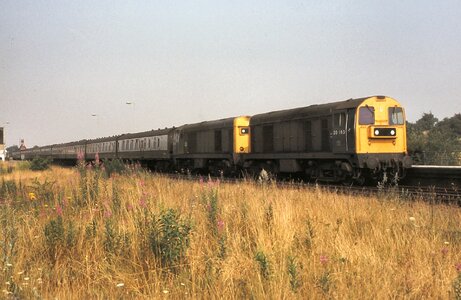
And then, on summer Saturdays, on excursion trains to the coast, in the 1970’s and 1980’s you would have scenes like this one with two diesel locomotives double heading such trains.
That’s absolutely fascinating about the Big Boy locomotives. I have always wanted a model of one, but it might foul the loading gauge on my model railway! Anyway, thank you for posting all that information and photos about the fabulous locomotives.
Double heading is a subject all of it’s own. You would often get the exhaust beats somewhat out of sync adding to the effect as two steam engines worked a heavy train.
And then, on summer Saturdays, on excursion trains to the coast, in the 1970’s and 1980’s you would have scenes like this one with two diesel locomotives double heading such trains.

Hi, Darren, thank you for dropping by in my thread, it is great to see you. I hope you are okay.
We’ve had a heatwave this week but it ends tomorrow.
thank you for dropping by in my thread, it is great to see you. I hope you are okay. We’ve had a heatwave this week but it ends tomorrow.


Hey Rob!
Guess who? (Hint Dr. Who)

Guess who? (Hint Dr. Who)
bluestar1079
JUB 10k Club
Hi








PalacePaul
JUB Addict
Good evening, Rob. I hope you enjoy the weekend

Hi Rob 