The Original Gay Porn Community - Free Gay Movies and Photos, Gay Porn Site Reviews and Adult Gay Forums

  • Welcome To Just Us Boys - The World's Largest Gay Message Board Community

    In order to comply with recent US Supreme Court rulings regarding adult content, we will be making changes in the future to require that you log into your account to view adult content on the site.
    If you do not have an account, please register.
    REGISTER HERE - 100% FREE / We Will Never Sell Your Info

    PLEASE READ: To register, turn off your VPN (iPhone users- disable iCloud); you can re-enable the VPN after registration. You must maintain an active email address on your account: disposable email addresses cannot be used to register.

  • Hi Guest - Did you know?
    Hot Topics is a Safe for Work (SFW) forum.

I'm not feeding the birds anymore

They are flying rats.Nasty fucking things.

I was just thinking that...rats with wings.

But then again, Seagulls are nearly as bad. And not afraid of people, either.

And both of them, their poop is so acidic, it eats through stuff. Experts blamed Pigeon Poo as the primary cause of that bridge that went down in Minneapolis (although there were some structural problems too.)
 
It's not the crows that are the bother. I've only seen them once or twice in the past few years.

It's really the pigeons and the blackbirds (starlings) which have moved in and evicted all the 'regulars' who were forced to move to another buffet somewhere else in the neighbourhood.
 
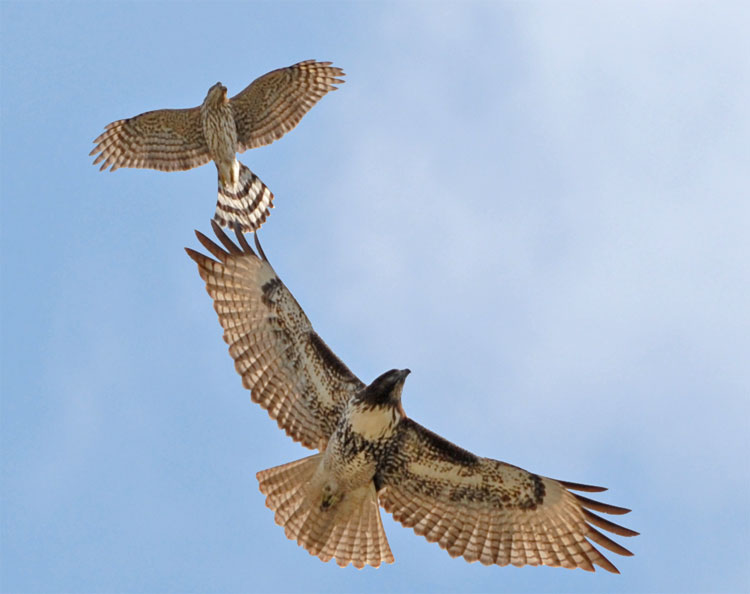
I have a solution to your crow and pigeon problem. Get some of these:

Hawks-pair-2.jpg
 
I used to have a birdfeeder on my balcony, but took it down because the birds crapped on every thing out there.
 
Can't you install a hanging bird feeder? Pidgeons, blackbirds etc are ground feeders. Smaller birds will be attracted to a feeder hanging from a tree. I have one outside my window and loads of different species use it. The pigeons just hang about underneath picking up what the others spill!

BTW are you sure about the swallows? European swallows eat insects and hardly ever land except to nest.
 
BTW are you sure about the swallows? European swallows eat insects and hardly ever land except to nest.

Good catch. I didn't even notice. I meant to type 'sparrows'. No idea how 'swallows' came out of my fingers. ..|
 
Ah, I miss sparrows! They have gone from being one of the UK's most common birds to being on the endangered list in just a few years. Hardly ever see one in my garden now.:(
 
^ We've got plenty of them here. Too bad we couldn't ship a few thousand of them across the ocean.

Why did yours become endangered?
 
^ We've got plenty of them here. Too bad we couldn't ship a few thousand of them across the ocean.

Why did yours become endangered?

Because sparrowhawks became a protected species.

(actually, no-one knows for certain. But the beginning of the decline did more-or-less coincide with the big "save the sparrowhawk" campaign)
 
^ Ah. We call them 'Kestrels' or 'Falcons'. They don't seem to find sparrows very tasty. They seem to prefer mice and voles and other small rodents to other avians.
 
^ Ah. We call them 'Kestrels' or 'Falcons'. They don't seem to find sparrows very tasty. They seem to prefer mice and voles and other small rodents to other avians.

Sparrowhawks and kestrels are totally different birds. The true sparrowhawk, Accipiter nisus, specializes - as the name suggests - in catching small birds.

This is a sparrowhawk:
771px-Accipiter_nisus_kill.jpg


Kestrel (Falco tinnunculus) for comparison:
712px-Common_Kestrel_2.jpg
 
That's a species of kestrel whose Latin name happens to mean "sparrow hawk". Quoth wiki:

The American Kestrel (Falco sparverius) is a small falcon. This bird was (and sometimes still is) colloquially known in North America as the "Sparrow Hawk". This name is misleading because it implies a connection with the Eurasian Sparrowhawk Accipiter nisus, which is unrelated; the latter is an accipiter rather than a falcon.

True sparrowhawks are not found in the new world. They are more closely related to eagles and kites, and are only distantly related to the kestrel (which is a falcon and not a hawk)
 
So the sparrows' overabundance for years was an imbalance caused by the absence of their major predator?
There is no doubt the sparrowhawk has made a healthy recovery. I drove from the south coast to the midlands last weekend and must have seen a dozen or more hovering over the motorway verges. They are a striking and beautiful bird.
 
Just one of the many things I like about JUB - the education to be had in all manner of areas, not just "what one would assume of a site like this" lol.

Kodak tower has a nesting pair of Peregrine Falcons - has had for several years.

The repopulation efforts of raptors has yielded good results - we went to a nature preserve the weekend before last and saw three Great Blue Heron, a pair of Golden Eagles, and at least one Bald Eagle, in addition to LOTS of red-winged blackbirds. And, the Asian Carp have invaded the estuary, so we even saw one of those leap out of the water - and a pair of black snakes swimming in the water - first apart, then together.

We have had a family of wild turkey and deer around our town home, and our "indoor" cat got out one day and brought back a dead (It may have been fresh kill - not sure - wasn't home) red fox.

Our neighbor has a feeder - cardinals, we've seen Blue Jays, lots of chickadees in the area. And, of course, Robins, sparrows, crows now and again. She gets mourning doves, too.
 
About the OP's swallows, I think they prefer bugs to seeds. They used to cruise up and down a nearby field just low enough to get the bugs and just high enough to avoid my leaping dog.

OTOH, maybe they do like seeds and the bugs were just their protein course.
 
So the sparrows' overabundance for years was an imbalance caused by the absence of their major predator?
There is no doubt the sparrowhawk has made a healthy recovery. I drove from the south coast to the midlands last weekend and must have seen a dozen or more hovering over the motorway verges. They are a striking and beautiful bird.

It's unlikely that's the sole cause, but it's probably a major contributor. Each sparrowhawk chick needs to be fed 2-3 sparrow-sized birds a day to survive, and they have 4-6 chicks at a time, so it all ads up. And that's not counting the adults.
 
Back
Top