

diamondstar
King Of Eternity & Hatred
- Joined
- Jul 24, 2010
- Posts
- 2,211
- Reaction score
- 0
- Points
- 0
Mars looks like an abandon beach. Pretty boring and disappointing looking. I want to see Saturn.


PLEASE READ: To register, turn off your VPN (iPhone users- disable iCloud); you can re-enable the VPN after registration. You must maintain an active email address on your account: disposable email addresses cannot be used to register.

Which is which? I'm guessing based on size from top to bottom Earth, Venus, Jupiter

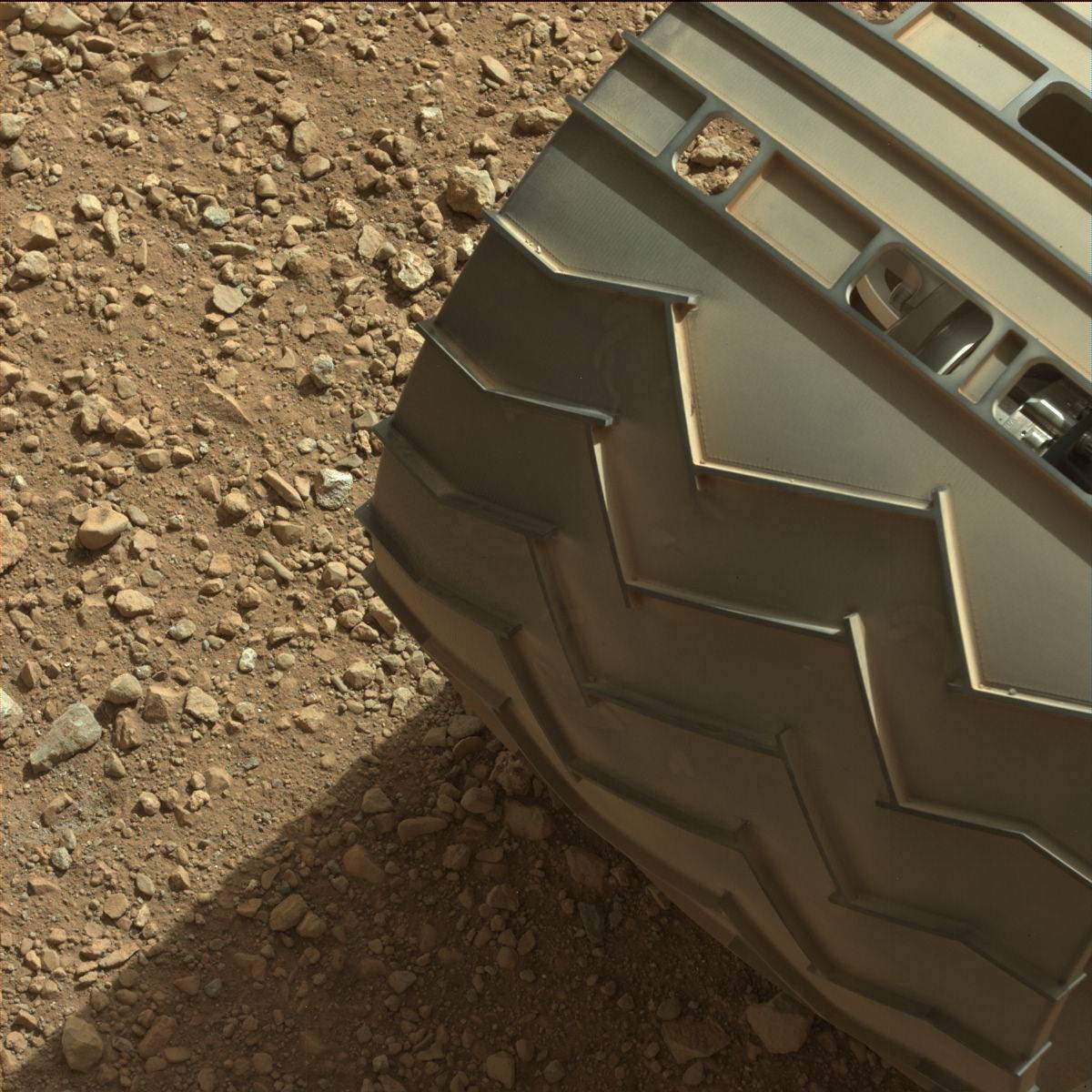


Wow
Truly a cousin of Earth
Curiosity Gets a 'Brain Transplant'
This weekend the Mars rover has been getting what NASA calls a “brain transplant,” a new version of flight software that’s better suited for working on the surface of Mars, such as driving and using Curiosity’s powerful robotic arm and drill. It will also give the rover better image processing ability so it can avoid obstacles while driving as well as go on longer drives.
The software upgrade began the evening of August 10 and should be complete on August 13.
It’s a pretty big deal considering the remote update is happening from 350 million miles away and if something goes wrong it could mean the last contact anyone has with Curiosity.
"It has to work," Steve Scandore, a senior flight software engineer at JPL, told Computerworld. "You don't' want to be known as the guy doing the last activity on the rover before you lose contact."
Where the Sky Crane Descent Stage Crashed
Some of the first images Curiosity captured included a strange cloud that set the blogosphere abuzz about what it might be.
Dust cloud from the carrier's crash (Source: NASA)
"We believe we've caught what is the descent stage impact on the Martian surface," Steve Sell, NASA's deputy operations lead for Curiosity's Mars landing, told reporters Friday at the Jet Propulsion Laboratory (JPL)in Pasadena, California, reports Space.com.
Now, with the high-res images in hand, geologists are looking closely at the crash site that exposes underlying materials as well as an upper layer made up of rock fragments embedded within finer substances.
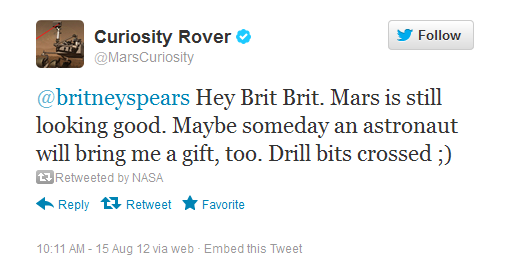


Amazing latest pictures just in.

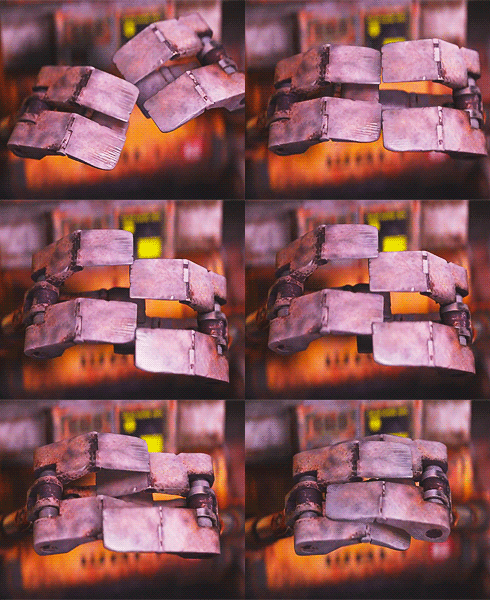
from someone on the internet with far too much time on their hands.





n its mad dash across the Martian plains to reach the base of Aeolis Mons, NASA's Curiosity rover is taking a breather to reach out and touch something.
The targeted rock, shaped like a pyramid and standing 25 centimetres tall, will be the first thing Curiosity makes physical contact with using any of its onboard geology tools.
The team has named the rock "Jake Matijevic" after a mission engineer who passed away on 20 August, and who was the lead engineer for all previous NASA Mars rovers.
As of 19 September, the rock sits just 2.5 metres in front of the rover, which means it'll soon be close enough to touch with the Alpha Particle X-Ray Spectrometer (APXS).
This device, seen above at centre mounted on the rover's arm, will sit against the rock face and use radioactive curium to bombard its target with energetic alpha particles and X-rays. This will induce each element in the rock to emit its own characteristic X-rays, which APXS can detect.
The team also plans to probe the rock remotely with the rover's ChemCam instrument, which will zap it with a laser and measure the spectra of the resulting vapour.
The benefit of closeness is better resolution. ChemCam can tell from a distance if the rock is mainly silicon, for instance, while APXS can determine the precise abundance of silicon down to 100 parts per million.
"We want to get compositional information on things that we can't see with our eyes," project scientist John Grotzinger said in a news conference today.
He thinks Jake Matijevic might be a piece of basalt kicked into Gale Crater by a separate meteorite impact.
"These rocks are what we saw with Viking and Pathfinder, [and] all over the place at Spirit's landing site," Grotzinger said. He added that they don't expect to find anything surprising in the first measurements of the rock. In fact, they hope not.
"We wanted a rock type that looks familiar, that looks like we've done something like this before," he says. The exercise will help them calibrate APXS by comparing its finely detailed view with the broader picture
ChemCam delivers.


Curiosity discovers pyramid shaped rock on Mars
http://www.newscientist.com/blogs/shortsharpscience/2012/09/mars-rover-curiosity-to-make-a.html
*waits for the Ancient Aliens helping out the Egyptians with their pyramids conspiracists*

NASA's Curiosity Mars rover has made its first major science discovery, and it's one for the ages.
Scientists announced Thursday that water—fast-running and relatively deep—once coursed over the now bone-dry surface, a finding based on the presence of rounded pebbles and gravel near the rover's landing site in Gale Crater.
What's more, the team has concluded that the water was present for "thousands or millions of years," though the researchers said it would take far more research to get a clearer picture of the flow's longevity.
The discovery is the first proof that surface water once ran on Mars. Planetary scientists have hypothesized that the cut canyons and riverlike beds photographed by Mars satellites had been created by running water, but only now do researchers have on-the-ground confirmation—and the promise of learning much more about the nature and duration of the water flows.
"We've now identified pebbles and gravel at the landing site that clearly have been carried down by water, have been broken down and very much smoothed out," said William Dietrich, a geomorphologist working with the Curiosity imaging science team. "This is the beginning of our process of learning how much water was running and how long this area was wet."
(Related: "Mars Has Liquid Water Close to Surface, Study Hints.")
Past Potential for Life?
The evidence in the newound streambed led Curiosity lead scientist John Grotzinger—known as a cautious and careful scientist—to conclude that the rover had already found a site that was potentially habitable in the distant past. That doesn't mean life existed there or anywhere else on Mars, he said, but rather that some key physical conditions appear to have allowed for its possible emergence.
"Habitability requires water, a source of energy, and a source of organic carbon, and now we have a hall pass for the water observation," he said at a press conference Thursday at NASA's Jet Propulsion Laboratory (JPL) in Pasadena, California, where the Curiosity mission control in headquartered. Chemical assessments will come later, when the two miniature labs on the rover begin doing their work, though not necessarily at the current site.
"We're still going to Mount Sharp," a three-mile-high (five-kilometer-high) mound at the center of the crater, said Grotzinger, "but this is insurance that we have already found our first potentially habitable environment."
While Curiosity is not a life-detection mission, it is considered an astrobiological exploration—a search for the building blocks of life as we know it and habitats where it might have emerged. The rover has been on Mars now for 51 Mars days, which translate into several additional Earth days.
(Also see "Mars Has 'Oceans' of Water Inside?")
Pebbles Like M&Ms
The full river and drainage system by the Curiosity landing site is about 200 square miles (520 square kilometers), Dietrich said. It includes the elevated area beyond the crater wall, with fossil streams that feed into a deep, 11-mile (18-kilometer) channel slowly falling down that cliff, and then a 20-square-mile (50-square-kilometer) alluvial fan—the roughly triangular deposit left behind by the long-gone flow. The canyon channel was about 2,000 feet (610 meters) wide.
The most interesting gravel and pebbles—the size of M&Ms or hard candies—were found in conglomerate rocks at three sites close to the landing site. Curiosity's thrusters had dug out the first, Goulburn, at landing. The two others, called Link and Hottah, showed the same pavement-like formations.
According to geologist Rebecca Williams of the Planetary Science Institute, the team did not expect to see the remains of the alluvial fan—now known as Peace Vallis—as far down as the landing site. That they were found, she said, appears to expand the size of the area once touched by water.
"The shapes tell you [the rocks] were transported, and the sizes tell you they couldn't be transported by wind," Williams said. "They were transported by water flow."
(Related: "Rover Finds 'Bulletproof' Evidence of Water on Early Mars.")
A Rich Crater Site
Grotzinger said the team had decided to release the dramatic new information so early because the data were so strong and because they showed the essential connection between satellite imaging (which had initially identified the canyon and fan) and on-the-ground geology.
That geology was conducted entirely by analyzing photos taken by Curiosity's large suite of cameras.
The rover will soon be headed to an area named Glenelg, which many team members believe is more clearly in the alluvial fan. The two chemistry labs are expected to be used for the first time at the Glenelg site—where three rock formations join—and could shed more light on the nature of the water that once flowed there.
Author of the National Geographic e-book Mars Landing 2012, Marc Kaufman has been a journalist for more than 35 years, including the past 12 as a science and space writer, foreign correspondent, and editor for the Washington Post. He is also author of First Contact: Scientific Breakthroughs in the Hunt for Life Beyond Earth, published in 2011, and has spoken extensively to crowds across the United States and abroad about astrobiology. He lives outside Washington, D.C., with his wife, Lynn Litterine.


What's more, the team has concluded that the water was present for "thousands or millions of years"


