Here's what I found:
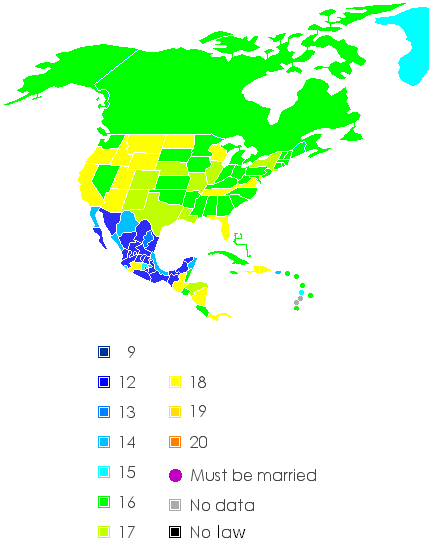
The Tackling Violent Crime Act took effect on 1 May 2008, raising the age of consent to 16 from 14.[7]
There exist two close in age exemptions, depending on the age of the younger partner. A youth of twelve or thirteen can consent to sexual activity with an individual less than two years older than they. A fourteen- or fifteen-year-old can consent to sexual activity with a partner who is less than five years older than they.[8]
Criminal law (including the definition of the age of consent) is in the exclusive jurisdiction of the federal government, so the age of consent is uniform throughout Canada. Section 151 of the Criminal Code of Canada makes it a crime to touch, for a sexual purpose, any person under the age of 16 years. Section 153 then goes on to prohibit the sexual touching of a person under 18 by a person in three circumstances: if he or she is in a "position of trust or authority" towards the youth, if the youth is in a "relationship of dependency" with him or her, or if the relationship is "exploitative". The term "position of trust or authority" is not defined in the Code but the courts have ruled that parents, teachers, and medical professionals hold a position of trust or authority towards youth they care for or teach. For determining whether or not a relationship is "exploitative", s. 153 (1.2) of the Code provides that a judge can consider how old the youth is, the difference in ages between the partners, how the relationship evolved, and the degree of control or influence that the older partner has over the youth.
The "position of trust under 18" anti-exploitation rules were expanded in 2005 by Bill C-2 where a judge may choose to term a situation to be sexual exploitation based on the age of the younger party, age difference, evolution of the relationship (how it developed, e.g.: quickly and secretly over the Internet), the control or influence over the young person (degree of control or influence the other person had over the young person). This passed before the 2008 amendments, and they were not repealed so they are still in effect and can apply towards adults in these situations with young persons over the age of consent and under 18 (16-17).
Where an accused is charged with an offence under s. 151 (Sexual Interference), s. 152 (Invitation to sexual touching), s. 153(1) (Sexual exploitation), s. 160(3) (Bestiality in presence of or by child), or s. 173(2) (Indecent acts), or is charged with an offence under s. 271 (Sexual assault), s. 272 (Sexual assault with a weapon, threats to a third party, or causing bodily harm), or s. 273 (Aggravated sexual assault) in respect of a complainant under the age of fourteen years, it is not a defense that the complainant consented to the activity that forms the subject-matter of the charge.
Anal intercourse
Section 159 of the Criminal Code criminalizes every act of anal intercourse, but provides exceptions for a husband and wife, and any two persons 18 years of age or older. These exceptions do not apply if a third adult is present, or if the anal intercourse takes place anywhere but in private.[9] However, courts in Ontario,[10]Quebec,[11] and Alberta[12] have independently declared s. 159 to be unconstitutional as violations of the equality provision of the Canadian Charter of Rights and Freedoms.
History
See also: Age of consent reform in Canada
During the 19th century, the age of consent for heterosexual vaginal sex was 12, in 1890, the Parliament raised the age of consent to 14.[13] The punishment for anyone who had sexual intercourse with someone younger than 14 was life imprisonment and whipping, while the punishment for anyone who only attempted to seduce an underage girl was two years' imprisonment and whipping.[14] Canada had also laws against "seducing" minor girls who were over the age of consent. In 1886, a law was enacted that made the "seduction" of a girl over 12 and under 16 "of previously chaste character" a criminal offence; the "seduction" of a female under 18 "under promise of marriage" was also made illegal in 1886, and amended in 1887 to apply to females under 21.[15] After the raising of the age of consent to 14, the laws against "seducing" minor girls were amended to apply to those older than 14, and various laws of this kind have remained in force through the 20th century.[15] The age of consent was raised from 14 to 16 in the spring of 2008, when the Tackling Violent Crime Act became effective. The new measures still allow for close in age exceptions between 12 and 16: if there is no more than a two-year gap for those 12 and 13, or a five-year gap for those 14 and 15. Anal sex remains illegal with exceptions for those over 18, if they comply with the restrictions set out under section 159.
Female homosexuality was never illegal in the former British colonies; oral sex was legalized in 1969 with the same age of consent as vaginal sex. Also introduced in 1969 were the exceptions regarding criminal anal sex (effectively legalizing it), but with a higher age barrier set at 21 & older, under section 159; in 1988, the age barrier for these exceptions was lowered to 18 & older. As of 2008 there are no plans to repeal section 159, even though it has been ruled unconstitutional in some Canadian provinces.