

The Original Gay Porn Community - Free Gay Movies and Photos, Gay Porn Site Reviews and Adult Gay Forums

  • Welcome To Just Us Boys - The World's Largest Gay Message Board Community

    In order to comply with recent US Supreme Court rulings regarding adult content, we will be making changes in the future to require that you log into your account to view adult content on the site.
    If you do not have an account, please register.
    REGISTER HERE - 100% FREE / We Will Never Sell Your Info

    PLEASE READ: To register, turn off your VPN (iPhone users- disable iCloud); you can re-enable the VPN after registration. You must maintain an active email address on your account: disposable email addresses cannot be used to register.

Paul Krugman Goes to B-----n and Embarrasses Some Non-American Teabaggers: Calls Them Liars

Lostlover

JUB 10k Club
Joined
Apr 9, 2006
Posts
10,273
Reaction score
7
Points
0
Location
United States
Paul Krugman appeared on the BBC's News Night to discuss the financial predicament Europe is in. He discussed this with their version of the teabaggers. It gets really funny when he exposes their dishonesty with their real goal: exploit the economic situation to stop paying for social safety nets.


Let's just say, they didn't handle it too well.

Grandpa says, "You're [Krugman] accusing us of lying?" Sure sounds like it... he needs to turn up his Miracle Ear.
 
What is a "B-----n" ?
 
All I can say is OUCH! It seems these politicians learned a valuable lesson here that American politicians already know: You don't engage in a live debate with someone as sharp as Paul Krugman on his OWN TURF and expect to be able to waffle, deflect and fudge and to get away with it. He will call you out on your shit.

American politicians are...I won't say smarter but I will say more savvy, in not appearing in a debate with Krugman (or any acknowledged expert) like this. It's just not smart to do so and to expect to come away looking good.

I thought that man was going to spit on him.
 
WOW, what a headline on that 2nd video! I didn't see "spendaholic" Krugman as getting "trashed" at all (much the other way round) but I guess the perception is all in the spin.

Definitely an inaccurate video title. The quality of the video was better and included the entire segment with the vignette.
 
Krugman is obnoxious and treated the other 2 very badly

he was condescending, dismissive and accused them of lying

what a wonderful "guest" ;)

and i believe the point of growing private relative to public sector is THE KEY

Krugman is ALL ABOUT lack of demand - that spending fixes everything

Krugman is smart but sadly it's book smart

as for "embarrassment" i'd say paul k embarrassed himself with his smarmy and boorish behavior

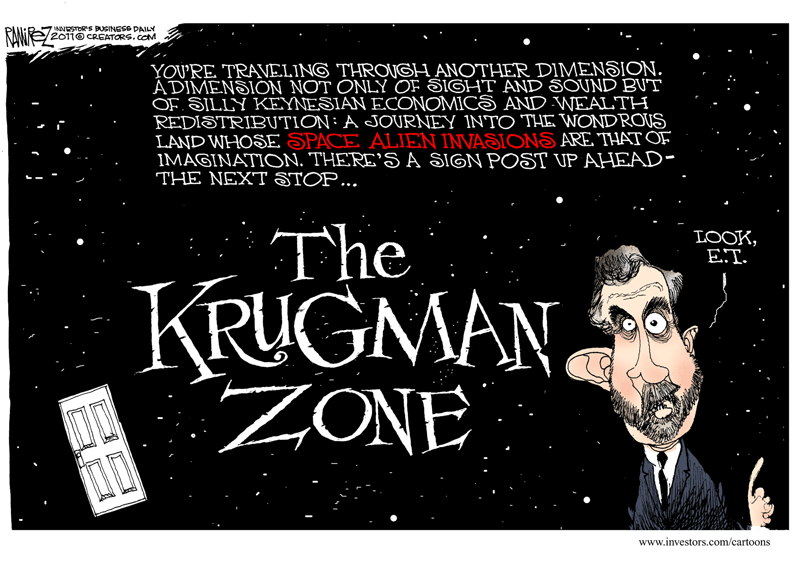
toon2_082211.gif.cms
 
He is too partisan to be credible as a "economist".
 
Krugman is ALL ABOUT lack of demand - that spending fixes everything

Krugman is smart but sadly it's book smart

as for "embarrassment" i'd say paul k embarrassed himself with his smarmy and boorish behavior

Did we watch the same interview? I thought Krugman was polite, direct and stayed very much on point. If there was any rudeness it was the woman, who interrupted more than any of the other speakers. But overall the entire discussion is civil and intelligent - I'd like to see a lot more like this. I think you're confusing disagreement with rudeness.

As to the public vs private point - I'm right with Krugman. There's no point making the private sector larger while there is no demand for goods and services. The woman's point is deluded: make it easier for young people to start their own businesses? The reality is that the vast majority of people leaving education are completely unequipped to run their own businesses, and will typically spend some years in the real world learning the ropes - whether a carpenter, a plumber, a shopkeeper or a financial advisor.

As Krugman stated. there is VAST evidence that his approach is correct. The economies that have fared the GFC best are those who spent. The economies that have fared worst are those who held back. Every economic downturn in the past century has shown us the same evidence: spend your way OUT of the downturn, then pay back the bills when times are good.

Think of the economy as a car. For the past 30 years (or more) we haven't been checking the brake fluid. Suddenly, we're driving towards a cliff and the brakes have failed. The austerity approach is rather like sitting in that car shouting "Check the brake fluid! Check the brake fluid!" But topping up the brake fluid whilst hurtling toward the cliff won't help you now. Concentrate on the steering wheel, turn away from the cliff, and worry about the brake fluid when you're out of immediate danger.
 
All I can say is OUCH! It seems these politicians learned a valuable lesson here that American politicians already know: You don't engage in a live debate with someone as sharp as Paul Krugman on his OWN TURF and expect to be able to waffle, deflect and fudge and to get away with it. He will call you out on your shit.

American politicians are...I won't say smarter but I will say more savvy, in not appearing in a debate with Krugman (or any acknowledged expert) like this. It's just not smart to do so and to expect to come away looking good.

I thought that man was going to spit on him.

And you don't cite studies at him, when he has a near-photographic, encyclopedic memory: odds are he's read it, and can even cite the graphs by page number . . . .

I really liked his point about devaluing currency working only when there's some more prosperous economy out there to devalue against -- and there is none! It seems obvious when he says it, but how many people have really put it together before?
 
Did we watch the same interview? I thought Krugman was polite, direct and stayed very much on point. If there was any rudeness it was the woman, who interrupted more than any of the other speakers. But overall the entire discussion is civil and intelligent - I'd like to see a lot more like this. I think you're confusing disagreement with rudeness.

Definitely.

Congress should take lessons.

As to the public vs private point - I'm right with Krugman. There's no point making the private sector larger while there is no demand for goods and services. The woman's point is deluded: make it easier for young people to start their own businesses? The reality is that the vast majority of people leaving education are completely unequipped to run their own businesses, and will typically spend some years in the real world learning the ropes - whether a carpenter, a plumber, a shopkeeper or a financial advisor.

Were I still doing the handyman thing right now, I definitely wouldn't be hiring anyone, even if I gave myself a massive pay cut: there aren't customers. The plumbers and sheet metal and roofing and other businesses here say the same: no one is buying, because there's no income to spare. It isn't just that the unemployed and underemployed don't have anything to spend; their friends and relatives have nothing extra because they're helping support them.

BTW, we lost a video store this week, because not enough people can afford to rent DVDs or games or whatever.

As Krugman stated. there is VAST evidence that his approach is correct. The economies that have fared the GFC best are those who spent. The economies that have fared worst are those who held back. Every economic downturn in the past century has shown us the same evidence: spend your way OUT of the downturn, then pay back the bills when times are good.

There's enough evidence to have convinced this libertarian that we can't go that way at this point -- we have to get our house in order first. It's like if civilization had collapsed and things fell into feudalism, and some Communists faced this: they wouldn't try to get a communist state going, because first one must move from feudalism onward and get to capitalism, and only then will conditions be right for socialism and finally communism. Before we can try for a smaller state, we have to pay off the debt.

What we can do at the moment is refuse to expand the state except for programs to deal with the economy.

Think of the economy as a car. For the past 30 years (or more) we haven't been checking the brake fluid. Suddenly, we're driving towards a cliff and the brakes have failed. The austerity approach is rather like sitting in that car shouting "Check the brake fluid! Check the brake fluid!" But topping up the brake fluid whilst hurtling toward the cliff won't help you now. Concentrate on the steering wheel, turn away from the cliff, and worry about the brake fluid when you're out of immediate danger.

That's a superb analogy! ..|
 
What we can do at the moment is refuse to expand the state except for programs to deal with the economy.


I agree entirely. There shouldn't be spending for spending's sake, and the ultimate goal must be to reign in debt over time. But the problem with the spending debate is ideology: it's all or nothing to many of the politicians and pundits.

As Jon Stewart often says, we have de-coupled "spending" from "value". The debate should not be "how much can we cut", but "how little can we spend whilst getting the most value?"
 
Did we watch the same interview? I thought Krugman was polite, direct and stayed very much on point. If there was any rudeness it was the woman, who interrupted more than any of the other speakers. But overall the entire discussion is civil and intelligent - I'd like to see a lot more like this. I think you're confusing disagreement with rudeness.

As to the public vs private point - I'm right with Krugman. There's no point making the private sector larger while there is no demand for goods and services. The woman's point is deluded: make it easier for young people to start their own businesses? The reality is that the vast majority of people leaving education are completely unequipped to run their own businesses, and will typically spend some years in the real world learning the ropes - whether a carpenter, a plumber, a shopkeeper or a financial advisor.

As Krugman stated. there is VAST evidence that his approach is correct. The economies that have fared the GFC best are those who spent. The economies that have fared worst are those who held back. Every economic downturn in the past century has shown us the same evidence: spend your way OUT of the downturn, then pay back the bills when times are good.

Think of the economy as a car. For the past 30 years (or more) we haven't been checking the brake fluid. Suddenly, we're driving towards a cliff and the brakes have failed. The austerity approach is rather like sitting in that car shouting "Check the brake fluid! Check the brake fluid!" But topping up the brake fluid whilst hurtling toward the cliff won't help you now. Concentrate on the steering wheel, turn away from the cliff, and worry about the brake fluid when you're out of immediate danger.

perhaps we did ;)

he talked down to them - several times - and was dismissive with matter of fact "you're wrong" type statements

calling them liars was over the top

i agree that it was mostly civil and I enjoyed it immensely

as for "spending" i agree with infrastructure/new deal esque type spending which is invst. based

otherwise i prefer making it easier to private business to expand vs. govt. expanding

i agree the idea of young people starting their own businesses was folly
 
BTW, we lost a video store this week, because not enough people can afford to rent DVDs or games or whatever.

Video stores (and brick and mortar bookstores) aren't failing do to lack of spending money (or just because of it), they are failing due to Netflix, Amazon, Vudu, etc. Hard copy media formats are dying out in the Internet age.
 
The problem with austerity programmes is that government actions act as a beacon for the private sector to follow.
Government wage cuts and layoffs increase the pool of unemployed, and decreases the wages necessary to attract staff in the private sector (employment rates and pay for full time workers may decrease overall across an economy). This reduces money spent by consumers, which harms the profitability of the private sector.

Cuts in government spending are often at the expense of private sector providers of goods and services to government.
A sharp reduction or freeze in spending on services and goods from the private sector is an easy first step for an austerity programme. But this reduces the profitability of affected private sector companies and their ability to employ staff, and may cause some companies to fail entirely. A sharp reduction in spending by any large entity in an economy harms the private sector.

It's more constructive to reduce government spending during the boom years, when employment and spending in the private sector is booming, as opposed to the bust years.
 
The video is very interesting, and thanks for posting it.
It is clear, as Paul Krugman points out, that austerity isn't working, especially in Europe, and increasingly in the US.
His opponents, as he highlights, have a deeper ideological agenda, which is a deep new-liberal hatred of the state, and that markets alone can solve our problems.
Nothing could be further from the truth. As Will Hutton says in a recent article:

We live in the aftermath of one of the biggest financial and intellectual mistakes ever made. For a generation the world, with the London/New York financial axis at its heart, surrendered to the specious theory that lending and financial contracts could grow many times faster than the underlying economy. There was a blind belief that in a free market banks could not make mistakes. Free markets didn't make mistakes – only clumsy bureaucratic states made economic mistakes. Or so they said. Financial alchemists, guided by the maxims of free market fundamentalism, could make no such errors.

http://www.guardian.co.uk/commentisfree/2012/jun/02/austerity-failed-will-hutton
 
He is too partisan to be credible as a "economist".

Why? Does a nobel prize automatically make facts about an economy untrue?

I think a 3rd grader could understand that increasing demand creates jobs, and you don't do that by cutting spending.

And coming from you its a pretty weak line to call someone partisan, OOOO SCARY WORD! Hes so PARTISAN! Except hes not, he works at Harvard as an economist. But I know how much conservatives dispise facts to the extreme that they would invent their own reality where their ideology makes sense, that anything deflating that reality is seen as an attack on their religion of stupidity.

It just goes to show how wrong you are - you cannot defend your own positions without resorting to political jabs.

But that is the mark of the brainwashed, you don't realize you are.

Keep undermining yourself every time you open your mouth.....just a fool in my eyes.
 
perhaps we did ;)

he talked down to them - several times - and was dismissive with matter of fact "you're wrong" type statements

calling them liars was over the top

i agree that it was mostly civil and I enjoyed it immensely

as for "spending" i agree with infrastructure/new deal esque type spending which is invst. based

otherwise i prefer making it easier to private business to expand vs. govt. expanding

i agree the idea of young people starting their own businesses was folly

another cave in. im glad some are finally seeing the light.
 
Back
Top