



kallipolis
Know thyself
There is a novel thought that laws, and the spirit that they appear to reveal are often in conflict, when reasoning that the interpreter of the law believes that laws should be fashioned to support their perceived right to be served by the law.
Distinguishing the "letter" from the "spirit" of the Law is a false dichotomy. One must be aware of ones motivation for following the "letter" of the law as much as one should not allow a subjective interpretation of the "spirit" of the law to cloud the objectivity inherent in The Mosaic Laws.
It may be worth noting that the "Law-free Christianity" to which Paul adhered, should not be understood as completely antinomianism or libertarianism.
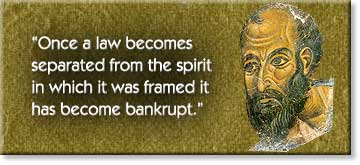
What Paul and the Hellenists before him opposed was adherence to such Laws that served to set up boundaries between Jews and Greeks, men and women, slaves and freemen, barbarians and the civilized (Galatians 3:11; Colossians 3:28).
Paul saw how clearly insistence on observance of the Law as the means of entry into the people of God was contrary to the Christian message and, in practical terms, even made it impossible for Gentile converts to share fully with Jewish converts the life of the Christian community. Paul equates the legalism and rule following that the Judaisers espoused as boundary markers separating Jew from Gentile with "a yoke of slavery" (Galatians 5:1b; cf. Romans 7:25).
Paul returns to this theme in 2 Corinthians (11:20), where he admonishes his audience for tolerating the false apostles who would "enslave" them. This statement echoes not only Galatians 2:4, but also Galatians 4:24-25 where Paul speaks of Jerusalem and its children as presently serving as a slave to the Mosaic covenant.
Paul of Tarsus is never one for the understatement. He makes his understandings crystal clear when telling his audience that right living must adhere to the call of The Spirit, and never in public observance of laws that neglect their invitation to live our life as our public image appears to demonstrate.
For followers of The Christ the death and resurrection of The Christ rendered observance of the Law redundant thus, Jews who converted ceased to be Jews (defined by observance of the Law). For Paul the Law served only to demarcate "them" from "us" and, thus, with the universal application of The Christ event such boundary markers were no longer relevant. He was not critical of Judaism, merely of those Nazarenes who wanted to remain Jewish by adhering to the Laws that marked them out as Jews.
Paul's comments, especially in Galatians and 2 Corinthians, indicate that not only was Law-observance a key component of his opponents' gospel, but that these opponents were also "Judaisers" whose message directly challenged the basic tenets of Paul's own gospel of justification by faith.
The issue for me as it was for Paul at Galatia and Corinth, is not that one is free from all rule-keeping or law-observing. Human society could not function without rules governing dangerously aberrant or violent behaviour. The result would be anarchy. Rules can, however, be the source of conflict, confusion, and injustice. All-too-often it is not the rules per se that are the cause of such problems, but one person's, or one group's attempt to impose their interpretation of the rules on others. This leads to factionalism, and divisiveness which inevitably results in the development of the self righteous I am right, you are wrong politics of the self elect.
Reading Paul's correspondence we hear the echoes of battles that seem to be perpetuated even in our own time. Paul is emphatic that this sort of nit-picking, legalistic Law-observance can only mean a diminution of the "liberty" wrought by The Christ (Gal 5:1, 13; 2 Cor 5:14-15, 21; 11:20).
Paul states that the death, and the resurrection of The Christ has set us free from all ethnic, social and gender boundaries between "Jew and Gentile, Slave and Free, Woman and Man" (Gal 3:11; cf. Col 3:28).
Paul proclaims that the followers of The Christ should be people without boundaries founded upon ethnicity, gender, socio-economic status; even our sense of self importance generated by our easy willingness to believe that the poor, disadvantaged and those discriminated upon are unworthy of our compassion, empathy and loving practical assistance. For he also, is my brother.
end
Distinguishing the "letter" from the "spirit" of the Law is a false dichotomy. One must be aware of ones motivation for following the "letter" of the law as much as one should not allow a subjective interpretation of the "spirit" of the law to cloud the objectivity inherent in The Mosaic Laws.
It may be worth noting that the "Law-free Christianity" to which Paul adhered, should not be understood as completely antinomianism or libertarianism.
What Paul and the Hellenists before him opposed was adherence to such Laws that served to set up boundaries between Jews and Greeks, men and women, slaves and freemen, barbarians and the civilized (Galatians 3:11; Colossians 3:28).
Paul saw how clearly insistence on observance of the Law as the means of entry into the people of God was contrary to the Christian message and, in practical terms, even made it impossible for Gentile converts to share fully with Jewish converts the life of the Christian community. Paul equates the legalism and rule following that the Judaisers espoused as boundary markers separating Jew from Gentile with "a yoke of slavery" (Galatians 5:1b; cf. Romans 7:25).
Paul returns to this theme in 2 Corinthians (11:20), where he admonishes his audience for tolerating the false apostles who would "enslave" them. This statement echoes not only Galatians 2:4, but also Galatians 4:24-25 where Paul speaks of Jerusalem and its children as presently serving as a slave to the Mosaic covenant.
Paul of Tarsus is never one for the understatement. He makes his understandings crystal clear when telling his audience that right living must adhere to the call of The Spirit, and never in public observance of laws that neglect their invitation to live our life as our public image appears to demonstrate.
For followers of The Christ the death and resurrection of The Christ rendered observance of the Law redundant thus, Jews who converted ceased to be Jews (defined by observance of the Law). For Paul the Law served only to demarcate "them" from "us" and, thus, with the universal application of The Christ event such boundary markers were no longer relevant. He was not critical of Judaism, merely of those Nazarenes who wanted to remain Jewish by adhering to the Laws that marked them out as Jews.
Paul's comments, especially in Galatians and 2 Corinthians, indicate that not only was Law-observance a key component of his opponents' gospel, but that these opponents were also "Judaisers" whose message directly challenged the basic tenets of Paul's own gospel of justification by faith.
The issue for me as it was for Paul at Galatia and Corinth, is not that one is free from all rule-keeping or law-observing. Human society could not function without rules governing dangerously aberrant or violent behaviour. The result would be anarchy. Rules can, however, be the source of conflict, confusion, and injustice. All-too-often it is not the rules per se that are the cause of such problems, but one person's, or one group's attempt to impose their interpretation of the rules on others. This leads to factionalism, and divisiveness which inevitably results in the development of the self righteous I am right, you are wrong politics of the self elect.
Reading Paul's correspondence we hear the echoes of battles that seem to be perpetuated even in our own time. Paul is emphatic that this sort of nit-picking, legalistic Law-observance can only mean a diminution of the "liberty" wrought by The Christ (Gal 5:1, 13; 2 Cor 5:14-15, 21; 11:20).
Paul states that the death, and the resurrection of The Christ has set us free from all ethnic, social and gender boundaries between "Jew and Gentile, Slave and Free, Woman and Man" (Gal 3:11; cf. Col 3:28).
Paul proclaims that the followers of The Christ should be people without boundaries founded upon ethnicity, gender, socio-economic status; even our sense of self importance generated by our easy willingness to believe that the poor, disadvantaged and those discriminated upon are unworthy of our compassion, empathy and loving practical assistance. For he also, is my brother.
end


