The Original Gay Porn Community - Free Gay Movies and Photos, Gay Porn Site Reviews and Adult Gay Forums

  • Welcome To Just Us Boys - The World's Largest Gay Message Board Community

    In order to comply with recent US Supreme Court rulings regarding adult content, we will be making changes in the future to require that you log into your account to view adult content on the site.
    If you do not have an account, please register.
    REGISTER HERE - 100% FREE / We Will Never Sell Your Info

    PLEASE READ: To register, turn off your VPN (iPhone users- disable iCloud); you can re-enable the VPN after registration. You must maintain an active email address on your account: disposable email addresses cannot be used to register.

Question for Jews, Christians, Muslims

BigChicken

Slut
Joined
Oct 14, 2010
Posts
185
Reaction score
0
Points
0
Location
Phoenix, ARIZONA
You have to remember that all religions are make believe and were made by humans to control other humans, and as such, they are full of errors, lies, and mistakes.

There is no God.

There is no afterlife.

This one life is all we are going to get, so we had better not waste our time worrying about religion, and instead, try to enjoy every day we have left of this life, before it's gone.
 
I imagine respecting your elders was more important back then. To make sure that your kids don't throw you over a hill when you're old and feeble. It's only logical that parents would not hurt their offspring in order for them to do the same.
 
If things have changed (now as opposed to back then), why hasn't God issued another set of commandments?

He did. There are two -- see below.

I don't think it's an oversight. I think God understands the parents have an inherent love for their children. But He understands as children get older they tend to question authority and have a need to seek independence. I think this is where this comes from. God is saying to them, don't forget to honor your parents because there's going to be a tendency to think, "I'm grown up, I don't have to listen to you."

That said, I think there are plenty of tenets in scripture that would apply to parents and their children. I don't think the lack of a specific command means it's not implied. Of course, the Old Law is just that. Old. It's behind us (Christians). We see the New Covenant as covering this is several ways. As Christ said (applying it even to the Old Law) "And he said unto him, Thou shalt love the Lord thy God with all thy heart, and with all thy soul, and with all thy mind. This is the great and first commandment. And a second like unto it is this, Thou shalt love thy neighbor as thyself. On these two commandments the whole law hangeth, and the prophets." - Matthew 22: 37-40

Except they're not really new, they're the basis for the others.

And in Acts 15 God explicitly leaves the Old Law in the synagogues and sets only a few requirements on Christians: no idols, no fornication, don't eat things killed by strangling, and no violence.
 
"Honor your parents" is such an important law that God supposedly included it among the Ten Commandments.

God additionally supposedly demanded that anyone who curses his parent must be put to death.

Yet there don't seem to be any comparable dictates mandating that parents honor their sons and daughters, or any comparable prohibitions against parents harming their sons or daughters.

Doesn't anyone find this to be a major oversight?

One can only assume that you are talking about the commandment to "Honor your father and mother that your days may be long upon the earth".

It does not call for those children that do not to be put to death. What it does do is imply that if you cause strife you will have troubles that will cause you to have a shorter life. In other words, you screw things up bad enough you get kicked out and have to fend for yourself. How long do you suppose children or even young teens survive out on the streets?

As for your other misconception: Ephesians chapter 6, verse 4: "And you, fathers, do not provoke your children to wrath, but bring them up in the training and admonition of the Lord".

There is no oversight, just a lack of understanding.
 
I'm not sure eating thing sacrificed to idols or things strangled were carried over. This passage deals with the wrestling with the idea that some early Christians that had converted from Judaism had a hard time with the notion of Gentiles coming to God. Some believe that the dietary portions of the law are still in place and that God was tempting Peter. I believe that God was showing Peter that he could eat at will. That which separated Jew from Gentile was no more. All men are equal now. There is no Judaic Law. It was fulfilled in Christ.

The items there were given by the Holy Spirit, according to the text, and it says that "no more" was to be set on the Gentile believers -- that sort of makes it God's viewpoint.

Though a good argument can be made, from the phrasing of the Greek, that this was meant only for the people in that conflicting situation, one thing that's harder to do is make the Roman Catholic argument that here is a foundation for the church to legislate and thusmore can be added, since it explicitly says "no greater burden".
 
Notice that in the OP I referenced scriptures that quote God's own words. Anything in Acts or Corinthians is merely opinion of spiritual leaders as opposed to the actual law.
.
.

Another cut & paste approach to deciding what's God's and what isn't?

If you're going to do that, why even ask questions? Just pick the parts you want and be content.
 
Acts 15 is a bunch of church fathers sitting around and deciding what the Holy Spirit, in their opinion, intends for how everyone should behave.

That's not much more reliable than the popes or archbishops of Canterbury or equivalents of the Greek Orthodox Church, etc declaring what the Holy Spirit says.

If you want to look at it that way, Genesis, Exodus, Leviticus, Numbers, and most of Deuteronomy are just Moses deciding what God, in his opinion, intends for how everyone should behave. The same would be true for all the rest, just with different writers.

So, as I noted, you're picking and choosing. By your reasoning above, there aren't any words of God.
 
This discussion was offered to Jews, Christians, and Muslims, most of whom accept that the story of Moses' having received God's word directly is valid.

Frankly, I find your characterizing my process of understanding as "picking and choosing" highly insulting. Why is my way of "picking and choosing" less valid than yours? You've clearly decided that the canonical books of your faith are the right ones, while those of others are false.

That aside, even if one accepts Acts 15 as conveying God's intent, it seems that expressing a rule through the Holy Spirit, necessitating parsing and interpretation by Church fathers ("It is my judgment, therefore, that we should not make it difficult for the Gentiles who are turning to God...." Acts 15:19), seems a less effective (or less subject to misunderstanding) way of communicating an important message than by speaking it directly or writing it down.

So I ask again why God didn't use as direct a method of communicating a rule governing parents' treatment of their sons and daughters as God previously used for the rule governing children's treatment of their parents?

Why avoid the important part of the chapter? It's a direct parallel to the one's you're relying on: "It seemed good to the Holy Spirit". How's that any less direct than "And God said"?
 
I am a Christian, and I think God just wants us to do the right thing in every situation. His word can be interpreted in all kinds of ways according to different situations. "Unclean" is attempting to qualify his own belief.
 
And in Acts 15 God explicitly leaves the Old Law in the synagogues and sets only a few requirements on Christians: no idols, no fornication, don't eat things killed by strangling, and no violence.

And that's why Jesus was an imposter and not the Jewish Messiah, when the Messiah of the Jews come, every Jew will know the Torah by heart (after Jesus came, exactly the opposite happened), and the Messiah will strengthen the belief and commitment to the laws (Torah), not shred it like Jebus did.
 
But it was prophesied by Jeremiah that God will create a "new covenant" with the House of Israel in which he will put his laws in our minds and write them upon our hearts. So, it was necessary for Jesus to shred the old covenant laws. This is why we no longer live under the law, but under God's grace and mercy.
 
And that's why Jesus was an imposter and not the Jewish Messiah, when the Messiah of the Jews come, every Jew will know the Torah by heart (after Jesus came, exactly the opposite happened), and the Messiah will strengthen the belief and commitment to the laws (Torah), not shred it like Jebus did.

Pure fiction -- none of that is in the Old Testament.

BTW, Jesus didn't "shred" the Torah: he upheld it better than anyone alive.
 
Pure fiction -- none of that is in the Old Testament.

BTW, Jesus didn't "shred" the Torah: he upheld it better than anyone alive.

The Torah is only one part of the scriptures that guide Judaism. And it doesn't matter what Christians think of our belief, but what I mentioned about Jesus is what all mainstream Jews believe about Jesus. We don't even need to look at scriptures or anything else, his mere existence as God walking on earth with a penis is against the very basic of the Jewish principle of the indivisibility of God. The Talmud says that if a man claims to be God, he's a liar. The Messiah will also compel all Jews in the way of the Torah, Jebus never even did close to that. His arrival will usher in an era of peace, his followers did exactly the opposite, right from the time of the burning alive of thousands of pagans in the early Christian state to the Holocaust. There's no point in debating this, we will NEVER accept this imposter.
 
But it was prophesied by Jeremiah that God will create a "new covenant" with the House of Israel in which he will put his laws in our minds and write them upon our hearts. So, it was necessary for Jesus to shred the old covenant laws. This is why we no longer live under the law, but under God's grace and mercy.

The Messiah will not be God who is also God's "son". And no one can EVER change the law (Torah), cannot remove nor add to it, period. No human being can EVER be divine, and confining and limiting the limitless God in the form of a Palestinian Jew with a penis and an unwed mother is blasphemous and evil.
 
Many members are ethnically Jewish though, you can't change that.
Yes, you can, the moment a Jew accepts another religion or that religion's basic tenets, he is no longer a Jew. If he/she wants to come back to Judaism, they'll have to officially convert to Judaism.


Anyway, a Messianic Jew might still even disagree.

I know that The Supreme Court of Israel has ruled that the Law of Return should treat Jews who convert to Messianic Judaism the same way it treats Jews who convert to Christianity. All I'm saying is it's all relative to me! ;)

Exactly, I'm from Israel and I'm familiar with these "Jews", they are not integrated at all in the Jewish society, and are considered Christians by everyone. If a bunch of American Messianic "Jews" want to move to Israel, they have to have been Jewish on their father's side (therefore not really Jewish according to Jewish law), but if that person's mother is Jewish, then he/she will not be allowed to migrate, because it'll be considered that a Jew had accepted another faith, therefore, will have to officially convert to Judaism before applying for aliyah.
 
The Messiah will not be God who is also God's "son". And no one can EVER change the law (Torah), cannot remove nor add to it, period. No human being can EVER be divine, and confining and limiting the limitless God in the form of a Palestinian Jew with a penis and an unwed mother is blasphemous and evil.

This article by the Biblical scholar, Dr. Ian Elmer sheds some light on the Jewish roots of Christianity.
Reclaiming our Jewish heritage...
TPotC_an.gif
ONE OF THE MOST IMPORTANT LESSONS that we as Christians have learnt over the past six decades since the Second World War is our indissoluble link to our Jewish brothers and sisters. The horror of the Holocaust has forced us to reassess old, worn-out myths about the Jews as the "killers of Christ" or as the first to persecute the early Jesus movement. However, few of us have fully appreciated the fact that Christianity began as, and remains, a sect of Judaism. We are Jews; messianic Jews to be sure, but Jews none-the-less. The Jewish scholar Alan Segal has poetically referred to Christianity and Rabbinic Judaism as twin daughters born of the destruction of Second-Temple Judaism in 70 CE.
Transparent1x1.gif
templetwo_200x132.jpg
Transparent1x1.gif
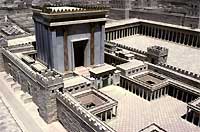
A model of the Second Temple destroyed by Titus in 70 CE
In the year 70, at the height of the Jewish revolt against Rome (66-73 CE), the Roman soldiers broke their thee-year siege of the Holy City of Jerusalem, leveling the city and destroying the Temple. With the fall of the Temple went Judaism as a sacrificial cult. In the decades that followed, one of the few remaining sects of the old Second-Temple Judaism, the Pharisees, began the arduous task of reinventing the Jewish faith and practice. The Judaism that rose like a phoenix from the ashes of smoldering Temple was fundamentally different from that of its forerunner. It was a faith focused entirely upon the "Book", the Hebrew Scriptures, that came to be seen as an inviolable compendium of divine revelation and the source of all wisdom. Along side this authoritative source, the founding fathers of Formative Judaism added further collections of teachings and interpretations deriving from some of the more important rabbinic schools of the Pharisees - the Mishnah and Talmud.

Another Jewish sect whom we might call Christian Jews was engaged in a similar process. They retained their scriptures and, like the Pharisees, added a further "testament" derived from some of their more important schools or communities. One of the reasons that the "New Testament" contains four gospels is because they each represent the gospel used in four of the most important centres in early Christianity. Matthew came from Syrian Antioch, the site of the first "Christian" community (Acts 11:26); Mark from Rome, which increasing grew in importance; Luke from the Pauline communities of Greece; and John from Christian Jewish communities in Asia Minor. The Acts of the Apostles, commonly attributed to the evangelist Luke, offers a view of early Christianity that traces the development of these important centres under the auspices of Peter, Paul and Barnabas.

This variety of texts may give the impression, and it is generally assumed, that the earliest Church was a diverse collection of various movements. This is certainly true, in part. Second-Temple Judaism was a similarly complex collection of various sects – Sadducees, Pharisees, Essenes, Zealots, and the followers of John the Baptist. The earliest Jesus movement seems to have drawn members from across the spectrum of these various other Jewish sects. But it is also significant that none of these early followers of the Jesus movement saw themselves as converting to a new religion. Christianity, a word that will not even appear until the first non-Jews join the movement (Acts 11:19-26), emerged first as just one more sect in the widely diverse spectrum of Second-Temple Judaism. And that fact alone was an important point of unity for all of these diverse Christian communities.

If we had to name one other Jewish group of the time that resembled the earliest Jesus Movement it would be the Essenes at Qumran, whose theology and faith practice can be reconstructed from the Dead Sea Scrolls. Similarly Acts 1-5 offers us an insight into the earliest community of believers in Jesus Messiah at Jerusalem. On the evidence of these two sources, it appears that both communities were consciously apocalyptic in their outlook. Conceiving of their respective communities as the climax of Judaism, the faithful remnant that was destined to constitute eschatological Israel, both communities lived according to a communistic ideal expressed in the sharing of resources and a common table.
breakingbread_200x188.jpg
Transparent1x1.gif
Transparent1x1.gif
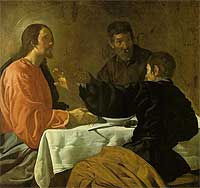
Breaking bread at Emmaus
Transparent1x1.gif
It is not entirely clear that Luke's "breaking of the bread" (2:42, 46; cf. 1 Cor 10:16) is meant as a reference to the Eucharistic celebration; although Luke does indicate elsewhere that this practice would become a central aspect of Christian fellowship (cf. Luke 24:25; Acts 20:7). Moreover, there are obvious parallels between the practice as described by Luke and that of Paul's description of the Lord's Supper in 1 Corinthians (11:17-34), which was similarly enacted in the context of a full communal meal (1 Cor 11:21-22, 33-34), celebrated frequently (Luke suggests both daily in Acts 2:46 and on the first day of the week in Acts 20:7), and involved the entire community (1 Cor 11:18). Such was the significance of the table fellowship in the earliest communities that it would become the instance for division at Antioch when Peter withdrew from sharing a common table with the Gentiles for fear of the circumcision putsch out of Jerusalem (Gal 2:12-13).

On the issue of the commonality of goods, Lukan idealism may have exaggerated the extent to which the Jerusalem church lived the common life. But the community's commitment to the communal ideal is confirmed implicitly in the numerous Pauline references to the "poor" in Jerusalem for whom he initiated a collection throughout his communities in Greece and Asia Minor (Gal 2:10; 1 Cor 16:1-4; Rom 15:25-28). Indeed, according to Galatians (2:10), the sole injunction laid upon Paul and Barnabas following the Jerusalem Council was "only that we remember the poor". It has been noted that the term hoi ptochoi (the Poor) used by Paul (Rom 15:26; Gal 2:10) may be drawn from the Hebrew word h'bywnym, which appears sporadically in the Dead Sea Scrolls as a self-designation of the Qumran community (1 QpHab 12:3, 6, 10; 1 QM 11:9, 13; 13:14). It is entirely possible that a similar title emerged early on at Jerusalem to describe this first community of messianic Jesus people who pooled their resources and established a quasi-monastic community in anticipation of the coming eschaton.

This appropriation of contemporary Jewish restoration theology is probably also implicit in the felt need to reconstitute the circle of the Twelve. It is noteworthy that the leadership of the Twelve at Jerusalem has been compared to the ruling council at Qumran, which was composed of twelve men and three priests - although it is uncertain if the three priests were distinct from the twelve (1QS 8:1). Whether or not one can draw a direct connection between the two organisational practices, it seems that for both communities the number twelve held eschatological significance. At Qumran, the War Scroll speaks of the division of the Sons of Light during the coming apocalyptic war into twelve armies representing the twelve tribes of Israel (1QM 3:13-14; 5:1-2). Within the primitive Christian movement, according to the earliest stratum of Gospel traditions derived from the hypothetical sayings source Q, the Twelve were thought destined to occupy the thrones of glory and judge the regathered twelve tribes of Israel (Lk 22:30; Matt 19:28). Later in Revelation (21:12-14), the Twelve Apostles are reckoned as the twelve foundation stones of the New Jerusalem, akin to the twelve gates upon which are written the names of the twelve tribes of Israel.

Remarkably, the Essenes never appear anywhere in the New Testament; although some scholars have thought that the gospel narratives on John the Baptist suggest that John may have been a member of this movement. Whatever the value of that line of speculation, however, it serves to remind us that Christianity did not emerge as a completely new and distinct religious movement until much later in its development. Along the way, the members of the Jesus Movement drew elements from a variety of Jewish beliefs and practices. Like its sister faith, Rabbinic Judaism, an important catalyst in that process was the Roman destruction of the Temple in 70 CE. Once separated from the former focus of their faith practice the Christian Jews, much like the Pharisaic Jews, were forced to reappraise their beliefs and liturgical praxis. It was only during that reformation that Christianity, as we know it, began to emerge as distinct from its Jewish matrix.
menorah_500x375.jpg
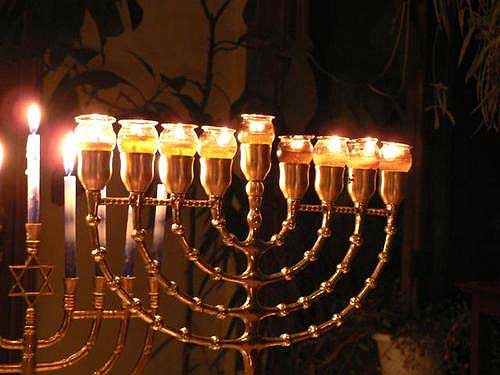
The menorah is a seven branched candelabra to be lit by Olive oil in the Tabernacle and the Temple in Jerusalem. The menorah is one of the oldest symbols of the Jewish people. It said to symbolize the burning bush as seen by Moses on mount Sinai (exodus 25). See Wikipedia for more information.

 
Back
Top