The Original Gay Porn Community - Free Gay Movies and Photos, Gay Porn Site Reviews and Adult Gay Forums

  • Welcome To Just Us Boys - The World's Largest Gay Message Board Community

    In order to comply with recent US Supreme Court rulings regarding adult content, we will be making changes in the future to require that you log into your account to view adult content on the site.
    If you do not have an account, please register.
    REGISTER HERE - 100% FREE / We Will Never Sell Your Info

    PLEASE READ: To register, turn off your VPN (iPhone users- disable iCloud); you can re-enable the VPN after registration. You must maintain an active email address on your account: disposable email addresses cannot be used to register.

Socialism is Good; Socialism is pro-life; Socialism is pro-People, pro-Planet

Communism and socialism are not synonymous.

Which is an unfortunate result of the complete abuse of the terms, by pretty much everybody. (socialist by those on the far right) One thing that every child in every high school in America should learn is the political spectrum (the visual version) that lays it all out.
 
Socialism is related mostly to economics and plays a part in your everyday life. Socialism is the sharing of common resources and worker ownership of the means of production. In this respect, unions fit into part of the definition of socialism. In your every day life, you drive on it on your way to work. You read from it at your local library. You have clean waterways to fish in. You live a free life when our soldiers are overseas. All these things are paid by taxes collected from everybody, a shared resource. We have a lot of socialist elements in our government and society, but that is different than complete socialism.

Communism is a family of political thought that believes in an egalitarian, classless society, with common ownership of property and complete socialist economic policy which is typically centrally managed by authoritarian government.

These are your own definitions. Historically what you call "communism" in the US was called usually called "socialism" by the communists.

Being a European, I very much resent the notion that 'socialism' is some holy system that just about everybody who called themselves socialist misunderstood.

Most of the notions the socialists have are inherently flawed. Socialism is what people who call themselves socialists do, in the same way Islam is what Muslims do.

What you are doing here is a version of the no true scotsman - fallacy. You are redefining socialism and communism ad hoc to suit your own beliefs.

The claim that fascism is "pro-planet" rather than communism/(other brands of) socialism is much better founded than the claim in the OP.
 
An American saying: "Why be normal?"

I would say that socialism must be pro-planet, etc. I don't apologize for redefinition. Everything dissolves in the rising tidal-deluge of human flesh.
And I would say that socialism must be intelligent enough to compete globally.
For instance, unionism should probably have influence commensurate with ownership.

The polluting versions of Eastern European and Russian socialism polluted in a context of the strong tea of desperation and paranoia, partly out of an undeveloped historical awareness. Or I would guess...you're the European, Harke.
 
What you are doing here is a version of the no true scotsman - fallacy. You are redefining socialism and communism ad hoc to suit your own beliefs.

See, this statement is hilarious because it's exactly what you're doing.

Harke, meet mirror.
 
Those definitions are quite standard, and I'm not trying to make any points at the moment. Thanks ..|

One thing that usually helps people is understanding socialism as a watered-down and less extreme version of communism. In fact, on the political spectrum, it makes it readily apparent that socialism is a 'stepping stone' of sorts to communism, though socialism most certainly does NOT necessarily lead to communism. (in the case of Lenin and Marx, however, socialism WAS the stepping stone towards the creation of the communist state)

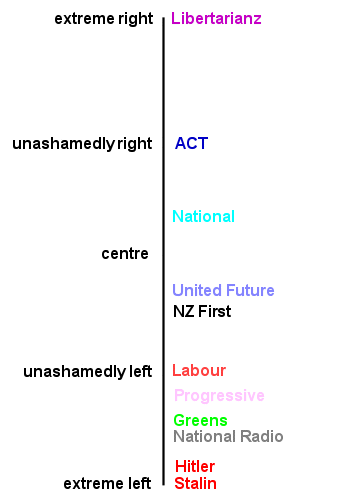
Here's a nice visual that sort of lines it up:

18290092_ac16e67711_o.gif


Here's a circular one, which is actually the most accurate representation, since the extreme left and extreme right are really actually quite close together.

political+spectrum.bmp
 
One thing that usually helps people is understanding socialism as a watered-down and less extreme version of communism. In fact, on the political spectrum, it makes it readily apparent that socialism is a 'stepping stone' of sorts to communism, though socialism most certainly does NOT necessarily lead to communism. (in the case of Lenin and Marx, however, socialism WAS the stepping stone towards the creation of the communist state)

Here's a circular one, which is actually the most accurate representation, since the extreme left and extreme right are really actually quite close together.

political+spectrum.bmp

The circular one is interesting -- good food for thought.
The vertical one is seriously lacking: Libertarian is not extreme right; it's extreme liberty, which is anathema to both left and right.
 
It appears in the circle that liberalism is a center political philosophy. Not in the US is isn't.

The vertical plotter is woefully inaccurate enough to be humorous.

The circle is weird.
Since when is "environmentalism" a political philosophy? or "Hedonism"? or "Parentism"? or Catholicism?

I tried to make sense of it, and decided that it looked like something you'd find in the margins of class notes of a bored college freshman wishing his economics professor would say something worth writing down.
 
Trying to pinpoint a label with which to describe your political philosophy is a frustrating and futile process. More important is to find out where you stand:

[STRIKE]hxxp://www.politicalcompass.org[/STRIKE]

Link (added by moderator): http://www.politicalcompass.org/
 
Trying to pinpoint a label with which to describe your political philosophy is a frustrating and futile process. More important is to find out where you stand:

http://www.politicalcompass.org

Oh, yes -- that's the one with questions so badly worded that answering them requires one to lie.
 
Kulin, I have to agree with you on an aforementioned point—Libertarianism isn't even close to being "extreme right". Furthermore, Hitler and Stalin being on the extreme left together is not even close to being accurate.

Whoever thought up that vertical table is full of it.

Full of something, or on something....


On the circle one, I'm still trying to figure out what "Parentism" is.


The problem with both those is that the underlying assumption is that the way delegates were seated in the French House of Deputies makes for a realistic description of the political process today. One-dimensional charts of politics don't make sense because no matter how you arrange it, things end up next to each other which are in reality very alien -- and the circle one is still one-dimensional.

That one does, though, by trying to include so many things, make clear that one dimension isn't sufficient. The one Xzilla7 offers is a step in the right direction, albeit a clumsy one because many of the questions are based on an assumption of one-dimensional alternatives.

The World's Smallest Political Quiz still stands as the best of them, yet even it -- with its "personal issues" and "economic issues" scales -- is insufficient to really describe a person. Just as an example, take two people who score 100/100, which charts as pure libertarian: they may still vehemently disagree on issue after issue. One may be (as has most of the Libertarian Party leadership been) a purist, refusing any compromise, while the other is willing to cut political deals so long as they move in the right direction; or one may be a revolutionary, advocating changing everything all at once, overnight, while the other may be a gradualist, seeing a need to progress step by step. That brings us to not just two axes, but four: personal issues, economic issues, pure believer, gradualism.

And it still leaves out religion, which ought to have its own scale, because two people who believe that religion should play a strong role in public life may totally disagree on that role -- one might believe that important religious principles should be enshrined in law, while the other that religious principles should not play any part at all in deciding law.

 
Back
Top