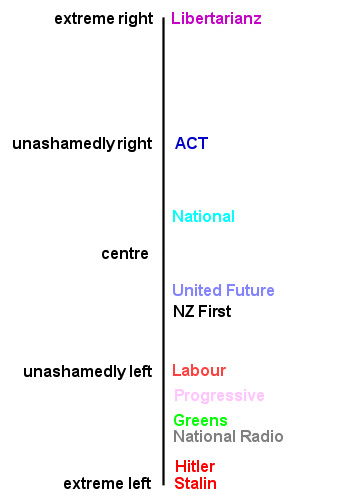
Kulin, I have to agree with you on an aforementioned point—Libertarianism isn't even close to being "extreme right". Furthermore, Hitler and Stalin being on the extreme left together is not even close to being accurate.
Whoever thought up that vertical table is full of it.
Full of something, or on something....
On the circle one, I'm still trying to figure out what "Parentism" is.
The problem with both those is that the underlying assumption is that the way delegates were seated in the French House of Deputies makes for a realistic description of the political process today. One-dimensional charts of politics don't make sense because no matter how you arrange it, things end up next to each other which are in reality very alien -- and the circle one is still one-dimensional.
That one does, though, by trying to include so many things, make clear that one dimension isn't sufficient. The one Xzilla7 offers is a step in the right direction, albeit a clumsy one because many of the questions are based on an assumption of one-dimensional alternatives.
The
World's Smallest Political Quiz still stands as the best of them, yet even it -- with its "personal issues" and "economic issues" scales -- is insufficient to really describe a person. Just as an example, take two people who score 100/100, which charts as pure libertarian: they may still vehemently disagree on issue after issue. One may be (as has most of the Libertarian Party leadership been) a purist, refusing any compromise, while the other is willing to cut political deals so long as they move in the right direction; or one may be a revolutionary, advocating changing everything all at once, overnight, while the other may be a gradualist, seeing a need to progress step by step. That brings us to not just two axes, but four: personal issues, economic issues, pure believer, gradualism.
And it still leaves out religion, which ought to have its own scale, because two people who believe that religion should play a strong role in public life may totally disagree on that role -- one might believe that important religious principles should be enshrined in law, while the other that religious principles should not play any part at all in deciding law.