The Original Gay Porn Community - Free Gay Movies and Photos, Gay Porn Site Reviews and Adult Gay Forums

  • Welcome To Just Us Boys - The World's Largest Gay Message Board Community

    In order to comply with recent US Supreme Court rulings regarding adult content, we will be making changes in the future to require that you log into your account to view adult content on the site.
    If you do not have an account, please register.
    REGISTER HERE - 100% FREE / We Will Never Sell Your Info

    PLEASE READ: To register, turn off your VPN (iPhone users- disable iCloud); you can re-enable the VPN after registration. You must maintain an active email address on your account: disposable email addresses cannot be used to register.

  • Hi Guest - Did you know?
    Hot Topics is a Safe for Work (SFW) forum.

The Bible Is Against Homosexuality

Sexuality isn't something that can be invented. It's human nature and has existed as long as mankind. Homosexuality as a set human nature predates the bible, only the terminology was invented later.

Why, you sound like you actually think there's something ahistorical, something timeless and eternal, that can be called 'human nature.'
 
Well, one of my degrees is a major in history. lol

One of mine was in divinity with further study in theology and philosophy of religion. ;)

My own philosophical genealogy runs from the the medieval Nominalists through Sade and Nietzsche to the post-structuralists. But I guess that's kind of obvious. :cool:
 
My history degree was in the history of war and European history. My university offers the two fields as one collective field- weird.

The theology study I did I did mostly as a hobby, and as part of my own religious beliefs. I started as a Catholic, went a little Pentecostal, then Baptist, and now I identify as an Anglican/United.
 
My history degree was in the history of war and European history. My university offers the two fields as one collective field- weird.

The theology study I did I did mostly as a hobby, and as part of my own religious beliefs. I started as a Catholic, went a little Pentecostal, then Baptist, and now I identify as an Anglican/United.

My degree was from Southwestern Baptist Theological Seminary. I was a Southern Baptist, and I cut my theological teeth on John Calvin's Institutes of the Christian Religion. Yeah, Calvin and Luther are in my genealogy, too. How could they not be? They were descendents of the Nominalists. And how could one really understand Nietzsche without some familiarity with Luther and the Reformation?

In any case, I agree that the Biblical texts in their original deployments contained no condemnation of modern gay life. The condemnation of the sin of Sodom (understood as carnal knowledge of men by men) really took off with John Chrysostom and finally found a synthesized construct in Peter Damian's invention of 'sodomy.' And sodomy was not co-extensive with homosexual activity. It included and excluded things that we would not. Masturbation, for example, was a form of sodomy in the medieval construct.
 
When I spoke to a Rabbi about Sodom, he told me that the sin in the story was actually the unwelcoming nature of the town. The desire to rape outsiders, to be unkind to strangers.

My minister at the United church agrees. Growing up Catholic, that struck me as a real shock. Thoughts?
 
When I spoke to a Rabbi about Sodom, he told me that the sin in the story was actually the unwelcoming nature of the town. The desire to rape outsiders, to be unkind to strangers.

My minister at the United church agrees. Growing up Catholic, that struck me as a real shock. Thoughts?

Your Rabbi is right. There were three protected classes in the Hebrew Scriptures--the widows, the fatherless, and the strangers. The sin of Sodom was its attempted violence against strangers.

When later biblical writers--and Jesus, too--refer to Sodom, it is often simply as an image of God's annihilating judgment. They see the sin of Sodom variously as pride and as injustice towards the powerless. Only Jude sees it as primarily sexual (although the sexual element is present in the story itself). In his epistle he relates it to sex between men and angels in keeping with the apocalyptic background of the epistle.

The biblical writers simply weren't the least concerned about the sex of the people in the Sodom story. Look at the Gibeah story in Judges 21 as a parallel. It's essentially the same story, but the victims at Gibeah were women, and they were raped and killed.
 
Look at the Gibeah story in Judges 21 as a parallel.

Correction: Judges 19. !oops!

everyone takes what they like from the bible and just ignores the parts they don't like....

very easy and practical....

I think that's pretty much what people do. For my part, I mostly ignore the whole thing. Still, it's interesting as an example of how canonical texts get redeployed. :cool:
 
The bible rightly and clearly is against heterosexuality. It is the very reason why Adam and Eve had to leave paradise.
 
Would someone please quote Leviticus 20:11 (commanding straight adulterers to be killed) and ask him when he plans to start petitioning the government to create criminal charges for adultery?

After all, we want a good ol'Bible-based legal system, right?
 
My degree was from Southwestern Baptist Theological Seminary. I was a Southern Baptist, and I cut my theological teeth on John Calvin's Institutes of the Christian Religion. Yeah, Calvin and Luther are in my genealogy, too. How could they not be? They were descendents of the Nominalists. And how could one really understand Nietzsche without some familiarity with Luther and the Reformation?

In any case, I agree that the Biblical texts in their original deployments contained no condemnation of modern gay life. The condemnation of the sin of Sodom (understood as carnal knowledge of men by men) really took off with John Chrysostom and finally found a synthesized construct in Peter Damian's invention of 'sodomy.' And sodomy was not co-extensive with homosexual activity. It included and excluded things that we would not. Masturbation, for example, was a form of sodomy in the medieval construct.
e10414c5c3ce46e1a42f5a6ddef16f40.gif

says, dang dude, you be all smart and stuff -- awesome!

I just have a plain ole secular education, but I did study Renaissance art and Michelangelo's contribution to the illiterate masses during my stint in graduate school. People don't realize that virtually everyone relied on pictures for their daily affirmation back then since only a handful of individuals could actually read. And they were mostly clergy.

Seriously though, thanks for the enlightenment bro.
 
Fuck the bible. Fuck the bible believers. And fuck their bronze age or earlier, god.

Never knew you were so against the bible and religion pianist. While this is a bad example to a certain extent faith can help people and guide them. Whether it be faith in themselves, faith in others or faith in something such as religion. It's when they take it word for word and pick and choose when it becomes bullshit. Oh and the preaching is annoying. They have over nine thousand followers. Like they really need to preach in every form possible to get even more.
 
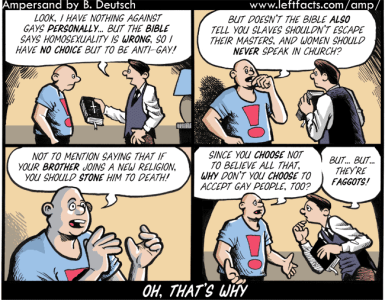
One can not just take those passages of the old covenant he/she likes then ignore the rest. One must take it all or none at all. See the clip. It is self-explanatory!


attachment.php
 

Attachments

  • oh_thats_why_color.png
    oh_thats_why_color.png
    70.8 KB · Views: 404
Faith, or belief in oneself, or others, those being friends, family, proven individuals is, in my opinion, not to be equated with faith in a god, gods, or relgious dogma or tenets.

The first two are substantive; the latter annecdotal at best. I can see, touch and hear me, and other corporeal beings, and can readily observe their behaviour; I have "faith" in my friends as they have, substantively proven themselves to be trustworthy and said proof is easily obvious to others, generally speaking.

And no, I don't believe in miracles. Huzzah and bully for those who do and profess to even have experienced them, but their annecdotal experience doesn't make it true regardless of HOW much they want it to be.

Certainly people are quite welcome to whatever relgious belief they want to hang their hat and hopes on, but I'm under no obligation to agree, or even respect it. I can respect them as people, dependant on their behaviour, but I don't have to respect their beliefs.

Truth be told, some of the most gracious and loving people I know don't profess to derive their morality from the pages of the bible.


I understand that faith doesn't have to be just about religion and can mean something different. That's rather interesting. You can understand the faith better in yourself and you're friends because you can feel the senses physically and through sight. I'm sure that's not the only reason but one of them.

It is much easier to comprehend and have faith in oneself, friends, and people around them. It's a lot harder to have faith in something that cannot be physically seen or (although some might object) felt. But even if you weren't using it in a religious context would you still disagree to not having faith in something you cannot feel, see, or hear. I'm not talking about spirits, ghosts, or even miracles. But surely there is much that is unknown to is in this world and there are things we cannot, hear, see, or understand. Whether it's because of our closed eyes, mind, heart, or just us being human it cannot be helped. But that doesn't necessarily mean that it's not there. Hell even a feeling. Think about people who search their lives for someone such as a partner, friend, or just someone. That person may not even exist and cannot be felt seen or heard but they press on and keep trying to find that person. Or maybe just that light. Yet they are encouraged and praised to keep trying in a similar way that people are praised an encouraged with religious faith.

Would that not be a little similar to believing and or hoping that a might all powerful being exists. I'm not saying you're wrong but I am just trying to understand you're point a little bit more and pick you're brain. I don't really believe in God or spirits but I still feel that there is a lot more out there than we realize and that closing our minds to it isn't the answer. But than again that's just my opinion. And just because it's out there doesn't mean I'm going to search for it all my life.

I'm not really sure if someone belief's should be respected. I think that's purely opinion regardless of the beliefs. I do sort of agree with you on that point.
 
Ahhh the bible.

I love debating Christians who quote to me from the Hebrew Scriptures (a.k.a. Old Testament or First Covenant).

The section of the bible that is known as "The Old Testament" was, in fact, the guide to creating a people of God -- the Jewish nation. If one interprets it literally, the world is but a few thousand years old and there can be no explanation for fossils, dinosaurs or many other things we know to be true.

The reason for its simplicity is that it was written as a guide to bring a group of individual people together to form a nation with belief in a single God. One had to follow all of the instructions to enter into and remain in "covenant" or relationship with God. There are scores of stories of what happened when the people fell out of that relationship; same for when they were in covenantal relationship.

But they couldn't pick and choose what they wanted and what they didn't; it was all or nothing. There were a series of instructs and "holy days (holidays)" which they had prescriptive instructions that continued the covenant.

Sexually, the intent of the instructions were to procreate; to build the nation for God. You didn't convert and if you weren't born into the covenantal community, you didn't just go through a ritual and join. It was thought that life began in the man's sperm and that he inserted it into the woman and injected a child. Persons who were barren or who couldn't bear children were thought to be cursed by God. Likewise, masturbation was forbidden because one would jack-off and spill babies all over that could be inserted into women and add to the population. It was the reason that concubines and others were accepted.

By the time of the "New Covenant," the religious had added instruction upon instruction (remember one of Jesus comments on the length of tassles?) There were literally hundreds of "add ons" to what was in scripture and it was virtually impossible to achieve.

So the New Covenant or Testament begins with "the Word." And the Word, became flesh...Jesus. His command? He didn't quote the old covenant instructions; he didn't add what had been included by the religious. He reduced it to two things: love for God; love for your neighbor.

It's hard to hate, it's hard to do anything wrong if you are in total love. All the other "things" become moot...love takes over. It is the same love that he mentions is heaven -- you don't need anything else because you will be surrounded and within total love (the reason for no husband, wife, or pets). Everything you would want, everything you would ever have is satisfied in total love.

Too many Christians have no idea where they came from or what the bible means. They like to cherry pick from each of the covenants, have not studied the Greek or original languages (and homosexual is not the translation of any of the "quotes" for which they cite.)

In the Greek it was very common for men to love men and then go home to a wife and procreate at night. Paul's cautions come from his Jewish roots (he was overruled that you didn't have to be circumcised to be in the New Covenant -- that was part of the first or old). He wanted people to procreate and cautioned against loving same sex because it did not create children.

It is also interesting that Paul was not married; that was shocking in the Jewish society. Likewise, Jesus not being married would have automatically put them under scrutiny. Males should have been married (or betrothed) by 14 to 16 and started having lots of babies.

Study of the scriptures can be quite fascinating for what IS NOT there but has been added by people who really have no clue what was indeed written.
 
Jesus even healed a man's lover- later rewritten as his 'servant'.

it was very common for Roman aristocracy and soldiers to have young male slaves. . .and yes, they had sex with them. Also, all but one Roman emperor has a young male lover in addition to their wife. . .and the guy who didn't was thought of as a weirdo because of it.


When I spoke to a Rabbi about Sodom, he told me that the sin in the story was actually the unwelcoming nature of the town. The desire to rape outsiders, to be unkind to strangers.

My minister at the United church agrees. Growing up Catholic, that struck me as a real shock. Thoughts?


The final straw was when they attempted to rape the angels who were sent to the city. After Lot and his daughters fled the city, they hid out in a cave. Wondering. In an effort to continue the family's bloodline, his daughters got him drunk and took turned having sex with him until they got pregnant.


What a wholesome and lovely book!
 
Back
Top