



kallipolis
Know thyself
A lawyer asks Jesus, who is my neighbour? The lawyer's question entails defining the boundaries of his responsibility.
The parable of The Good Samaritan transforms our black, and white world of easy understandings on the meaning of good neighbourliness into an invitation to embrace our enemies, and the marginalised of our society that we may know that our neighbour is the entire human race.
Jesus does not appeal to the stereotypical role model to illustrate the meaning of good neighbourliness, rather he paints a disturbing picture of a priest, and a levite ignoring calls for help from an injured man way-laid by thieves.
The two travellers from whom society would expect practical help under such circumstances, choose to cross the road and go on their merry way, leaving an innocent victim of robbery, and violence to die.
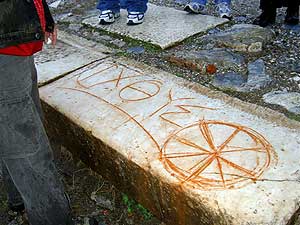

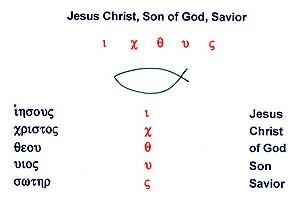
The Ichthus inscription at Ephesus
Jesus introduces an enemy of the Jews, a Samaritan into his story to challenge deeply ingrained stereotypical behaviour, that only those from within our community should be recognised as our neighbour.
In widening our concept of our neighbour, Jesus creates a hero out of a Samaritan whom the Jews stereotyped as unworthy, and beneath their status as God's chosen people dedicated to serving the Mosaic Laws.
Jesus invited his audience to embrace those who traditionally are marginalised outside the boundaries of a society; whose tribal customs, and history has created enemies of those who do not conveniently fit into the acceptable pattern of human behaviour expected by law abiding Jews.
Jesus practised all that he preached, when socialising with the marginalised of Jewish society, including tax collectors, prostitutes, Samaritans, the sick and mentally disturbed, Gentiles, debtors, children of the streets and all those who Jewish society determined were beyond the boundaries set by the self-righteous person.
Jesus never shunned a human being who did not fit into the acceptable mould of the self imagined righteous person, rather he went out of his way to socialise with all who would welcome him into their homes, and in so doing Jesus reminds each of us that his love, is never limited by the perceptions of those who believe that they are more deserving than others.
The parable of The Good Samaritan transforms our black, and white world of easy understandings on the meaning of good neighbourliness into an invitation to embrace our enemies, and the marginalised of our society that we may know that our neighbour is the entire human race.
Jesus does not appeal to the stereotypical role model to illustrate the meaning of good neighbourliness, rather he paints a disturbing picture of a priest, and a levite ignoring calls for help from an injured man way-laid by thieves.
The two travellers from whom society would expect practical help under such circumstances, choose to cross the road and go on their merry way, leaving an innocent victim of robbery, and violence to die.
The Ichthus inscription at Ephesus
Jesus introduces an enemy of the Jews, a Samaritan into his story to challenge deeply ingrained stereotypical behaviour, that only those from within our community should be recognised as our neighbour.
In widening our concept of our neighbour, Jesus creates a hero out of a Samaritan whom the Jews stereotyped as unworthy, and beneath their status as God's chosen people dedicated to serving the Mosaic Laws.
Jesus invited his audience to embrace those who traditionally are marginalised outside the boundaries of a society; whose tribal customs, and history has created enemies of those who do not conveniently fit into the acceptable pattern of human behaviour expected by law abiding Jews.
The actions of the Samaritan in assisting an injured Jew further surprises Jesus' listening audience, for not only does the Samaritan transport the Jew to an inn for treatment and convalescence; but he also pays the inn keeper in advance for the injured man's board and lodging.
Jesus teaches his audience that good neighbourliness is much more than kind words; he also widens the concept of neighbour not only to include the object of love, but also the focus of our love. A neighbour should have mercy, sympathy and love revealed in deeds, rather than in words that speak of good intentions.
Jesus practised all that he preached, when socialising with the marginalised of Jewish society, including tax collectors, prostitutes, Samaritans, the sick and mentally disturbed, Gentiles, debtors, children of the streets and all those who Jewish society determined were beyond the boundaries set by the self-righteous person.
Jesus never shunned a human being who did not fit into the acceptable mould of the self imagined righteous person, rather he went out of his way to socialise with all who would welcome him into their homes, and in so doing Jesus reminds each of us that his love, is never limited by the perceptions of those who believe that they are more deserving than others.
In the parable of The Good Samaritan there are six characters, whom Jesus brings to life, but only one who actively loves his neighbour, as he would expect to be loved were he to become the victim of life's many tragedies.
In reminding his audience that an enemy of the Jews set the example of a good neighbour, Jesus invites each of us to go, and do likewise.
If I were to try and characterise Jesus' wise words, it would be to say that they amounted to a radicalisation of the Mosaic Law — a reinterpretation that emphasised mercy and compassion over judgement and condemnation.
end

