T-Rexx
JUB Addict
- Joined
- Dec 21, 2009
- Posts
- 6,026
- Reaction score
- 0
- Points
- 0
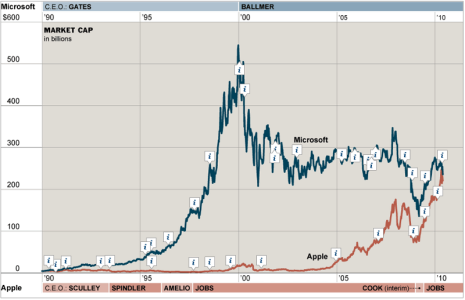
On Wednesday (26 May 2010), Microsoft's stock price dropped 4%. That caused Mcrosoft's market capitalization to drop below that of Apple's ($219 billion for Microsoft vs $222 billion for Apple). In other words, Apple is now bigger than Microsoft, for the first time in more than two decades.
In truth, the two companies are neck and neck in vying for status as America's second largest company (after Exxon Mobile). Market fluctuations could reverse which company is standing on top tomorrow. But, Apple has experienced dramatic, persistent growth over the past five years while Microsoft has stagnated for a decade. The pace of Apple's growth has been astounding. In the last two years, Apple has nearly trebled in size, while Microsoft has remained unchanged.

Apple has introduced one outstandingly successful product after another, while Microsoft has suffered a string of relative failures: iPod, iPhone, iPad, iTunes store vs Zune, Vista, Courier, and Windows Mobile. The HP Slate, which Steve Ballmer proudly showed off at CES as an upcoming Windows 7 success, has been delayed and may be converted to WebOS Linux. Windows Mobile has dropped to just 6.8% of smart phone market share, down from 10.4% last year. Windows Mobile is now in FIFTH place amongst smart phone OSs, behind Nokia, RIM, Apple, and Android. And Windows Mobile's long-overdue replacement, Windows Phone 7, won't be here for a few more months. It will have to struggle against firmly-entrenched and more dominant competitors when it arrives.
Microsoft continues to generate far more profit than Apple as a result of its Windows and Office monopolies. But Windows and Office account for most of Microsoft's profits, and that's not necessarily good for the long term future of the company. While Microsoft has been extremely successful in defending the monopoly position of its franchises, the future may not lie in proprietary desktop software applications. The decision by the market yesterday to value Apple above Microsoft is essentially a bet on the future. Apple dominates the mobile computing space, which Microsoft seems unable to crack. But mobile computing would seem to represent the obvious future of technology. Microsoft's success at defending its monopolies may not mean much, in the long run. These may soon become as useful as monopolies on buggy whips, whale oil lamps, and telegraph keys.
http://blogs.wsj.com/digits/2010/05...f-microsoft-in-the-market/?mod=wsj_india_main
http://www.nytimes.com/2010/05/27/technology/27apple.html
In truth, the two companies are neck and neck in vying for status as America's second largest company (after Exxon Mobile). Market fluctuations could reverse which company is standing on top tomorrow. But, Apple has experienced dramatic, persistent growth over the past five years while Microsoft has stagnated for a decade. The pace of Apple's growth has been astounding. In the last two years, Apple has nearly trebled in size, while Microsoft has remained unchanged.
Apple has introduced one outstandingly successful product after another, while Microsoft has suffered a string of relative failures: iPod, iPhone, iPad, iTunes store vs Zune, Vista, Courier, and Windows Mobile. The HP Slate, which Steve Ballmer proudly showed off at CES as an upcoming Windows 7 success, has been delayed and may be converted to WebOS Linux. Windows Mobile has dropped to just 6.8% of smart phone market share, down from 10.4% last year. Windows Mobile is now in FIFTH place amongst smart phone OSs, behind Nokia, RIM, Apple, and Android. And Windows Mobile's long-overdue replacement, Windows Phone 7, won't be here for a few more months. It will have to struggle against firmly-entrenched and more dominant competitors when it arrives.
Microsoft continues to generate far more profit than Apple as a result of its Windows and Office monopolies. But Windows and Office account for most of Microsoft's profits, and that's not necessarily good for the long term future of the company. While Microsoft has been extremely successful in defending the monopoly position of its franchises, the future may not lie in proprietary desktop software applications. The decision by the market yesterday to value Apple above Microsoft is essentially a bet on the future. Apple dominates the mobile computing space, which Microsoft seems unable to crack. But mobile computing would seem to represent the obvious future of technology. Microsoft's success at defending its monopolies may not mean much, in the long run. These may soon become as useful as monopolies on buggy whips, whale oil lamps, and telegraph keys.
http://blogs.wsj.com/digits/2010/05...f-microsoft-in-the-market/?mod=wsj_india_main
http://www.nytimes.com/2010/05/27/technology/27apple.html