

- Joined
- Jan 15, 2006
- Posts
- 122,930
- Reaction score
- 4,419
- Points
- 113
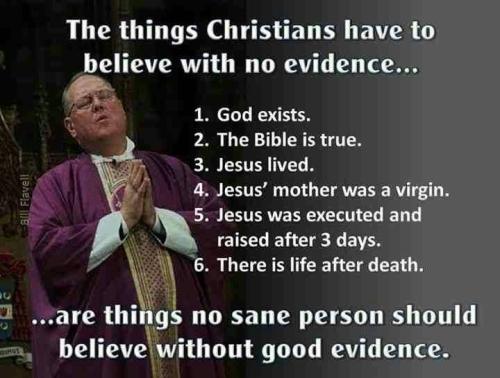
Be honest -- what you mean is evidence that you're willing to accept. Your case is very simple because you exclude anything that doesn't help it.


PLEASE READ: To register, turn off your VPN (iPhone users- disable iCloud); you can re-enable the VPN after registration. You must maintain an active email address on your account: disposable email addresses cannot be used to register.
If you were, you'd understand that it was a conditional premise, the truth of which one doesn't need to accept, which leads to the observation being made. To me it seems that you just don't like the observation that God asks man what he can't do himself. So you just ignore and/or attack the contingency on which it is based. Lazy and defensive thinking.
I drew out the nonsense inherent in your original metaphor.
So inconsistent eye witness accounts prove the truth of what what witness? Piffle. More of the endless apologias for obvious mistakes, inconsistencies and things that don't make sense.
A different standard because one is dealing with different issues, immutability/choice, etc.
I won't lie i've been drinking a lot tonight, but the more you try to justify christian beliefs, the more an atheistic approach makes sense. Or at least an agnostic approach "I don't know". Scriptures as messed up, logistically speaking.
Your thinking just doesn't hold up. Antisemitism in Shylock can be analyzed both within the apparent values of the play and by external moral principles. OK one shouldn't pretend to be doing one thing while doing the other. But the two approaches aren't mutually exclusive. The one can, and should, supplement the other. In the case of religious writings, they can be both internally contradictory and reprehensible by any reasonable or scientific outside standard. Or not as the case may be.
Be honest -- what you mean is evidence that you're willing to accept. Your case is very simple because you exclude anything that doesn't help it.
That is christianity in it's simplest terms...
I have not anywhere in this thread tried to justify any Christian beliefs. All I am doing is insisting on accuracy and logic. I do the same thing for science, politics, etc., regardless of whether I support someone or some religion or not.
I have also pounced on inaccuracies in insults to Islam.
And logically speaking (I presume that's what you meant) the Christian scriptures are a consistent whole. They just have to be read in their entirety instead of, as a great number of the attacks on them do, picking and choosing.
And I suspect you include everything that you would never accept to prove anything else. Much of theism is faith based so the better response to the picture would seem to be that faith isn't based on evidence. Most folk get it that there is more out there than one can prove or figure out.
"My" thinking is just the rules of logical critical thought. That's all I have argued for here and in the FARIP thread before it was given special status.
And since most of your paragraph above actually describes my thinking, you plainly don't disagree with it.
Faith is based on evidence, at least the faith the Bible talks about. The whole point of Paul's writings in the New Testament is that the whole thing rests on evidence.
That's why the great Creeds of Christianity all give historical events: the entire thing rests on evidence. And it's strong evidence, enough to convince professionals in the fields of investigation and history in every generation who have set out to prove it wrong that it isn't wrong after all. As a French historian in the eighteenth century put it, the evidence unavoidably 'convicts' Jesus of having risen from the dead -- a historian who started as an atheist who set out to prove it was all nonsense.
So what you're saying is that it has nothing to do with any actual religion, it's just a sheer hypothetical spun out of thin air.
If it's dealing with a specific religion, then I can't find the religion it deals with -- it certainly isn't one associated with the Bible. If it's attempting to address the Bible, then the original premise is false.
So once again you're supporting argument based on falsehood, without any concern for the rules of logic.
No, you departed from the point of discussion. A metaphor has one point of comparison; twisting it to try to do something else is not legitimate.
It's no apology -- that's how eye-witness accounts are evaluated. It basic criminology: when accounts match perfectly, they're suspect. A set of accounts which agree substantially but not on every detail are more likely to be actual eyewitness accounts than a set of accounts which are in perfect agreement.
There's a book by an investigator who became a Christian after setting out to apply the modern methods of investigation to make a case against Christianity. His unwanted result was that the Gospels have all the marks looked for in a courtroom of solid eyewitness testimony, and he was forced to conclude that in a modern court of law the case for the Resurrection is stronger than most cases proved in courts. It sets out the criteria for sound eyewitness testimony, and shows how he had to admit that the Gospels fit them. I'm just relating one of those criteria.
For that matter, it's also a principle in assessing the reliability of ancient documents as approached by historians: people engaged in a conspiracy to put over some take strive to make it all look as good as possible, so when things are all rosily consistent and there are no flaws in any of the characters presented, the accounts are suspect.
But a double standard because it allows for free insult to religion. People here get away with slurs against religion that wouldn't be tolerated for anything else.


