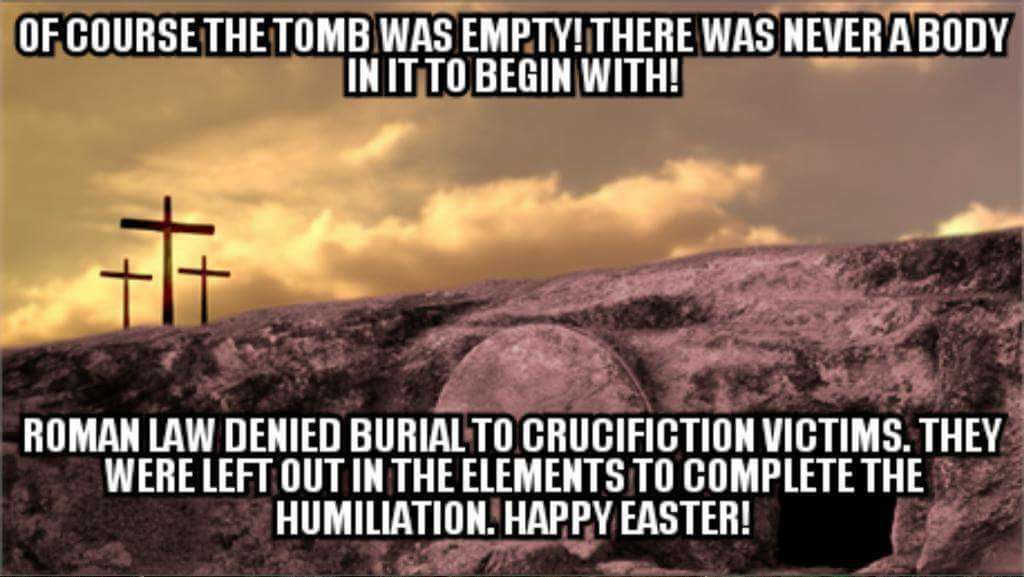
This is plainly not a settled matter amongst scholars, although I expect it will be contended that any scholar that doesn't accept the physical resuscitation of Jesus isn't following the rules, or is stupid or is "lying".
Nor is this thread conducted on the usual principles of rational discourse.
I think it's nice that Spensed is engaging in critical thinking. But something else entirely is going on that can't be remedied with such.
Spensed is engaging in a lot of dodging critical thinking, especially in his failure to acknowledge established scholarship and in his employment of a priori assumptions.
As for scholars, there's a huge gulf among what pass for New Testament scholars, and it's behind a lot of the silliness in what has passed for theology for the last sixty years or so: on one side are the 'document' scholars who spin theories about how documents develop, with little regard for any actual study of the history of how documents develop -- a game I learned to play at the graduate level, with results such as declaring that the book/scroll of Joshua is an ancient tourist guide to central Canaan or that the letters we know as Paul's were written by as many as four different people; on the other side are historians who look at not just documents but the whole array of sources of historical materials. The former tend to come with an
a priori assumption that there is nothing supernatural, and often a further one that no one does anything except for his own profit, and so end up spinning what in any other field would be called conspiracy theories about the texts -- and that is where the disagreement about the Resurrection almost invariably comes from. The historians who doubt the Resurrection often work from the same two
a priori assumptions, and so deny the possibility not on the basis of the evidence but on philosophical grounds.
A good example is the "Jesus Seminar", which has been clearly shown to operate far more on subjective notions than on historical scholarship. Every one of them assumes without examination that there can be no miracles, no prophecy, no special knowledge, and that blinds them from examining the texts the same way they would any others.
In contrast, when I came to the Gospels I had decided from science that there was a Creator, so I didn't have a closed mind about the supernatural -- I had no reason to believe a Creator
wouldn't poke His finger, so to speak, into Creation, as it seems irrational that such an entity would churn out this whole universe and make no attempt to communicate to intelligent creatures within it.