The Original Gay Porn Community - Free Gay Movies and Photos, Gay Porn Site Reviews and Adult Gay Forums

  • Welcome To Just Us Boys - The World's Largest Gay Message Board Community

    In order to comply with recent US Supreme Court rulings regarding adult content, we will be making changes in the future to require that you log into your account to view adult content on the site.
    If you do not have an account, please register.
    REGISTER HERE - 100% FREE / We Will Never Sell Your Info

    PLEASE READ: To register, turn off your VPN (iPhone users- disable iCloud); you can re-enable the VPN after registration. You must maintain an active email address on your account: disposable email addresses cannot be used to register.

  • Hi Guest - Did you know?
    Hot Topics is a Safe for Work (SFW) forum.

Discussion Thread from the Funny Anti-Religious Pictures thread.

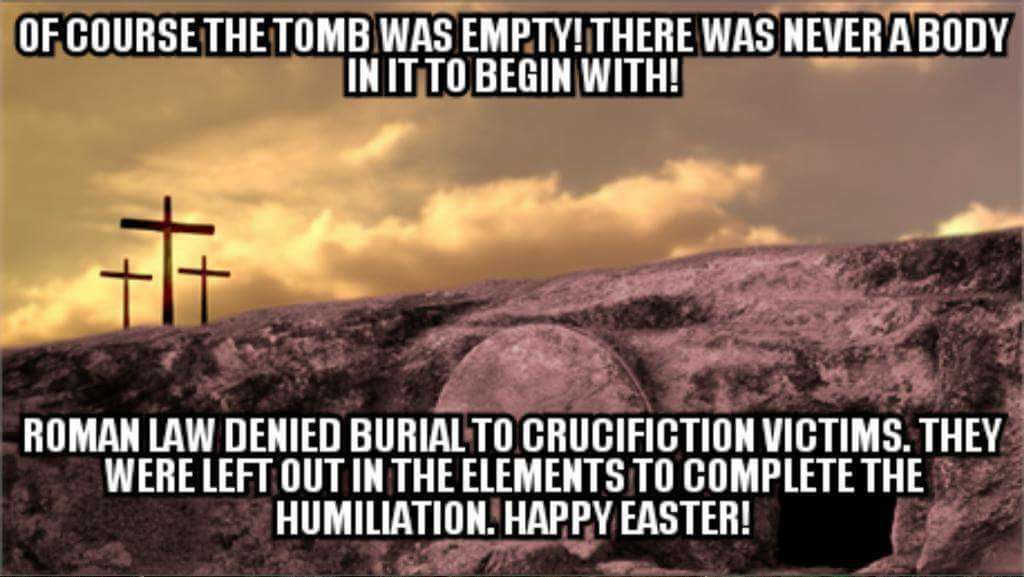
tumblr_oo3aieXq071vd9az6o1_1280.jpg

That's historically false. Criminals were denied burial, but Jesus was not crucified as a criminal. And even if He had been, the Jews had special status that allowed them to follow their religious law, and that would only have excluded Jess from being buried in his family tomb.
 

Actually the third, fifth, sixth and seventh are examples of Christians following the Bible. If this was directed at Jews, you'd have a point, but the only rules from the Old Testament that apply to Christians, according to the Bible, are these:

eating blood or meat containing blood
eating meat of animals not properly slain
fornication
idolatry

That's it, according to the Bible.
 
... I approached them as I would any other ancient document, and the result is that on the basis of accepted rules of scholarship it has to be concluded that Jesus rose from the dead.
...

This is plainly not a settled matter amongst scholars, although I expect it will be contended that any scholar that doesn't accept the physical resuscitation of Jesus isn't following the rules, or is stupid or is "lying".

Nor is this thread conducted on the usual principles of rational discourse.

I think it's nice that Spensed is engaging in critical thinking. But something else entirely is going on that can't be remedied with such.
 
Dawkins is neither a historian or any other kind of ancient religion scholar. ....

not convinced that you are, either, sport..


what degrees do you hold? ( and in what areas) and are they from accredited schools?
are you a phd?
do you publish?
are you, or have you ever been, on the faculty of any college, university, or public school system? (not talking about tutoring, grading papers for a professor or covering a few classes for him God knows how many years ago, etc.)


here's an idea...if you're the ''scholar" that you claim to be, why not go head to head against some of the heavy hitters who post in the political, spiritual/religious, history/archaeology threads here. You'll get a run for your money
http://www.unexplained-mysteries.com/forum/

oh, and if you're up for the challenge, be prepared to provide sources/ evidence.

there'll be none of that "I'm-not-going-to-do-your-work-for-you" nonsense with these people


let's see how you do up against the big boys
 
^^ Yes! Definitely this! All claims should be verifiable.
 
This is plainly not a settled matter amongst scholars, although I expect it will be contended that any scholar that doesn't accept the physical resuscitation of Jesus isn't following the rules, or is stupid or is "lying".

Nor is this thread conducted on the usual principles of rational discourse.

I think it's nice that Spensed is engaging in critical thinking. But something else entirely is going on that can't be remedied with such.

Spensed is engaging in a lot of dodging critical thinking, especially in his failure to acknowledge established scholarship and in his employment of a priori assumptions.

As for scholars, there's a huge gulf among what pass for New Testament scholars, and it's behind a lot of the silliness in what has passed for theology for the last sixty years or so: on one side are the 'document' scholars who spin theories about how documents develop, with little regard for any actual study of the history of how documents develop -- a game I learned to play at the graduate level, with results such as declaring that the book/scroll of Joshua is an ancient tourist guide to central Canaan or that the letters we know as Paul's were written by as many as four different people; on the other side are historians who look at not just documents but the whole array of sources of historical materials. The former tend to come with an a priori assumption that there is nothing supernatural, and often a further one that no one does anything except for his own profit, and so end up spinning what in any other field would be called conspiracy theories about the texts -- and that is where the disagreement about the Resurrection almost invariably comes from. The historians who doubt the Resurrection often work from the same two a priori assumptions, and so deny the possibility not on the basis of the evidence but on philosophical grounds.

A good example is the "Jesus Seminar", which has been clearly shown to operate far more on subjective notions than on historical scholarship. Every one of them assumes without examination that there can be no miracles, no prophecy, no special knowledge, and that blinds them from examining the texts the same way they would any others.

In contrast, when I came to the Gospels I had decided from science that there was a Creator, so I didn't have a closed mind about the supernatural -- I had no reason to believe a Creator wouldn't poke His finger, so to speak, into Creation, as it seems irrational that such an entity would churn out this whole universe and make no attempt to communicate to intelligent creatures within it.

 
not convinced that you are, either, sport..


what degrees do you hold? ( and in what areas) and are they from accredited schools?
are you a phd?
do you publish?
are you, or have you ever been, on the faculty of any college, university, or public school system? (not talking about tutoring, grading papers for a professor or covering a few classes for him God knows how many years ago, etc.)

Ph.D.? No -- I got tired of classrooms and stopped at a Master's, after my B.A. in biblical languages. My professors weren't happy with that; both my thesis advisor and academic advisor thought I should go on and end up teaching.

here's an idea...if you're the ''scholar" that you claim to be, why not go head to head against some of the heavy hitters who post in the political, spiritual/religious, history/archaeology threads here. You'll get a run for your money
http://www.unexplained-mysteries.com/forum/

oh, and if you're up for the challenge, be prepared to provide sources/ evidence.

there'll be none of that "I'm-not-going-to-do-your-work-for-you" nonsense with these people


let's see how you do up against the big boys

Been there, done that, got made a moderator, got tired of it. I haven't seen that forum, though, so I may take a look.

Come to think of it, having been a moderator may have prejudiced me as far as the FARIP thread -- we had MUCH higher standards of respect (and of documentation, which people in that thread plainly abhor).
 
Ph.D.? No -- I got tired of classrooms and stopped at a Master's, after my B.A. in biblical languages. My professors weren't happy with that; both my thesis advisor and academic advisor thought I should go on and end up teaching.

And... what was your Master's in?

Which accredited school did you go to?

What were your grades?

What have you published?
 
Calling it hearsay rejects the fact that oral-transmission societies have kept the accounts identical word-for-word for generations. It ignores the cultural difference, in fact throws it out and imposes one cultural view on another.

Lied? Not credible. Duped? Also not credible. In order to conclude either of those to be the case it's necessary to ignore the culture of the people under discussion.

And you continue to present a false statement. The only cause can be an irrational prejudice giving an a priori assumption that has the relationship totally backwards.

You never address the central issue. Even if you believe that oral transmissions can be accurately transmitted for generations (a big if), you do not know whether what is being transmitted is true or false as to its source. Garbage in and garbage out. Nothing to do with imposing cultural views, just common sense and standard legal safeguards.
 
Because they believe without that specific evidence. Make up hoops if you like them, but I'm just addressing the text.

But your claim is empty: children have evidence.

And sure "faith need not have an evidence requirement" -- but we're talking about what the Bible means by faith, and according to both prophets and apostles, faith rests on evidence.

I exclude faith-driven notions. So stop the lying.

Disagreeing with your buffet scholarship and asserted certainties isn't lying. It's just challenging your preconceived conclusions.
 
I'm following standard scholarship. He is operating on the basis of an a priori prejudice.

Operating on the standard basis of evaluating ancient sources, the Gospels stand up more strongly than anything until almost the printing press. The ONLY reason that is denied is because of pre-judging due to their being religious material. I approached them as I would any other ancient document, and the result is that on the basis of accepted rules of scholarship it has to be concluded that Jesus rose from the dead. The only possible reason to reject that is because of some prejudice.

I follow where the evidence leads, and on the basis of both historical scholarship and accepted rules of evidence, the conclusion that what the Apostles preached -- things we know even without looking to the Gospels -- is true. As I said, I often want to reject that, but applying critical thinking excludes that option -- the evidence is too strong.

You're confusing two different issues. Even though one may have doubts about it, one doesn't have to challenge your notions of standard scholarship as to the historical chain of title that you assert. All one needs to do is to point to the fact that you have no way of knowing whether what was reported initially actually happened or not. The integrity of the transmission process you seem to put so much faith into is worthless if elements like the resurrection were made up by wishful thinking believers. Maybe all those elements did happen to source their historical transmission. But maybe they didn't. That you can't accept any doubt or uncertainty on that issue tells one that your considerations are faith orientated. Nothing wrong with that and good luck to you if you have the strength of faith that you appear to. But don't expect to convince others, who may be a tad more skeptical and questioning.
 
Funny you should post that, since the whole FARIP thread eagerly avoids actual scrutiny -- your last two posts being superb examples of that.

There is no requirement that funny pictures or cartoons withstand "actual scrutiny". They are attempts, not always successful, at humor. They can be glib, based on false premises, etc., all the things you seem to take exception to. They don't need to fit into anyone's preconceptions. As soon as you understand that, you'll feel a lot better. Teehee.
 
...it seems irrational that such an entity would churn out this whole universe and make no attempt to communicate to intelligent creatures within it.


A purely subjective temporal observation. Objectively, the reverse is just as irrational. The truth is that ultimately one simply cannot know either way with any absolute certainty. One can have faith and encompass that unknowable.
 
You never address the central issue. Even if you believe that oral transmissions can be accurately transmitted for generations (a big if), you do not know whether what is being transmitted is true or false as to its source. Garbage in and garbage out. Nothing to do with imposing cultural views, just common sense and standard legal safeguards.

No, it isn't "common sense", or if it is, it's just another example of where common sense fails: it's known that certain oral-tradition cultures have passed on accounts word-for-word for generations.

And stop changing the subject: your claim was that such transmission is not accurate, which is a false based on your cultural experience, so don't switch to a different claim.
 
Disagreeing with your buffet scholarship and asserted certainties isn't lying. It's just challenging your preconceived conclusions.

It's not "buffet scholarship" -- it's standard scholarship.

And yes, you're lying, because you keep falsely stating something you've been told otherwise. Your second sentence just does it again -- it's contrary to the evidence and thus just your personal prejudice.
 
Back
Top