The Original Gay Porn Community - Free Gay Movies and Photos, Gay Porn Site Reviews and Adult Gay Forums

  • Welcome To Just Us Boys - The World's Largest Gay Message Board Community

    In order to comply with recent US Supreme Court rulings regarding adult content, we will be making changes in the future to require that you log into your account to view adult content on the site.
    If you do not have an account, please register.
    REGISTER HERE - 100% FREE / We Will Never Sell Your Info

    PLEASE READ: To register, turn off your VPN (iPhone users- disable iCloud); you can re-enable the VPN after registration. You must maintain an active email address on your account: disposable email addresses cannot be used to register.

  • Hi Guest - Did you know?
    Hot Topics is a Safe for Work (SFW) forum.

Discussion Thread from the Funny Anti-Religious Pictures thread.

Countless religions have gone before. The surviving ones don't mean their any more right that those which have passed us by. I'd say the Ancient Egyptians had one of the longest religious cultures on the planet, four thousand or so years long, and their gods are not worshipped anymore. One would think therefore that that in future times, the religions of the world today will be consigned to the dustbin of history too.

Yeah, the god in the Bible is just as anthropomorphic as any other god.

Whether crucified on a cross, or chopped into pieces and buried in a chest, or castrated and nailed to a tree, it's the same mythical archetypes and story patterns created by ancient man and circulated over and over again, each times changing the details slightly but retaining the same essence.

BTW, Jesus wasn't the only god who is supposed to have been crucified.
 
1b05906ed7bf032020aa6aac8ad538c96207b9116401e941c1ed319b6a287fd3.jpg

You did that one before. It's still based on ignorance due to a bad translation.

I've actually never quite understood that one; the scholars who did the King James translation knew better, as did most other translators into English, yet no English translation got it right until the late seventeenth century! Even Martin Luther, whose Hebrew knowledge was as good as that of the King James translators later, used the wrong word (IIRC "toten" rather than "murdren", but my German is barely grade-school level).

Besides the goof in "The love of money is the root of all evil" (instead of the accurate "all kinds of evil"), this error has caused more trouble than any other. If the point is making fun of the translators who darned well knew better, then the cartoon is good -- but without making that clear, it's at best sloppy.
 
Countless religions have gone before. The surviving ones don't mean their any more right that those which have passed us by. I'd say the Ancient Egyptians had one of the longest religious cultures on the planet, four thousand or so years long, and their gods are not worshipped anymore. One would think therefore that that in future times, the religions of the world today will be consigned to the dustbin of history too.

From wikipedia on blashemy law


Incompatible with the safety and wellbeing of individuals and freedom of expression. That is damning for all it's simplicity.

No relevance at all to my post you quoted.

???
 
BTW, Jesus wasn't the only god who is supposed to have been crucified.

I know there's a list of about a dozen and a half alleged crucified gods, but on examination it turns out that half or better only have attestation from after Christ, and for a couple the only attestation is from a late seventeenth-century writer who gave no sources. Others come from Frazer's The Golden Bough, but later scholarship has shown he played fast and loose with the original material, basically forcing it to fit into an invented category of "dying and rising gods", in fact again mostly based on texts coming from much later than the Gospels. In fact, examination of these claims using the Encyclopedia of Religion (MacMillan, 1996) shows that noen of the claims holds up.

There's a thorough and detailed discussion of the matter here.
 
Yeah, the god in the Bible is just as anthropomorphic as any other god.

He can certainly be treated that way, given the human tendency to diminish God to the level of our understanding, and given the fact that any attempt to explain what is greater than we are is always going to use referents also used to describe us (part of what is called "the problem of language" by theologians). But He is also most definitely beyond anthropomorphic, such as in the name given to Moses, "I Am that Am', which describes God as the originator of His own Being, something that definitely goes beyond humans, who are plainly contingent beings.
 

Heh. St. John Chrysostom would love that one -- he's the originator of the idea that the path to hell is paved with the bones of preachers, though the imagery actually goes back to the Old Testament where the prophets speak of Israel's appointed shepherds feeding off the flock rather than feeding it.
 
Which He could say because He'd given them plenty of evidence already. So this is a statement about those who come to faith on less than the ultimate evidence.

Then why bother parsing degrees of evidence? Your explanation makes no sense.
 
Then why bother parsing degrees of evidence? Your explanation makes no sense.

It makes perfect sense: you missed something that I forgot -- the others believed because they already had the evidence. Thomas hadn't been there, so Jesus provided the evidence for him more personally. In both cases, they believed because of evidence.
 
But Rome had nothing to do with it -- no authoritarian heirarchy did. The canon was approved by people on the ground, often people who had known Jesus, who knew the Apostles, weighing in on what fit with what the eyewitnesses had handed down. The Gospel writers didn't get to spin anything; they could only write what was validated by the combined witness of those who had also been there. The standard by which anything was accepted or rejected was whether it held to what was known to be true. So what you're stretching the term "editing" to cover was edited in favor of truth, not of any agenda.

Again, you're making little sense. Even if what you say has any supporting facts to it, you've already conceded that some texts were accepted and some rejected, i.e. the corpus was subjectively edited. That's the point being made to you.

No, it's opposite. In Scientology the texts were handed down from on high, they didn't arise from the community who had been there. Further, they have to ignore much of Hubbard's life, so they can avoid the fact that his real skill lay in making up stories and risking concluding that Scientology was just one more.

And nothing meaningful on Jesus' life for 33 years or so either. The only difference on the text side is that they're younger. Give it a few decades and I suspect someone will be spinning a similar yarn to yours.

No wishful thinking involved -- that was a value of the culture; you didn't change things, you passed it on accurately. As for witnesses to the resurrection, Paul would not have claimed hundreds if there hadn't been hundreds, or people would have called BS -- and there's no indication that anyone did, just as there's no indication that anyone claimed the tomb wasn't empty. If there had been such challenges, the early community would have recorded them, as that's the pattern: they reported challenges and addressed them.

It's what one expect from cult-type material. Later writers supporting unverifiable accounts because everyone in the chain of evidence is so dedicated to truth like all modern day Christians are. Give us a break.

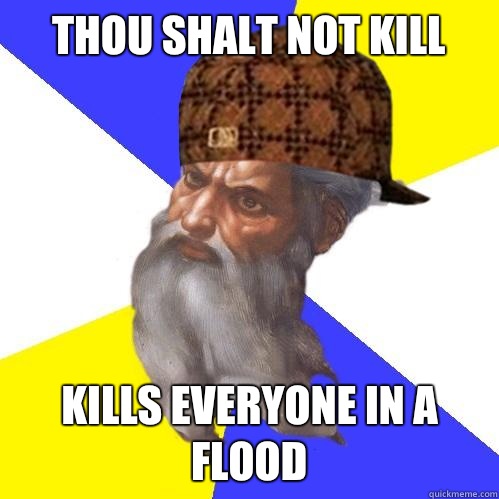
"Thou shat not kill" is a superb example of God being consistent, not inconsistent. It only appears inconsistent due to the ignorance propagated by the choice of word in translation. The only "word games" are from people who assume they know what they're talking about without having bothered to actually learn anything -- the most prominent example being young-earth Creationists who never bothered to understand what the opening chapters of Genesis are in the first place and so just read them as though they were addressed to twentieth-century materialist-literalists, just in quaint language.

Thank goodness we have so many experts to give us their different explanation of what the text really means.

"If faith is a gift of God, it does not require evidence" is just a restatement of a false dichotomy. It's a statement made, in fact, on the same basis that young-earth Creationists make theirs: it assumes a materialist-literalist interpretation rather than bothering to take into consideration that the text wasn't written for materialists or literalists or, for that matter, modern linear thinkers. So you're engaging again in the fallacy of trying to interpret something without asking what it actually says, imposing outside definitions rather than doing the thinking to understand it.

If the Thomas story supported the "no evidence" position, Jesus wouldn't have offered any -- He would have just told Thomas to believe because it was a gift. Instead, He offered evidence. And what was the result of that evidence? It was faith. So plainly evidence and faith are not in conflict.

A grasp of the Bible would show that dichotomy to be empty in the first place: one of the unstated themes is that God works through means. He used a wind to part the Red/Reed Sea, a wooden boat to save Noah & Co., etc. This is why the Psalmist can say "You are a God who hides Yourself": God consistently uses intermediaries or means to accomplish things, a pattern only broken when Jesus is on the scene and does things directly -- yet even there God is hidden in/as a man. So the use of means -- in this case, evidence -- does not contradict that it is the action of God.

If faith was the result of evidence, there would have been no need for the Thomas story, for the Bible to say that faith itself was the gift, for the Catholic Church to advocate that. OK for you, if you need evidence to support your belief, but other Christians disagree with that position without jumping through the hoops that you try to. IMHO.
 
It makes perfect sense: you missed something that I forgot -- the others believed because they already had the evidence. Thomas hadn't been there, so Jesus provided the evidence for him more personally. In both cases, they believed because of evidence.

The text doesn't support your explanation. "Because thou hast seen me, thou hast believed: blessed are they that have not seen, and yet have believed". (John 20:29)
 
The text doesn't support your explanation. "Because thou hast seen me, thou hast believed: blessed are they that have not seen, and yet have believed". (John 20:29)

The text requires my explanation: the other disciples believed because they had seen, and Thomas believed because he had seen. Both believed because they had seen. There was no one present at the time who had believed without seeing.

The church has always recognized this, which is why it's hard to find any interpreter who doesn't say that Jesus was referring to generations to come when there was no one around who had seen Him.
 
Again, you're making little sense. Even if what you say has any supporting facts to it, you've already conceded that some texts were accepted and some rejected, i.e. the corpus was subjectively edited. That's the point being made to you.

No, it was OBJECTIVELY edited: eyewitnesses were available to comment on it. The ones they found lacking didn't get accepted. To know this all one has to do is read the hundreds of records of early congregations telling each other what items they accepted and why, a process that eventually let to regions of churches exchanging the same lists and then a full council publishing that list.

And nothing meaningful on Jesus' life for 33 years or so either. The only difference on the text side is that they're younger. Give it a few decades and I suspect someone will be spinning a similar yarn to yours.

That's because it's known what Jesus was doing: being a good Jew, working at his (human) dad's occupation. That's one of the reasons a number of fake Gospels were recognized as fakes -- they made crap up about His childhood.

And no, the difference on the text side is that with Scientology one guy wrote it all out of his imagination, and with the Gospels it was eyewitnesses.

It's what one expect from cult-type material. Later writers supporting unverifiable accounts because everyone in the chain of evidence is so dedicated to truth like all modern day Christians are. Give us a break.

What later writers? By standard historical measure, the Gospels were all eyewitnesses, and other eyewitnesses were around to call foul.

And no, modern Christians have nothing like the culture concerning transmission of material that prevailed then -- there's no need, for one thing, given the printing press. Besides which, the comparison is ludicrous because the chain of evidence ends once everyone who knew the apostles were dead. Use some common sense!

Thank goodness we have so many experts to give us their different explanation of what the text really means.

The experts agree unanimously, from the ancient rabbis to the present. Why some got it wrong is an interesting question, because it's evident that they knew better.

If faith was the result of evidence, there would have been no need for the Thomas story, for the Bible to say that faith itself was the gift, for the Catholic Church to advocate that. OK for you, if you need evidence to support your belief, but other Christians disagree with that position without jumping through the hoops that you try to. IMHO.

"Need"? What does "need" have to do with it? Nothing in the Gospels was recorded for "need", it was recorded because it was true.

Stop trying to impose your linear rationalistic viewpoint on something foreign to it: the Bible has the Thomas story, which shows Jesus giving Thomas the same evidence the others already had, and the Bible says the faith which resulted was a gift. There is no contradiction involved unless you impose an outside standard on the text -- in which case you're demonstrating that you're not interested in understanding it, just in sounding off.

And what other Christians think isn't relevant -- the only thing that's relevant is what the text says, and it says that faith rests on evidence -- that's what the Thomas story shows, and what Paul says.

 
The text requires my explanation: the other disciples believed because they had seen, and Thomas believed because he had seen. Both believed because they had seen. There was no one present at the time who had believed without seeing.

The church has always recognized this, which is why it's hard to find any interpreter who doesn't say that Jesus was referring to generations to come when there was no one around who had seen Him.

So, even on your interpretation, future generations are to be blessed if they believe without seeing him, i.e. they don't need the evidence of seeing him to believe. You can't just ignore what the Bible, etc. say (that faith is a gift of God), just because you think that you got to your own beliefs by finding enough evidence to suit you, though others have seen the same "evidence' and aren't convinced by it.
 
No, it was OBJECTIVELY edited: eyewitnesses were available to comment on it. The ones they found lacking didn't get accepted. To know this all one has to do is read the hundreds of records of early congregations telling each other what items they accepted and why, a process that eventually let to regions of churches exchanging the same lists and then a full council publishing that list.

Naive faith based thinking. Eyewitnesses to texts, produced decades after the events. Notoriously inaccurate verbal transmissions. Scant literacy. There is no such thing as objectively including and excluding historical texts, each action represents a subjective judgment. Again the point being made to you.

That's because it's known what Jesus was doing: being a good Jew, working at his (human) dad's occupation. That's one of the reasons a number of fake Gospels were recognized as fakes -- they made crap up about His childhood.

And no, the difference on the text side is that with Scientology one guy wrote it all out of his imagination, and with the Gospels it was eyewitnesses.

You have already indicated that the texts you're talking about were written decades after the events. The idea that the eyewitness accounts were accurately preserved by oral transmission would be laughed out of court. Give it a few centuries and Scientology will be based on eyewitnesses also, doubtless also preserved by super-accurate non-written transmissions.

What later writers? By standard historical measure, the Gospels were all eyewitnesses, and other eyewitnesses were around to call foul.

As I say, you have indicated that the Gospels were written decades after the events. And not all were written at the same time. That isn't reliable testimony, at least not to those not pre-disposed to believe it.

And no, modern Christians have nothing like the culture concerning transmission of material that prevailed then -- there's no need, for one thing, given the printing press. Besides which, the comparison is ludicrous because the chain of evidence ends once everyone who knew the apostles were dead. Use some common sense!

No need to get even more overly defensive than you were to begin with. No one's talking about modern day continuation of the so called "chain of evidence". The point is that, even with the benefits of printing, the internet, etc., modern day Christians can't agree that 2 + 2 = 4, so what chance really is there of that having happened centuries ago based on cult-like and hearsay testimony?

The experts agree unanimously, from the ancient rabbis to the present. Why some got it wrong is an interesting question, because it's evident that they knew better.

Ah yes, the experts agree unanimously, except some who got it wrong. Teehee.

"Need"? What does "need" have to do with it? Nothing in the Gospels was recorded for "need", it was recorded because it was true.

Stop trying to impose your linear rationalistic viewpoint on something foreign to it: the Bible has the Thomas story, which shows Jesus giving Thomas the same evidence the others already had, and the Bible says the faith which resulted was a gift. There is no contradiction involved unless you impose an outside standard on the text -- in which case you're demonstrating that you're not interested in understanding it, just in sounding off.

And what other Christians think isn't relevant -- the only thing that's relevant is what the text says, and it says that faith rests on evidence -- that's what the Thomas story shows, and what Paul says.


Some Christians spin things one way, others another. Faith isn't reliant on any one subjective interpretation of the evidence, especially if it's at least decades old and/or inconsistent and/or hearsay.
 
Naive faith based thinking. Eyewitnesses to texts, produced decades after the events. [STRIKE]Notoriously inaccurate verbal transmissions.[/STRIKE] Scant literacy. There is no such thing as objectively including and excluding historical texts, each action represents a subjective judgment. Again the point being made to you.

Fixed that. And of course there's "objectively including and excluding historical texts" -- by a set standard. If that can't be objective, NOTHING is objective.

You have already indicated that the texts you're talking about were written decades after the events. The idea that the eyewitness accounts were accurately preserved by oral transmission would be laughed out of court. Give it a few centuries and Scientology will be based on eyewitnesses also, doubtless also preserved by super-accurate non-written transmissions.

"The idea that the eyewitness accounts were accurately preserved by oral transmission would be laughed out of court." Totally false -- once the system and the values at the time were explained by experts, it would be taken as evidence.

Why are you allowing Scientology centuries to come up with eyewitnesses (to nothing, because there's nothing to be an eyewitness to). BTW, non-written transmission today would vary wildly in accuracy depending on who was doing them. Give the material to the right group of Buddhist monks and it could be preserved a millennium word-for-word.

As I say, you have indicated that the Gospels were written decades after the events. And not all were written at the same time. That isn't reliable testimony, at least not to those not pre-disposed to believe it.

Again you misrepresent the facts. "written decades after the events" in that culture meant "written down from the original passed down with required accuracy for a couple of decades". And in terms of examining historical texts to evaluate testimony, yes, it is reliable, to historical scholars, regardless of where it came from.

No need to get even more overly defensive than you were to begin with. No one's talking about modern day continuation of the so called "chain of evidence". The point is that, even with the benefits of printing, the internet, etc., modern day Christians can't agree that 2 + 2 = 4, so what chance really is there of that having happened centuries ago based on cult-like and hearsay testimony?

That people can't all agree doesn't have the least thing to do the reliability of eye-witness evidence in a totally different situation.

Ah yes, the experts agree unanimously, except some who got it wrong. Teehee.

Yes, the experts agree unanimously. And none got it wrong -- they knew, at least as far as we know of the translation skills, and did it wrong anyway. With the KJV that wouldn't be surprising; there are other choices for translation that are politically motivated.

So you're laughing at something you made up, not what I wrote.

Some Christians spin things one way, others another. Faith isn't reliant on any one subjective interpretation of the evidence, especially if it's at least decades old and/or inconsistent and/or hearsay.

This sounds like you have no idea of scholarship. There are rules for evaluating reliability, and the Gospels rate highly. And you continue misrepresenting the situation; the content of the Gospels was not "old"; in reliability terms it rates a fresh, because of how such things were passed down. And that passing down didn't start after the Resurrection; Jesus preached in a tradition of using a certain set of lessons, whether parables or stories or what, designed to be memorable, and expected to be passed on word for word -- so by the time He was no longer around, most of the content of the Gospels had already been memorized by hundreds of people -- that's why there's so much in common. There's reason to believe that the rest is from lessons specifically for Jerusalem, others specifically for the north (Galilee), so the writers had distinct sets of memorized eye-witness accounts to work with while themselves being eyewitnesses.
 
So, even on your interpretation, future generations are to be blessed if they believe without seeing him, i.e. they don't need the evidence of seeing him to believe. You can't just ignore what the Bible, etc. say (that faith is a gift of God), just because you think that you got to your own beliefs by finding enough evidence to suit you, though others have seen the same "evidence' and aren't convinced by it.

I'm not ignoring anything -- that's baseless, in fact less than baseless because it twists what I've said.

Faith is a gift of God. Faith requires evidence. These are both statements from the New Testament and the Old. I didn't make either of those up, and I didn't hunt form evidence that suited me as I had no idea what would "suit me" until I had all the evidence, ad then what suited me was to follow standard scholarship.

And there is no disagreement on faith requiring evidence. That's taught at Baptist, Episcopal, Lutheran, Methodist, and Catholic seminaries (the latter who say that at the same time faith is caused by evidence and that faith is the gift of God). Yes, there will be fringe examples (especially in church who think an educated preacher isn't a "Spirit" preacher) where some will divide faith from evidence, but no serious New Testament scholar.
 
Back
Top