The Original Gay Porn Community - Free Gay Movies and Photos, Gay Porn Site Reviews and Adult Gay Forums

  • Welcome To Just Us Boys - The World's Largest Gay Message Board Community

    In order to comply with recent US Supreme Court rulings regarding adult content, we will be making changes in the future to require that you log into your account to view adult content on the site.
    If you do not have an account, please register.
    REGISTER HERE - 100% FREE / We Will Never Sell Your Info

    PLEASE READ: To register, turn off your VPN (iPhone users- disable iCloud); you can re-enable the VPN after registration. You must maintain an active email address on your account: disposable email addresses cannot be used to register.

How do you intelligent people possibly choose "faith"?

Because I'm very curious. This question isn't really directed to people who believe because they have some vague happy feelings about God. This is directed specifically to those who aren't the kind to jump to conclusions, to utilize sound methods of reason to reach decisions, who insist on empyrical data before accepting anything as being definably real. I know you're out there, and I want to know why, if you're willing to indulge me.

How can you be so sure? And if you're not so sure, why should I follow you?


You shouldn't follow anyone. Walking in Faith is a personal journey, filled with challenges, doubts and in the end, happiness.


I was raised in a house of faith and knowledge. When I started to question, my parents understood, and I went off on my own journey.

"Everyone ought to worship God according to his own inclinations, and not be constrained by force." -Flavius Josephus

"At any rate, I am convinced that He (God) does not play dice." -Albert Einstein

Faith is both a gift and a choice.
 
I'm reading Lee Strobel's The Case for A Creator. He was an atheist journalist who always based his atheism on the science he learned growing up. Then he began talking to scientists in his adulthood and found that much of what science said was fact is now not considered true anymore. He begins to talk to scientists who even have faith themselves due to what they've learned about the universe's "design." It's an interesting book to read about how a man of science begins to reconcile that with a growing sense of faith.

More reading material! :D
 
You should learn to read what's in front of you.
I have always been fascinated by the number of intelligent, monolingual English speakers who are staunch defenders of religions originating in other languages.

Have you all played "Telephone?" You know, the game where one person makes up a sentence and then it's whispered from person to person until the last person reads it to the group? It almost inevitably ends up as some nearly unintelligible version of the original phrase.

Now, consider this:
- Religions are passed on over thousands of years from person to person
- Some books are written, but many followers have not read them thoroughly and/or cannot even speak the language(s)

Given this, it amazes me how many people argue language, definitions, and semantics to "prove" points regarding faith, religion, and philosophy. (Especially ancient philosophers)

I wish I could say why intelligent people choose faith, but I can't. I can, however, make three observations.
1) Due to thousands of years of "social evolution," most religions have become too complicated for anyone to fully grasp and weave into a coherent picture that doesn't contradict itself.
2) Due to this complexity, people tend to pick and choose which aspects of a religion best suit them or are most salient.
3) Cultural/social forces are incredibly strong. Even if we're able to see outside the tainted lens of our society, the pressure exerted on us can still be tremendous. Look how much closeted gays suffer.


then again, i'm probably just rambling. i'm with blacksyringe on this one

I think it's unreasonable to have faith, yet equally unreasonable denying the existence of something unfathomable...so...I think the 'intelligent people' are the agnostics. :wink:
 
I have always been fascinated by the number of intelligent, monolingual English speakers who are staunch defenders of religions originating in other languages.

Have you all played "Telephone?" You know, the game where one person makes up a sentence and then it's whispered from person to person until the last person reads it to the group? It almost inevitably ends up as some nearly unintelligible version of the original phrase.

Now, consider this:
- Religions are passed on over thousands of years from person to person
- Some books are written, but many followers have not read them thoroughly and/or cannot even speak the language(s)

Given this, it amazes me how many people argue language, definitions, and semantics to "prove" points regarding faith, religion, and philosophy. (Especially ancient philosophers)

That's why I firmly hold that no one who can't read the Bible in the original languages -- and I mean read, as in pick up and get the meaning from any passage selected at random -- has any business preaching or teaching except perhaps under the direct supervision of someone who can.

The game of telephone is applicable to any religion with an actual text only if anyone along the line can go back and ask the first or second person in line what the statement was.

I got tired of hearing sixteen preachers claim "the original Greek says" and getting seventeen different opinions, only to discover they were reading out of someone else's book and probably didn't know one Greek letter from another, so I took classical Greek and went on to Koine, along the way having the delight of reading such things as Aesop's Fables in the original, Xenephon's Anabasis,
and other goodies (though Homer was a pain in the butt). I ended up with a few thousand dollars' worth of references, just to be confident I had a solid foundation.

And I expect anyone who wants to be taken seriously when they talk about what the text means to have done the same, or more.
 
The way you define faith makes the question wrong. Faith is not belief in the absence of evidence, it's belief extrapolated from evidence.

I've sat on a jury three times, and can tell you that as a jury we never abandoned critical thinking (well, some never got to that point....). We had to employ critical thinking, and in two of those cases we had to do so on the basis of incomplete evidence. I'm proud that in one case we decided that just because there wasn't enough evidence to satisfy our questions, we said "Not Guilty." But in the other, we had to commit to a belief -- a verdict -- without sufficient belief.

And that's what goes in in lawsuits: the standard there is "the preponderance of evidence." It isn't "proof"; rarely is there "proof" in a lawsuit. Nevertheless, there is critical thinking involved.

Surely any idea that deserves to be "Believed in" must be proved beyond all reasonable doubt?

In most cases the ideas that people "Have Faith In" are very well below this basic standard of proof.

There is some confusion on what the word "Faith" means. This varies between "Belief in an idea with no need for any evidence" to that of "Belief based on or deduced (extrapolated) from evidence".

In the first case Faith would seem to be a very bad idea - while if the word Faith is used to mean proved beyond all reasonable doubt - then this seems to me a good idea.

My personal view is that where most people talk about faith they mean ideas they hold for which there is no objective evidence,

In this case there can no excuse for rational people chosing this type of "Faith".

On the other hand - very ntelligent people are just as likely to hold irrational ideas as the rest of us less ntelligent people - just they are more articulate in trying to justify these irrational ideas.
 
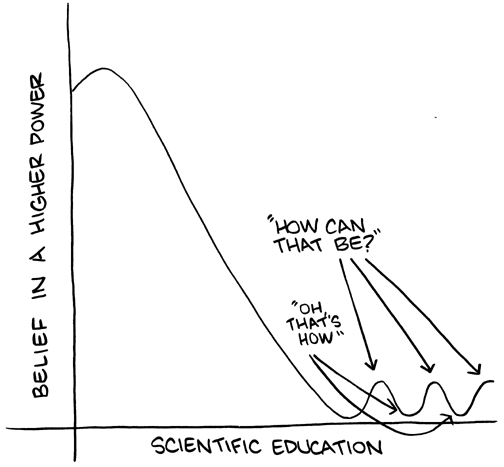
I just came here, to post this

http://www.smbc-comics.com/index.php?db=comics&id=1763#comic

20100117.gif
 
Surely any idea that deserves to be "Believed in" must be proved beyond all reasonable doubt?
How about "He loves me!", said in regard to a new bf?

For a "Brand New BF" this is often sadly a triumph of hope over experience!

In terms of our fundamental beliefs - the world would be a better place if people only accepted those ideas that had been proved beyond all reasonable doubt.

Very Intelligent people are just as capable as the rest of us of in holding ideas that are not rational.

So faith in an idea that is backed by very substantial evidence is rational - while faith in any idea for which there is no proof is not rational.
 
Please excuse me, but I must tell you that your discussion is confusing me. It seems you have no agreement on the words you use. I am content to let others decide whether I base my ideas and the actions that flow from them on faith or solid evidence. At times, I am not sure after I have decided why I chose one thing over another.

But, I do pay attention to others. As a child I found it wise to follow those whom I trusted assuming, I suppose, that they had reasons for their actions and their ideas. When, as happened, I found that their model was defective, I changed. I learned to have faith in my own judgment along the way but I have tried to remain open to the ideas of others.

There are so many areas of life where we have to make choices. I am attracted to persons who have what I would call "vision" and that vision is based on what some would call "blind faith" while others call it intuition. Yet, such persons do make progress that is often amazing. They seem to be the kind of people who are content with the next step and do not worry about what lies beyond. I should hate to have to have solid evidence for the wisdom of all the choices I have to make. I relate to the poet who wrote: "I do not ask to see the distant scene; one step (is) enough for me."

The atheist and I agree that there are things we know nothing about: I have no proof for what lies beyond this life and neither does the atheist. Yet, the atheist often declares that there is nothing beyond this life, while I prefer to be open to the possibility that the Author of Life may have considered what is to follow
this earthly life and I am happy to anticipate the surprise that may lie beyond life. Is my choice less intelligent than that of many who call themselves atheists?
 
I should hate to have to have solid evidence for the wisdom of all the choices I have to make.

I'd agree that people don't need solid evidence for every single choice they have to make.

But they should have proof for those ideas that are important and have a major impact on their lives.

The atheist and I agree that there are things we know nothing about: I have no proof for what lies beyond this life and neither does the atheist. Yet, the atheist often declares that there is nothing beyond this life, while I prefer to be open to the possibility that the Author of Life may have considered what is to follow
this earthly life and I am happy to anticipate the surprise that may lie beyond life. Is my choice less intelligent than that of many who call themselves atheists?

Most athiests would say that the concept of there being a "Ghost in the Machine" that lives on for all eternity after people die is probably not true.

This is not the same as knowing what lies beyond this life - but just based on the simple fact that there is no evidence for either "Eternal Life" or that life has any "Author".
 
Lack of evidence for is not evidence against. Basic rule of science.

Therefore no one can say with legitimate confidence that there IS NO life after death...just that there's no evidence in favor of it, and it's likely there would be if life after death existed. Therefore they believe it's probably not there.

The atheists I know seldom say more than that.
 
I'd agree that people don't need solid evidence for every single choice they have to make.

But they should have proof for those ideas that are important and have a major impact on their lives.

That's a pretty darned out-of-touch viewpoint. Most people couldn't follow a proof if their lives depended on it, let alone construct one for themselves.

This is not the same as knowing what lies beyond this life - but just based on the simple fact that there is no evidence for either "Eternal Life" or that life has any "Author".

There are prominent scientists who disagree with you.
 
I haven't read anything what people have said sorry, but I'll answer the question. Personally, if I didn't see (and feel) the help of what prayer does to me and my family and others then I would really have a hard time just going on faith alone.

From a scientific standpoint (I am a man of science, so your question particularly applies to me), I see no reason for entropy (randomness, disorder, etc) to become more orderly as time goes on. So while possible, take the big blender that is the universe, stir it up and after billions of years you get us? It doesn't make sense. No reactions go from being chaotic to orderly. They may dissipate but they are transferred and they don't make life.
 
From a scientific standpoint (I am a man of science, so your question particularly applies to me), I see no reason for entropy (randomness, disorder, etc) to become more orderly as time goes on. So while possible, take the big blender that is the universe, stir it up and after billions of years you get us? It doesn't make sense. No reactions go from being chaotic to orderly. They may dissipate but they are transferred and they don't make life.

This is a garbage argument. Entropy increases overall, but not necessarily locally. Crystals form, after all. Order and organization can be part of the path to a higher state of entropy.

This is a crap reason for believing in something. Faith is fine, but don't balance it on garbage science.
 
My response back must be a garbage too. I'm talking entropy leading towards life. Obviously there are structures, stars, matter, planets etc. When those crystals spawn life. Then I'll be impressed.
 
My response back must be a garbage too. I'm talking entropy leading towards life. Obviously there are structures, stars, matter, planets etc. When those crystals spawn life. Then I'll be impressed.

Well...they did. Entropy doesn't lead to life. Random chance in the currents and eddies of entropy leads to life.

If you were really a scientist you would understand that.
 
But they should have proof for those ideas that are important and have a major impact on their lives.

That's a pretty darned out-of-touch viewpoint. Most people couldn't follow a proof if their lives depended on it, let alone construct one for themselves.

In fact their lives do depend on it - just they don't realise it - but most of us still know what the concept of "proof" means

Most athiests would say that the concept of there being a "Ghost in the Machine" that lives on for all eternity after people die is probably not true.

This is not the same as knowing what lies beyond this life - but just based on the simple fact that there is no evidence for either "Eternal Life" or that life has any "Author".

There are prominent scientists who disagree with you.

There are no prominent scientists that claim there is any proof for religion - though there are some that have a personal (unproven) faith in this sort of idea.

Again - this just goes to show that intelligent people can have faith in non rational ideas,
 
In fact their lives do depend on it - just they don't realise it - but most of us still know what the concept of "proof" means

I taught in a high school for a while, and not even close to a majority could have given a decent explanation for what proof is, and of those who could, half wouldn't have been able to assemble one at all.

I taught and tutored college students, and the percentages weren't a heck of a lot better.

Most people have no clue why airplanes even fly -- they take it on faith that they do. Most people have no clue why electrical circuits work, especially once you get beyond a simple series -- they take on faith that they do.

There are no prominent scientists that claim there is any proof for religion - though there are some that have a personal (unproven) faith in this sort of idea.

Again - this just goes to show that intelligent people can have faith in non rational ideas,

Now you changed the standard.

There are numerous prominent scientists who have concluded on the basis of their fields that there must be a Creator. There's nothing irrational about that.
 
From a scientific standpoint (I am a man of science, so your question particularly applies to me), I see no reason for entropy (randomness, disorder, etc) to become more orderly as time goes on. So while possible, take the big blender that is the universe, stir it up and after billions of years you get us? It doesn't make sense. No reactions go from being chaotic to orderly. They may dissipate but they are transferred and they don't make life.
It makes perfect sense. You should look up the following topics:

  • Self-organization
  • Emergent properties
  • Spontaneous Order
  • Self-Similarity

Order arising out of chaos actually makes more sense than chaos producing no order.
 
It makes perfect sense. You should look up the following topics:

  • Self-organization
  • Emergent properties
  • Spontaneous Order
  • Self-Similarity

Order arising out of chaos actually makes more sense than chaos producing no order.

Those are all worth consideration.

Underlying them is one simple thing: the "chaos" of this universe rests on order at the root -- the universal constants.

Water and its orderly properties rest on the constants governing atomic bonds. Aqueous solutions and colloids and such and their orderly properties rest on the behavior of water. And life and its properties rest on the behavior of those solutions and colloids and such.

There are only two places at which the question of why order emerged apply: the origin of the universal constants, and the appearance of intelligence (possibly at the emergence of life itself, but I'm not entirely convinced either way there).
 
Back
Top