The Original Gay Porn Community - Free Gay Movies and Photos, Gay Porn Site Reviews and Adult Gay Forums

  • Welcome To Just Us Boys - The World's Largest Gay Message Board Community

    In order to comply with recent US Supreme Court rulings regarding adult content, we will be making changes in the future to require that you log into your account to view adult content on the site.
    If you do not have an account, please register.
    REGISTER HERE - 100% FREE / We Will Never Sell Your Info

    PLEASE READ: To register, turn off your VPN (iPhone users- disable iCloud); you can re-enable the VPN after registration. You must maintain an active email address on your account: disposable email addresses cannot be used to register.

Shaking up Japan -- an 8.9 quake

What baffles me on this is why they didn't have better/more safety systems in place. My cousin a nuclear engineer, who worked on safety issues and systems at Hanford, twenty-five years ago described to me better safety systems than the Japanese seem to have, because if they had them, they wouldn't be having this trouble. They were devised in case of an actual attack on the Hanford reactor, but apply equally well to reactors in earthquake zones.

A sophisticated one was a modular core, that in case of potential meltdown could be swung apart into six pieces, leaving one more in the middle, thus seriously slowing the reaction and allowing easier cooling. A very brute-force one was a core designed with hollow pipes through it, and in case of possible meltdown sand mixed with grains of lead would dump on top of the core, so the lead/sand mix would pour down the pipes, making a crude but effective damping system. A further one is a back-up power system; Hanford had a bank of diesel generators (pulled from decommissioned WWII submarines) with 50% more capacity than needed to run the place.

From the news reports, the last of those would have sufficed to deal with at least one of the reactor situations they're having. Either of the others would be enough to stop the heating problem.


From what is being said, the situation that Japan is encountering is one that no one could possibly prepare for. Their system was properly fortified for earthquakes. But they couldn't have predicted the complete destruction of ALL of their back-up systems as has occurred here.

The problem here is that NO amount of preparation could have prevented what's occurring. It isn't that their preparation was inadequate; its that every single thing that could have gone wrong HAS gone wrong.
 
From what is being said, the situation that Japan is encountering is one that no one could possibly prepare for. Their system was properly fortified for earthquakes. But they couldn't have predicted the complete destruction of ALL of their back-up systems as has occurred here.

The problem here is that NO amount of preparation could have prevented what's occurring. It isn't that their preparation was inadequate; its that every single thing that could have gone wrong HAS gone wrong.

Having backup power would help immensely -- they say the cooling systems would work if they just had power.

Here, they would have just called up a National Guard unit for a generator on a truck, which turns out enough power to supply a dozen homes(that was done here when a storm knocked out power for a chlorination plant, leaving about 1200 people without water).

The sand-&-lead system is hard to knock out; my cousin did part of the design on that, and it's almost idiot-proof: the containers of the mix are already above the core, and the delivery openings are held shut by gravity-powered hydraulics. To use it, fire-hose size valves are opened, releasing the pressure holding the containers shut. The biggest risk with the system is that something could accidentally set it off.

Looking back for details on this, I was reminded of a proposal by Isaac Asimov: to put all nuclear reactors on big barges off the coast , where earthquakes wouldn't shake them and tsunamis couldn't flood them -- and if there was a real meltdown problem, you sink the barge.
 
Okay,

Time for more people to hate me....but the big news catetwailers just ran

30 seconds of the catastrophic 'natural god directed' horror of the flooding

and devastation in the US of A, NE division. They did manage to get that

local color in between graphic films of Japan and pubic service announcements

of how we could send $10.00 or more to help Japan.

Who is our Go To? China or Korea? Libya maybe?

:mad::p:mad:
 
I actually remember a science teacher in high school (almost 20 years ago!) talking about how crazy it was that Japan built nuclear plants when they are so prone to earthquakes.
 
yup. sometimes, despite everything you can do, things fail.

That's why at Hanford they were into paranoid redundancy -- they had backups for the backups. There were three main systems for killing the core in case of overheating, three ways that would kill it and result in a total overhaul, and a couple of ways that would kill it and ruin it permanently. For backup power, they had the generators, but they also had a pipe from the Columbia river that when opened would have powered generators the old-fashioned way, by turning turbines. That was one they always hoped they'd never need: it would have absolutely destroyed the local ecology, and the folks at Hanford were very much into taking care of their piece of desert -- the pipe brought water in, the turn the turbines, but there was no provision for any place for it to go.

Maybe private utilities can't or don't want to spend enough to put in that many systems. My cousin said he was floored when they had their first meeting for updating and improving safety system: a senior engineer asked what the budget, and the government guy said, "There is no budget -- give us systems that work, and send us the bills."

In a way that was all very weird: back in the early Cold War days, all trash that had been exposed to radiation just went into pits. It was everything from gloves to window glass to various pipes and casings, with all sorts of grease and sealants and solvents, enough that my cousin said the pits were toxic totally apart from radioactivity. Real nuclear waste, radioactive substances, was but in barrels, and the barrels stacked in the pits -- and forgotten. The aim was to make metal for bombs, and things not contributing to that were only given enough attention to get them out of the way.
Then came the seventies, and the place changed, till by the eighties they were all dedicated to the environment. Once he was done with the safety system project, my cousin was assigned to the problem of cleaning up that embarrassingly irresponsible mess. They did tests, and found that they'd have to excavate twenty or more feet down under the pits to get all the contamination, both chemical and radioactive.

That takes me back to topic: they had a hydrogen explosion at the one reactor in Japan. The containment sits on a massive, and massively reinforced, concrete slab. But should that slab crack, the only way they'll ever be able to use that ground again for anything will be to excavate huge pits.
Fortunately, they have a subduction zone to dump the stuff into.
 
I actually remember a science teacher in high school (almost 20 years ago!) talking about how crazy it was that Japan built nuclear plants when they are so prone to earthquakes.

Isaac Asimov had the same comment. It's why he came up with the notion to put them on barges.

And it's why I find it hard to fathom that they didn't have ridiculously redundant safety systems, from active depending on electricity to passive depending on gravity.

Time to reconsider Asimov's idea, I think.
 
Having backup power would help immensely -- they say the cooling systems would work if they just had power.

Here, they would have just called up a National Guard unit for a generator on a truck, which turns out enough power to supply a dozen homes(that was done here when a storm knocked out power for a chlorination plant, leaving about 1200 people without water).

The sand-&-lead system is hard to knock out; my cousin did part of the design on that, and it's almost idiot-proof: the containers of the mix are already above the core, and the delivery openings are held shut by gravity-powered hydraulics. To use it, fire-hose size valves are opened, releasing the pressure holding the containers shut. The biggest risk with the system is that something could accidentally set it off.

Looking back for details on this, I was reminded of a proposal by Isaac Asimov: to put all nuclear reactors on big barges off the coast , where earthquakes wouldn't shake them and tsunamis couldn't flood them -- and if there was a real meltdown problem, you sink the barge.

They HAD back up power, and they're trying to GET back up power back in the area.

Look, I know its all well and good to say that they should just truck in generators, but we're talking about a natural disaster unlike anything any of us have experienced. They can't just truck in generators, especially now that the plant is an extraordinarily dangerous place to be. They're doing the best they can in a situation that no one could have ever predicted. I doubt any other nation would be doing any better.
 
I just heard that Honshu actually moved over two meters! So GPS locations there are all two meters different than they were.

That is freaking scary!

Now the guy is saying it actually affected the earth's rotation and orbit. As my uncle used to say, "Goodgodalmighty!"
 
Okay,

Time for more people to hate me....but the big news catetwailers just ran

30 seconds of the catastrophic 'natural god directed' horror of the flooding

and devastation in the US of A, NE division. They did manage to get that

local color in between graphic films of Japan and pubic service announcements

of how we could send $10.00 or more to help Japan.

Who is our Go To? China or Korea? Libya maybe?

:mad::p:mad:

Nope...

We're a SELF SUFFICIENT nation... :p

Well...

Unless an airplane hits a building...

:help::help::help:
 
#-o#-o#-oOH#-o#-o#-o

well don't I feel naive and maybe even stupid now

](*,):rolleyes::cool::rolleyes:](*,)
 
I wonder how having a 10,000 square mile slab of crust broken off will affect the tectonics. It could, over a few hundred thousand years, reattach to the plate it came from, or attach itself to the other plate, but in the meantime....
 
Miracles do happen. Quite a story.

attachment.php


http://www.bbc.co.uk/news/world-asia-pacific-12727282

13 March 2011 Last updated at 11:51 ET

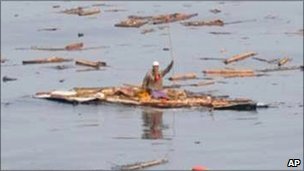
Japan quake: Survivor rescued from roof out at sea
Hiromitsu Shinkawa waves to rescuers before being rescued to a Maritime Self-Defense Force destroyer on Sunday Hiromitsu Shinkawa says he had returned home to gather some possessions after the earthquake

A 60-year-old man has been rescued from the roof of his floating home far out at sea, two days after a tsunami devastated Japan's north-east coast.

Hiromitsu Shinkawa was found by a defence ministry destroyer 15km (10 miles) from shore, officials said.
 

Attachments

  • japan.jpg
    japan.jpg
    10.6 KB · Views: 143
I read some theory that such a significant quake, following so closely on the heels of the christchurch quake, indicates a general realignment of the ring of fire, and that the whole thing can expect a period of higher activity. Hopefully the west coast of the Americas will come out okay too.

and yes, of course i forgot where to cite it..
 
I read some theory that such a significant quake, following so closely on the heels of the christchurch quake, indicates a general realignment of the ring of fire, and that the whole thing can expect a period of higher activity. Hopefully the west coast of the Americas will come out okay too.

and yes, of course i forgot where to cite it..

It was based on thinking like that, that a scientist actually predicted an earthquake of extreme magnitude for Japan.

I find it entirely reasonable in this case to expect other things to follow this. A mass that big moving 8 or more feet puts a lot of stress somewhere. If it hits along here, I'll put in my request for volcanoes rather than quakes.
 
It was based on thinking like that, that a scientist actually predicted an earthquake of extreme magnitude for Japan.

I find it entirely reasonable in this case to expect other things to follow this. A mass that big moving 8 or more feet puts a lot of stress somewhere. If it hits along here, I'll put in my request for volcanoes rather than quakes.

You can get those in your neck of the woods, can't you? Do you get meandering slow moving lava with tourist potential, or torrential pyroclastic flows that race down valleys and obliterate towns entirely?

If you don't mind, I think I'll stick with Vancouver Island Earthquakes...two or three weeks in duration, releasing a huge amount of strain, but so subtle that seismologists only realized they exist since the last few years of detailed GPS surveys...They're below the detection thresholds of standard-issue seismographs. The easy shimmy-quake! What's not to like?
 
You can get those in your neck of the woods, can't you? Do you get meandering slow moving lava with tourist potential, or torrential pyroclastic flows that race down valleys and obliterate towns entirely?

Yes, and yes. We get lave like Kileauea's, we get lave that flows like pudding, we get lave that squeezes out like the earth's turds and goes tumbling down the slope, deforming as it goes until it stops with a heavy dull 'splut' somewhere, we get lava so thick it oozes out so slowly that gases eventually blow it out was lava bombs and cinder -- or sometimes sets up in the vent, so the magma finds another place to pop out; we get ash and cinder and pumice and pyroclastic flows. Some of our volcanoes pump out only two or three of those, a few have done all of them.
And occasionally we get a blast that turns a mountain that would bury Manhattan into so much sand and ash and dust and pebbles and scatters it over five states -- haven't had one in a while, but when the settlers got here the natives told about one, which no one really believed until some geologists decided to actually looked at what was left of the mountain. Since then they've found two more, side by side, and at least one which shows the right signs to be a candidate for doing the same thing one day.

If you don't mind, I think I'll stick with Vancouver Island Earthquakes...two or three weeks in duration, releasing a huge amount of strain, but so subtle that seismologists only realized they exist since the last few years of detailed GPS surveys...They're below the detection thresholds of standard-issue seismographs. The easy shimmy-quake! What's not to like?

Historically, there have been quakes as large as 8.5 within fifty miles of the Oregon coast. There are places that have risen as much as two meters, and dropped back over time, five or six times that are evident. There are traces of tsunamis that scoured everything from the coastal plain clear to the mountains, and forests snapped off at shoulder height and then buried in another meter of sediment. There are stretches with buried boulders that didn't get that way from sediment, but because the ground liquefied and the boulders sank. There are formation here where lava sits on sandstone, sandstone sits on the lave, more lave sits on that sandstone, river deposited mudstone conglomerate sits on that lava, and more lava sits on top -- and the bottom and top lavas were plainly deposited above sea level, but the middle one just as plainly erupted under water, and just for variety, if you know what you're looking for, "level" was different for each of those lava flows.

I'll take the volcano over the quake.

Especially since there's evidence that more than once a big quake apparently triggered one or more volcanoes.

There is a mount within the Portland city limits that was once a volcano. Geologists considered it dead, until once back during St. Helens' glory days, the parking lot on the top was getting hot -- enough that it melted some car tires. I'd really rather that one didn't erupt.

 
Mmmm. I can relate to the complacency part. We have of course the same basic geography in BC, which of course shows no activity since Vancouver's time, thus leading everyone to conclude the volcanos are all extinct....until of course one day someone's tires start to melt. That, combined with an utter lack of preparation, is not ideal.

BTW, some day I aspire to drive from Idiotville to the Boring Lava Fields. You can't make this stuff up.
 
Back
Top