












kallipolis
Know thyself
God reveals himself to the Hebrews; at the Horeb (Exodus 3) and the Sinai (Exodus 19), where he enters into a covenant with them and gives them his commandments (Exodus 20).
It could therefore be said that The Decalogue is an attempt to codify that which already operated as a code of honour between ancient peoples. In this sense Moses attempted to regulate the behaviour of his fellow Hebrew refugees, by imposing a written decree upon them that they may better understand how they should behave between one another. As slaves in Egypt The Pharaoh's laws were familiar to the Hebrews. As were the penalties had they broken those laws.
The Decalogue, or Ten Commandments derive from two sources within the Jewish Scriptures — Exodus 20:1-17 and Deuteronomy 5:6-21 — but the two versions are slightly different, and neither passage explicitly numbers the commandments one through ten.
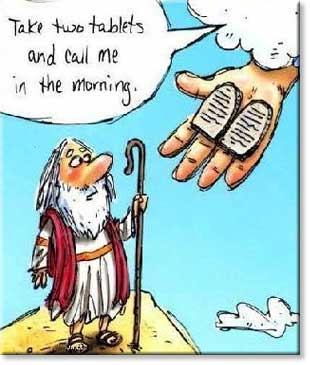
It is commonly understood that The Decalogue form the heart of the Torah — that is, the "Instruction" given by God through Moses, in the first five books of Holy Scripture. Yet these are far from the only commandments contained in those books.
Rabbinic Jewish tradition maintains that the Torah contains a total of 613 commandments (Hebrew. mitzvoth). In Jewish understanding, all 613 mitzvot are equally important; the ritual and dietary commandments are considered just as significant and central as the theological or ethical commands. If you break any one of them, you've broken God's Law.
Law codes of the type found in Exodus, Leviticus, Numbers and Deuteronomy Code of Hammurabi, dating from several hundred years earlier than Moses, were not uncommon in the ancient world. Archaeologists have discovered a large number of legal collections, including those of Sumerian, Babylonian, Hittite and Assyrian origin.
The Decalogue is not seen as a stand-alone Law code, but are seen as the "fine print" on the Covenant, or "agreement" made with God.
The focus on the preservation of the Hebrew community was viewed more in social and civil terms. Only in the Israelite community are issues such as murder, adultery, bearing false witness, and coveting a neighbour's property viewed as theologically significant — observance of the commandments were linked with ritual purity and righteousness before the divine.
The focus on the preservation of the Hebrew community was viewed more in social and civil terms. Only in the Israelite community are issues such as murder, adultery, bearing false witness, and coveting a neighbour's property viewed as theologically significant — observance of the commandments were linked with ritual purity and righteousness before the divine.
Out of the Birth of The Jewish Nation, The Decalogue might well be viewed as a form of Bill of Rights. Framed in the style of ancient suzerainty treaty, The Decalogue encapsulates the rights and responsibilities that the Israelites owed to their divine over lord. But these "ten words" are only part of a larger national constitution outlined in the Torah as a whole. They are part of the fine print upon an ancient contract outlining a revolutionary-new polity — a theocracy based upon a divine law that laid down stipulations about every aspect of life, from the marriage bed to the law court. When we read these commandments as mere moral obligations, we miss much of their original intent and meaning.


