

The Original Gay Porn Community - Free Gay Movies and Photos, Gay Porn Site Reviews and Adult Gay Forums

  • Welcome To Just Us Boys - The World's Largest Gay Message Board Community

    In order to comply with recent US Supreme Court rulings regarding adult content, we will be making changes in the future to require that you log into your account to view adult content on the site.
    If you do not have an account, please register.
    REGISTER HERE - 100% FREE / We Will Never Sell Your Info

    PLEASE READ: To register, turn off your VPN (iPhone users- disable iCloud); you can re-enable the VPN after registration. You must maintain an active email address on your account: disposable email addresses cannot be used to register.

The Ten Commandments

kallipolis

Know thyself
Joined
Aug 29, 2004
Posts
17,230
Reaction score
5
Points
0
Location
Piraeus, Greece
God reveals himself to the Hebrews; at the Horeb (Exodus 3) and the Sinai (Exodus 19), where he enters into a covenant with them and gives them his commandments (Exodus 20).

It could therefore be said that The Decalogue is an attempt to codify that which already operated as a code of honour between ancient peoples. In this sense Moses attempted to regulate the behaviour of his fellow Hebrew refugees, by imposing a written decree upon them that they may better understand how they should behave between one another. As slaves in Egypt The Pharaoh's laws were familiar to the Hebrews. As were the penalties had they broken those laws.

The Decalogue, or Ten Commandments derive from two sources within the Jewish Scriptures — Exodus 20:1-17 and Deuteronomy 5:6-21 — but the two versions are slightly different, and neither passage explicitly numbers the commandments one through ten.
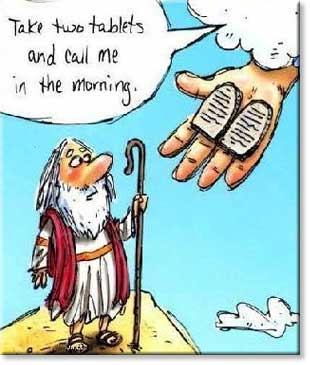
It is commonly understood that The Decalogue form the heart of the Torah — that is, the "Instruction" given by God through Moses, in the first five books of Holy Scripture. Yet these are far from the only commandments contained in those books.

Rabbinic Jewish tradition maintains that the Torah contains a total of 613 commandments (Hebrew. mitzvoth). In Jewish understanding, all 613 mitzvot are equally important; the ritual and dietary commandments are considered just as significant and central as the theological or ethical commands. If you break any one of them, you've broken God's Law.​

Law codes of the type found in Exodus, Leviticus, Numbers and Deuteronomy Code of Hammurabi, dating from several hundred years earlier than Moses, were not uncommon in the ancient world. Archaeologists have discovered a large number of legal collections, including those of Sumerian, Babylonian, Hittite and Assyrian origin.

The Decalogue is not seen as a stand-alone Law code, but are seen as the "fine print" on the Covenant, or "agreement" made with God.

The focus on the preservation of the Hebrew community was viewed more in social and civil terms. Only in the Israelite community are issues such as murder, adultery, bearing false witness, and coveting a neighbour's property viewed as theologically significant — observance of the commandments were linked with ritual purity and righteousness before the divine.
Out of the Birth of The Jewish Nation, The Decalogue might well be viewed as a form of Bill of Rights. Framed in the style of ancient suzerainty treaty, The Decalogue encapsulates the rights and responsibilities that the Israelites owed to their divine over lord. But these "ten words" are only part of a larger national constitution outlined in the Torah as a whole. They are part of the fine print upon an ancient contract outlining a revolutionary-new polity — a theocracy based upon a divine law that laid down stipulations about every aspect of life, from the marriage bed to the law court. When we read these commandments as mere moral obligations, we miss much of their original intent and meaning.
end
 
I wonder if Christianity would be the same way even without the Ten Commandments. Would people behave in the same way (christian or not), since they are mostly "common sense" rules on maintaining a peaceful society......
 
Those who want to enshrine the Ten Commandments do seem to forget that the prophets in the Old Testament were already fighting against the way in which the rituals prescribed were preserved but severely corrupted and separated from the ethical demands of the Law.

In our own time we are reminded that the rule of law is no great boon when the law itself fails the more important standard of justice.

Some of us see in Jesus of Nazareth the
lifting of the yoke of a religion of law with its ritual demands that ignore our fallen condition and separation from God, but also ignores God's promised forgiveness of sin and the empowerment of the Holy Spirit by which all God's children are welcomed into newness of life. And all this is made plain to us through God's offering of himself in the redemption of humankind in the suffering, death, and resurrection of Christ, our Lord.

Human beings have attempted to enshrine this Gospel of God in creeds and statements of faith, but in the end end it still depends on the willingness of each person to make this truth his own.

Yes, this is the Amazing Grace we celebrate in song. It is the gift that keeps on giving. "Oh to Grace, how great a debtor, daily I'm constrained to be. Let Thy Mercy, like a fetter, bind my wandering heart to Thee."
 
The Decalogue is not seen as a stand-alone Law code, but are seen as the "fine print" on the Covenant, or "agreement" made with God.
pect of life, from the marriage bed to the law court. When we read these commandments as mere moral obligations, we miss much of their original intent and meaning.[/COLOR]
[/INDENT]
[/COLOR][/SIZE]​


That seems backwards. I think it was Bright who noted that the Ten Words are the substance, and the rest merely explication.
I think it was also Bright who pointed out that, sensibly numbered, the First Word is "I am the Lord your God" -- not a commandment at all, as we conceive it.​
 
I find it amazing, and very interesting, that God gave Moses 10 commandments for us to follow. Then man got involved and those 10 commandments became 613.

Similarly, Jesus gave us two commandments to follow. Man screwed that up too!
 
That seems backwards. I think it was Bright who noted that the Ten Words are the substance, and the rest merely explication.
I think it was also Bright who pointed out that, sensibly numbered, the First Word is "I am the Lord your God" -- not a commandment at all, as we conceive it.

Bill Bright might well have struck a chord with traditional Christian understandings, when stating that The Decalogue is the substance of The Law, whereas I must always defer to Rabbinic (Jewish) interpretations of The Jewish Scriptures, when drawing the reader's attention to the 613 commandments.

The implications of The Mosaic Laws in the life of the Christian faithful could well lead us to the Book of John and the leadership of The Holy Spirit. This is another topic for another thread.

I might well offer a few paragraphs on The Logos, when I can find the time.
 
Christians are not under the law

1.The Bible clearly states that we are not under the law. Romans 6:14For sin shall not have dominion over you: for ye are not under the law, but under grace.

See All... says, "For sin shall not have dominion over you: for ye are not under the law, but under grace." Since we are under grace, we are not under the law. The two are mutually exclusive.

2.Jesus Christ has delivered us from the curse of the law (Galatians 3:10-13 [10] For as many as are of the works of the law are under the curse: for it is written, Cursed is every one that continueth not in all things which are written in the book of the law to do them. [11] But that no man is justified by the law in the sight of God, it is evident: for, The just shall live by faith. [12] And the law is not of faith: but, The man that doeth them shall live in them. [13] Christ hath redeemed us from the curse of the law, being made a curse for us: for it is written, Cursed is every one that hangeth on a tree:

See All...). Those who "are of the works of the law are under the curse" (v.10) But "Christ hath redeemed us from the curse of the law" (v.13). We come to God by faith and "the law is not of faith" (v.12).

3.Before faith came (clear faith in the person of Jesus Christ), we were kept under the law (Galatians 3:23But before faith came, we were kept under the law, shut up unto the faith which should afterwards be revealed.

See All...). The "law was our schoolmaster to bring us unto Christ" (v.24). "But after that faith is come, we are no longer under a schoolmaster" (v.25). How much clearer could it be? We are no longer under the Mosaic law as a rule of practice.

4.In Galatians, Paul goes even further. The very desire to be under the law is a carnal desire. He calls the Galatians "foolish" for trying to return to the practices of the law as a way to please God (Galatians 3:1-3 [1] O foolish Galatians, who hath bewitched you, that ye should not obey the truth, before whose eyes Jesus Christ hath been evidently set forth, crucified among you? [2] This only would I learn of you, Received ye the Spirit by the works of the law, or by the hearing of faith? [3] Are ye so foolish? having begun in the Spirit, are ye now made perfect by the flesh?

See All...). In Galatians 4:21-31 [21] Tell me, ye that desire to be under the law, do ye not hear the law? [22] For it is written, that Abraham had two sons, the one by a bondmaid, the other by a freewoman. [23] But he who was of the bondwoman was born after the flesh; but he of the freewoman was by promise. [24] Which things are an allegory: for these are the two covenants; the one from the mount Sinai, which gendereth to bondage, which is Agar. [25] For this Agar is mount Sinai in Arabia, and answereth to Jerusalem which now is, and is in bondage with her children. [26] But Jerusalem which is above is free, which is the mother of us all. [27] For it is written, Rejoice, thou barren that bearest not; break forth and cry, thou that travailest not: for the desolate hath many more children than she which hath an husband. [28] Now we, brethren, as Isaac was, are the children of promise. [29] But as then he that was born after the flesh persecuted him that was born after the Spirit, even so it is now. [30] Nevertheless what saith the scripture? Cast out the bondwoman and her son: for the son of the bondwoman shall not be heir with the son of the freewoman. [31] So then, brethren, we are not children of the bondwoman, but of the free.

See All..., he tells an allegory to those "that desire to be under the law" (v.21). He concludes that those who follow the law are "children of the bondwoman" (v.31), but those who follow faith are "free." Paul is not dealing here with the law as a plan for salvation. He is dealing with those who have trusted in Christ and then desire to return to the law in order to please God.


Jesus Christ told us the greatest commandment is to LOVE God and then our neighbor and all the other commandments ( law of prophets ) hang on this.
 
Below are the words of god is beyond logic as god is silent !!!
I am 100% sure that the 10 commandants were the law of the land at the time.

1. I am the Lord your God
2. You shall have no other gods before me
3. You shall not make wrongful use of the name of your God
4. Remember the Sabbath and keep it holy
5. Honor your Father and Mother
6. You shall not murder
7. Do not be false to the married relation.
8. Do not take the property of another.
9. Do not give false witness against your neighbour.
10. You shall not covet your neighbor's wife
 
Of all the rules in all the world that could benefit mankind, does anyone honestly believe that these are the ten absolute best rules to follow? And if not, why would a supposedly supreme being choose these ten and not, for instance, include something like "thou shall not rape young boys in your parish"? I mean, he wastes the first four to simply ensure his own ego is properly satisfied, throws in a couple of decent ones like murder or theft, then says you can't have worldly desires. Seriously?

Abortion...There are absolutely no justification for this..

I can come up with some.
 
What applies to the 5th commandment 'Thou shalt not kill'?

Fighting...unless it is in self-defense, or Just cause for War.
Suicide...in some cases, a person isn't held accountable if not right in the head.
Murder...unless it is committed in self-defense
Abortion...There are absolutely no justification for this.
Words...that hurt or wounds interiorly, and leaves a permant inner scar.


Really?
There are so many reasons for acceptable abortion.
Such as if the fetus is severely disable ... etc.
You can keep it and spend YOUR money on that child.
 
I wonder if Christianity would be the same way even without the Ten Commandments. Would people behave in the same way (christian or not), since they are mostly "common sense" rules on maintaining a peaceful society......

Most of the rules in the Ten Commandments were popular throughout the ancient Mediterranean. Solon and Lycurgus include similar laws in their constitutions (or so Aristotle says), and Hammurabi's first few laws are almost identical (the likely grandfather of the Ten Commandments). IOW, they're pretty universal and not unique. I think what makes the difference is that Christians and Jews assert that their laws came from a god, whilst others were more practical and said, "This works." If you want to know how people observe these laws without the threat of divine wrath, then look at cultures outside of Judea.

**Note: Almost every culture had rules regulating sins against their gods, just not the particular rules appearing in the Ten Commandments.
 
Most of the rules in the Ten Commandments were popular throughout the ancient Mediterranean. Solon and Lycurgus include similar laws in their constitutions (or so Aristotle says), and Hammurabi's first few laws are almost identical (the likely grandfather of the Ten Commandments). IOW, they're pretty universal and not unique. I think what makes the difference is that Christians and Jews assert that their laws came from a god, whilst others were more practical and said, "This works." If you want to know how people observe these laws without the threat of divine wrath, then look at cultures outside of Judea.

**Note: Almost every culture had rules regulating sins against their gods, just not the particular rules appearing in the Ten Commandments.

Remarkably so, I have already stated this in my opening post.
 
What I stated still stands as is. I'm sure that there are always families willing to adopt a defective baby, and Love them as their own.

What about when a stepfather rapes his 9 year old stepdaughter, after which she gets pregnant? Given the physiology of a 9 year old girl, if forced to carry to term, would almost certainly mean the death of the fetus, and, in all likelihood, herself as well.
 
In all likelyhood, it would be next to impossible for her to get pregnant at such a young age, as her sexual functions are as unlikely to be fully developed, and producing the eggs needed. Also, if vaginally penetrated...very likely to cause a dangerous tear, and bleed to death, and therefore...the charge of Murder on the penatrator. If, for the sake of argument, she can get pregnant...what may the percentages of that happening in the first place? I think that it is all in the Mathematical, and scientific Probabilities.

My hypothetical was not actually a hypothetical. It really happened. The girl was pregnant with twins, weighed only 80 lbs, and would, in all probably, have died had she been forced to carry to term, which is exactly what the roman catholic church of brazil wanted her to do. The scenario I described actually happened.
 
FirmaFan - you must remember that orthodoxy, including Catholic, is about setting forth standards which others are expected to meet.
 
^^ If this is true, this is completely outrageous! There isn't anything horrible enough that could be said to the people who tried to stop this abortion.
 
Cases like this, adult rape and incest pregnancies are actually rare.

So what? They exist, and by banning abortion, the poor girls would have to suffer or die.

The Church's excommunications aren't rare. There was a case here in the US of a nun helping a woman who would have died in childbirth. The Catholic Church excommunicated the nun.
 
What applies to the 5th commandment 'Thou shalt not kill'?

Fighting...unless it is in self-defense, or Just cause for War.
Suicide...in some cases, a person isn't held accountable if not right in the head.
Murder...unless it is committed in self-defense
Abortion...There are absolutely no justification for this.
Words...that hurt or wounds interiorly, and leaves a permant inner scar.

As for Abortion again from the scientific perspective it is not murder as fetuses/embryos/clusters of cells are not persons nor when abortion is done at the early stages is a person developed.

I also love how Christians try to be pro life but the god of the Bible is anything but. He has children butchered and torn out of their mothers womb. Hell he even kills living children such as the children of Egypt or David and Bathsheeba's child.

As for the Ten Commandments they are a poor source of law. It is tought crime and a symbol of patriarchhal dominance to forbid the coveting of a neighbors wife. Further more as we see in the commandment against murder it clearly did not apply against Pagans and those who did not believe in Yahweh, or non virginal women, homosexuals etc. Also the first command is against religious freedom as it prohibits the worship of any other God accept Yahweh.
 
Back
Top