Tbh, it's p hard to have high expectations for a movie that's just another throwaway rom-com. And as cynical as it may sound, I'm p sure a lot of the positive reviews made by hetero film critics are them just holding back their real opinion in order to avoid accusations of homophobia. Of course, that changes when gay viewers tell it as it is, so to speak. The writing is as clichéd and average as any other throwaway rom-com; the fact that it focuses on a gay couple rather than a straight one doesn't automatically make it immune to that. It's especially amusing when hetero progressivists (the ones who are everyday people, not film critics) rave about how "incredible" said film, the recent Hallmark Christmas films (loool), and the other ones I listed in my previous post are. Dude, they're not "incredible," they're just average; quit lying to yourself.
LGBT characters have come the full circle now.
In the post WWII period, gays were portrayed in movies as the spy-traitor, the weak effeminate pansy or the predatory evil character. They almost always were killed by the end of the movie.
Then came the "dying from AIDS" period in the 1990s where all of the characters were uniformly sympathetic, tragic and dead by the end of the movie.
Then there was the "gay best friend" period. During this time, they were the sexless foil for the top-billed actors. The gay best friends were there to be the jester for the movie while the main character got all of the drama, love and sex.
Recently, gay characters are getting more "normalized". They can still be the best friend but they can also be in the primary storyline and they can have sex, be imperfect and do all the things that the rest of the characters get to do, including falling in love.
It only makes sense that LGBT also get to be in really bad rom-coms and Hallmark movies. They've finally achieved the Holy Grail of entertainment: mediocrity.
"Bros" is a bad movie. It just makes no sense that Luke McFarlane would be pursuing Billy Eichner. And it's confusing in that by being an over-the-top absurd parody, it ended up being an inside joke that gay people didn't want to see. Straight people were never going to get it.
There's another similar storyline in "Smiley" which is running on Netflix. It does a much better job of presenting a story of an unlikely same-sex couple without being over-the-top and unbelievable. The core ideas in "Smiley" - that we self-sabotage and pick the wrong people is something that everyone - gay, straight and in-between- can better relate to.
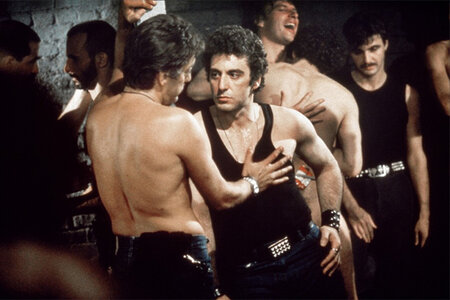
That's p much inevitable when the overwhelming majority of audiences is composed of straight people. They watch a movie like Love, Simon, they think, "Ah, so that's how gays are; clean-shaven, sensitive, pretty, boyish-looking, in touch with their feminine side..." They watch a movie like Cruising, they think, "Ah, so that's how gays are, Freddy Mercury clones, creepy, perverted, fond of leather, manly..." They can't seem to get in their heads that the gay population is diverse, composed of people with different personalities, ways of thinking, likes, etc, and that the movie is representing one section of the population. Again, it's especially amusing (or sad) when hetero progressivists are the ones who are guilty of that, since it goes against what they believe. I remember during my brief time attending college in the US a lot of the kids (I was a lot older than them, so they were kids to me) there who'd preach about how liberal (as they call it) they are would contradict themselves by relying on stereotypes as a guidebook to identify gay people; the old "he looks gay" and "he doesn't look gay." It could be argued that they're just kids who are still learning, but eh, there were plenty of grown adult students and professors who seemed to think that way, too.
When the original rainbow flag was promoted as a gay symbol 50 years ago, the idea was that the colors in the flag didn't represent any specific thing other than a representation of how diverse the "Lesbian and Gay" communities were. That's always been one of the strengths of the community- that sexual orientation is a trait that isn't limited to one particular socio-economic, ethnic, religious or other societal subculture. It also makes it hard as fuck to portray in entertainment.
There probably are "clean-shaven, sensitive, pretty, boyish-looking, in touch with their feminine side" who live in the suburbs with their loving still-married parents. There are "Freddy Mercury clones, creepy, perverted, fond of leather, manly" guys who live in large urban areas. How do you create entertainment that portrays such a diverse group of people in a way that a large audience can relate to?
That is one of the problems with entertainment for gay people, made by gay people, written by gay people, performed by gay and intended for gay people is that it will only portray the limited gay experiences of
those gay people who were involved. That's what happened with "Bros", probably. There were just too many inside jokes that only affluent gays living in Chelsea in NYC (and summering on Fire Island and Provincetown) would get. The rest of us were thinking, "If he said that to my mother, that would have been the end."
There was a funny scene in the series "Uncoupled" where Neil Patrick Harris, newly single, manages to get into bed with uber-hot dermatologist Peter Porte, only to discover that Porte has a huge dick. NPH is uncertain whether he will be able to accommodate Porte's huge dick. Porte reassures NPH that it will fit and just in case, he offers him a shot of anal botox. The scene is funny and is like some of the hysterical situations that the series "Sex and the City" (also a Darren Star production) captured. The problem is that a gay person living in Mississippi or Ohio is probably going to look at that and think, "WTF? Anal botox is a thing?". And a straight person living just about anywhere is going to think, "Gay people botox their buttholes?".
View attachment HarrisNeilPatrick&PortePeter_Uncoupled-S01E05.mp4