

The Original Gay Porn Community - Free Gay Movies and Photos, Gay Porn Site Reviews and Adult Gay Forums

  • Welcome To Just Us Boys - The World's Largest Gay Message Board Community

    In order to comply with recent US Supreme Court rulings regarding adult content, we will be making changes in the future to require that you log into your account to view adult content on the site.
    If you do not have an account, please register.
    REGISTER HERE - 100% FREE / We Will Never Sell Your Info

    PLEASE READ: To register, turn off your VPN (iPhone users- disable iCloud); you can re-enable the VPN after registration. You must maintain an active email address on your account: disposable email addresses cannot be used to register.

Universal vs. Market-Based Health Care

I learned a long time ago in Stat 101 that any set of data can be manipulated to produce virtually any desired outcome.

My comments have been based upon personal observations and experiences over a period of years and therefore are hardly 'uninformed.'

I really doubt your statistics class taught you that so you could go on to disregard any statistic you ever heard. I really doubt you had a professor of statistics who said to you "My profession is worthless to anyone but a liar, and nothing but artifice and chicanery."

If you paid attention in Stat 101 it was probably to teach you to think thoughtfully about statistics so you wouldn't be duped by stats, or by clichés about stats for that matter.

If you paid attention in Stat 101, you would have also learned just how anecdotal personal observations and experiences are reasonably useless when studying something on the scale of a national health care system.
 
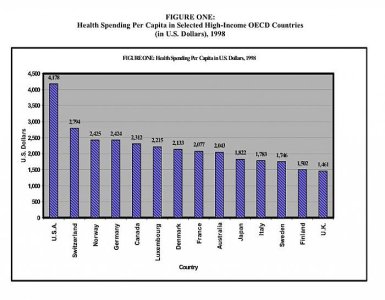
The graph below shows the 1998 health spending of OECD Nations per capita. Since 1998 this disparity is even greater - the US pays more than DOUBLE what most other OECD nations pay per person for healthcare.

attachment.php


What do they get in return?

• More than 40 million citizens without health insurance.

• Ranked 26th among industrialized nations for infant mortality rates.

• Ranked 24th on disability-adjusted life expectancy.

• Ranked 55th (lowest rating) on the WHO "Fairness in Financing" scale.


Stats are drawn from this paper from Maine University. Note it is a downloadable PDF, not a web page:

US Healthcare: Best In The World, or Just The Most Expensive?
 

Attachments

  • WHO.jpg
    WHO.jpg
    55.8 KB · Views: 471
I'm not going to say that something doesn't need to be done. But when universal care is mentioned it reminds people of the disastrous Hillary Care plan of 15 years ago. The truly needy should be provided for. Those who can't afford care could get a tax deduction or perhaps credit for what they can't afford. The rest of us could keep our insurance.

I think my first two categories should go through private insurers (the government could entirely subsidize the truly needy and partially subsidize the semi needy). Using private insurers would increase efficiency and drive down costs through economies of scale. Everyone could get preventative care further reducing costs. Before anyone says that private insurers wouldn't be a good idea just look at the Medicare Supplements...a very good public/private partnership.
 
• Ranked 26th among industrialized nations for infant mortality rates.

]

That is perhaps the most mis-leading statistic of all.

The US counts infant mortality differently that do other countries.

The death of a newborn child is a tragedy, and the fact that the United States has a higher infant mortality rate than other developed countries is often cited as a serious failing of America’s health care system. But according to Dr. Linda Halderman, the higher U.S. rate is due in part to the fact that we try to save the lives of more infants than do other countries:

Low birth weight infants are not counted against the “live birth” statistics for many countries reporting low infant mortality rates.

According to the way statistics are calculated in Canada, Germany, and Austria, a premature baby weighing <500g is not considered a living child.

But in the U.S., such very low birth weight babies are considered live births. The mortality rate of such babies — considered “unsalvageable” outside of the U.S. and therefore never alive — is extraordinarily high; up to 869 per 1,000 in the first month of life alone. This skews U.S. infant mortality statistics.

Norway boasts one of the lowest infant mortality rates in the world. But when the main determinant of mortality — weight at birth — is factored in, Norway has no better survival rates than the United States.

Source Link (added by moderator): http://pajamasmedia.com/blog/the-do...tality-comparisons-a-statistical-miscarriage/

More. The article also notes other differences in the way infant mortality is calculated by different countries that skew their infant mortality rate. Many countries, for example, won’t count a child as a live birth if he dies within 24 hours of being born. Since 40% of all infant mortality occurs within the first 24 hours after birth, this fact makes the infant mortality rate of those countries appear a lot better than it actually is.
 
That is perhaps the most mis-leading statistic of all.

The US counts infant mortality differently that do other countries.


Since, once again, you failed to cite any of your post's content, I researched the author of your quote. I can't find a single reference to such claims other than those of the following:

Dr Linda Halderman is a non-practicing ex-surgeon who writes for "Pajamas Media", a partisan conservative website which runs banner ads such as "The Third Jihad - Radical Islam's Vision For America"!! (Exclamation point added by me for comedy purposes). She is described on the site thus: "Dr. Linda Halderman was a Breast Cancer Surgeon in rural central California until unsustainable Medicaid payment practices contributed to her practice's closure. She now serves as a policy advisor in the California State Senate."

Please note that, even within the comments on her own article, the site's readers question her lack of statistics, citations or justifications for her conclusions. Her article is little more than an opinion piece. Also note that the Medicaid system you have suggested meets the need of the financially challenged, apparently doesn't meet the needs of Dr Halderman.

I would be intrigued to hear what affiliations she has with any health insurance organizations. In the meantime, please excuse me if I stick with my own cited World Health Organization statistics, rather than non-practicing Dr Halderman's.
 
I detect a hint of desperation there.
There are other sources - when I have time, I will look them up,.
 
^ While you're looking, perhaps you can also answer my earlier question about why American taxpayers have to fund a health system that costs double per capita of any other OECD nation?

Desperation? Actually, I'm quite enjoying myself! :-)
 
^ While you're looking, perhaps you can also answer my earlier question about why American taxpayers have to fund a health system that costs double per capita of any other OECD nation?

! :-)

Here is a newspaper article quoting two doctors. There is more information available.

http://www.ocregister.com/ocr/sections/commentary/orange_grove/article_443950.php

The answer to your question is that the taxpayers do not fund much of the health care system.

Your infant mortality data is a perfect example of how statistics can be mismanaged.

Someone once famously said: "There are liars, damn liars, and statistics."
That has been attributed to Mark Twain - and others.

People quote that 40 million uninsured number as though it means that 40 million people are without access to health care.

People quote that infant mortality crap as though it actually means something.

Unless you have an understanding of the underlying data, the statistics are meaningless, and more important, completely dishonest.

Of course, dishonest and misleading data is the province of the left.
 
I'm not going to say that something doesn't need to be done. But when universal care is mentioned it reminds people of the disastrous Hillary Care plan of 15 years ago. The truly needy should be provided for. Those who can't afford care could get a tax deduction or perhaps credit for what they can't afford. The rest of us could keep our insurance.

I think my first two categories should go through private insurers (the government could entirely subsidize the truly needy and partially subsidize the semi needy). Using private insurers would increase efficiency and drive down costs through economies of scale. Everyone could get preventative care further reducing costs. Before anyone says that private insurers wouldn't be a good idea just look at the Medicare Supplements...a very good public/private partnership.

Much as I hate to say anything good about government based programs, the Medicare system seems to work most of the time.
 
Do all realize this argument has been going on Since Harry Truman was President?

Probably longer.


Its being going on in this forum for a while, as well.

Every few months someone trots out the same old tired and generally accurate stuff, and others jump on board. What does that say about us?
 
Here is a newspaper article quoting two doctors. There is more information available.

http://www.ocregister.com/ocr/sections/commentary/orange_grove/article_443950.php

The answer to your question is that the taxpayers do not fund much of the health care system.

Your infant mortality data is a perfect example of how statistics can be mismanaged.

Someone once famously said: "There are liars, damn liars, and statistics."
That has been attributed to Mark Twain - and others.

People quote that 40 million uninsured number as though it means that 40 million people are without access to health care.

People quote that infant mortality crap as though it actually means something.

Unless you have an understanding of the underlying data, the statistics are meaningless, and more important, completely dishonest.

Of course, dishonest and misleading data is the province of the left.


Just as you accuse WHO statistics as skewed, your source fails to address that countries such as Australia, New Zealand and the UK calculate infant mortality to the WHO standard. They have universal healthcare programs. They have lower infant mortality than the US.

But, to debate over a few percentage points is obfuscation. Your original statement was "Actually, the USA has the best health care in the world." You now seem to be arguing that it's half-a-percent or so better than the World Health Organisation says it is. So maybe it's 15th or 20th, rather than 27th. I dunno about you, but if my country was paying double what all the other countries are, I'd expect first place in every category on the scale.

The answer to your question is that the taxpayers do not fund much of the health care system.

You dodged the question entirely by focusing on a separate issue. Let me slim it down for clarity:

Why does the US pay twice as much of their GDP on healthcare as any other OECD nation, when most studies find US healthcare to be below the standard of others?
 
Why does the US pay twice as much of their GDP on healthcare as any other OECD nation, when most studies find US healthcare to be below the standard of others?

Most studies? LOL

That's the most disingenuous post I've yet seen. It borders on downright nonsense.
 
Both have a place in different societies, and right now in the US and Canada, they are both being shown to be inefficient quite often. In Canada wait times are ridiculous due to so many people being able to get in for surgery or get in beds, while in the states, millions are without any form of health care and rely on doctors in free clinics to diagnose problems before they become untreatable.

From my viewpoint, it's quite hard to decide which is the best.
 
I agree, but only because he didn't post a source to attribute his "ranking".

Yes I did, in all my statistical posts in this thread. Here's just one, with source in bold:

The graph below shows the 1998 health spending of OECD Nations per capita. Since 1998 this disparity is even greater - the US pays more than DOUBLE what most other OECD nations pay per person for healthcare.

attachment.php


What do they get in return?

• More than 40 million citizens without health insurance.

• Ranked 26th among industrialized nations for infant mortality rates.

• Ranked 24th on disability-adjusted life expectancy.

• Ranked 55th (lowest rating) on the WHO "Fairness in Financing" scale.


Stats are drawn from this paper from Maine University. Note it is a downloadable PDF, not a web page:

US Healthcare: Best In The World, or Just The Most Expensive?


Stats in the above paper are taken from several sources, primarily the World Health Organization.

But, if you prefer, The Commonwealth Fund:
http://www.commonwealthfund.org/publications/publications_show.htm?doc_id=482678

Or data compiled from numerous sources for Canadian Parliament (Downloadable PDF, not webpage):
http://www.google.com.au/url?sa=t&s...7SuBLTnckHE9H07Cw&sig2=u9zJLTSqn82MBvy919OmDA

Or data provided directly from the OECD used in this report:
http://www.libraryindex.com/pages/1...ALTH-CARE-SPENDING-RESOURCES-UTILIZATION.html

And please note the independent Harris Interactive 7000-people survey I referenced from this article:
http://www.washingtonpost.com/wp-dyn/content/article/2005/11/03/AR2005110301143.html


So far, Henry's opposing argument has been the opinion of a non-practicing Californian doctor, and a newspaper article by two doctors who cite no source or statistical evidence to prove their statements. All of these doctors write for partisan conservative websites and/or newspapers.

Anyways, I'm bored with the "You're wrong because I say so" contradiction, so I'm finished here. :D

 
Universal health care is better than what we have now... universal health insurance is not better, but better than market-based health insurance (which is worse than, and is NOT the same as, market-based health care). I have no idea why people are deluded in thinking that health insurance is not the scam that it is.

Whether or not it's a scam depends on the company. There are a lot of fraternal companies out there which provide excellent coverage at admirable rates, because they're not paying stockholders, not spending millions on advertising, and not paying outrageous CEO salaries. The one I'm covered under gives grants, but is limited in how much can be given as a percentage of income, and they have to be related to personal health, and benefit more than one of their members.

Lets put it this way:

Would you go to the county hospital today?

Absolutely.
It's run by Seventh Day Adventists, who even after my insurance pays it portion give me a 90% discount due to my income level.

You are so full of it.
. . . .
Here in America they only treat you properly if you're rich. If you're poor you get rubber stamped and sent home with "take asprin" scribbled on a piece of scrap paper.

Sorry, Jasun, but you're "full of it" here.
My last visit to the hospital, I sat next to a guy who'd just seen the lady at the financial window, and had in his hand a certification that the five-figure care he was about to receive wouldn't cost him more than a required co-pay of ten dollars.
And the doctors don't care what your income is, they just treat you.

The reality is that if you're poor or can only afford an HMO, you're going to get rubber-stamped and sent on your way. We're all living with the present system so there's no need to deny it.

In Canada that's not the way it works... you choose your own doctor based on your own needs... one isn't selected for you from a list of cheap doctors.

HMOs have their problems, yes. But the folks I know in Canada visit the U.S. one or more times a year just to get acceptable medical care -- like, prompt, and thorough.

I would have thought that a good conservative would have had the personal sense of responsibility to have Health Insurance instead of depending on the rest of society to pay for his problems. I think Ayn Rand would have let this guy rot in the gutter.

Maybe your really a socialist at heart Henry!

Or a thief? :rolleyes:
 
Clearly you neither read nor understood. I had insurance. He did not.

And being the warm-hearted fellow you are, and with the wealth you evidently have, you didn't help someone living under your roof with medical insurance... because he hadn't earned it.

Henry, you're proof of my thesis in the Why Politics Has Become So Destructive thread.
 
I think, if you were able to dig deeply, you would find that those surveyed chose to go without treatment because they couldn't afford it, which is not the same thing as saying that treatment was not available.

There are safety nets in place, ie., Medicaid etc.

Medicaid is for those who qualify and who pay for it -- it's hardly a "safety net".
And for people on SSI for disabilities, Medicaid is more a punishment -- it can take up to 2/3 of their SSI income! ](*,)

You can't "chose to go without treatment" at very many American hospitals: most are required to take all patients who come, and treat them.
I don't know what fantasy world you're living in, but it's really skewed! :help:
 
Back
Top