- Joined
- Jan 15, 2006
- Posts
- 123,002
- Reaction score
- 4,586
- Points
- 113
Which part is "deceitful"?
Here:
http://www.justusboys.com/forum/showpost.php?p=6671447&postcount=29


PLEASE READ: To register, turn off your VPN (iPhone users- disable iCloud); you can re-enable the VPN after registration. You must maintain an active email address on your account: disposable email addresses cannot be used to register.


Which part is "deceitful"?

Weird that we would carry 55 to 60 % debt while be balanced......
Johnson's the one that started the games of lies to make the budget look balanced, to finance the war he lied about not wanting, so he could beat Goldwater. Not even Clinton undid the mendacious accounting Johnson started -- if he had, he wouldn't have been able to maintain his lie about a balanced budget. And unless Obama stops the lying, by at the very least cutting Social Security receipts out of the budget and making that a totally separate set-up, he won't be balancing it, either.
There haven't been any presidents since Kennedy to maintain a balanced budget.
Laughable. Just simply laughable. Balanced budgets and fiscal responsibility have never been a tenet of liberalism. Ever.
As I suspect you are aware, only liberal presidents balance budgets. Conservatives believe in deficit spending (I presume because they think it stimulates big business). Fiscal responsibility is an exclusively liberal value.

So, what you're saying is that you won't accept any numbers from anyone, because they're all lies.
That would make it impossible even to discuss, wouldn't it?
As I suspect you are aware, only liberal presidents balance budgets. Conservatives believe in deficit spending (I presume because they think it stimulates big business). Fiscal responsibility is an exclusively liberal value.










Actually, there are a lot of gaycists (gay racists), so it'd follow that there are gay Repubs.

I think the LGBT equality movement has gotten much more conservative over the last 30 years. NOT politically, but certainly philosophically. It is no longer about free love and people being who they are (though that is still certainly an element), but is instead about seeking the things that straight couples have had for generations. Marriage, children, everything that signifies the transition to a full adult life. I mean, how many guys on here want kids, want a husband or wife, want the house in the burbs or the apartment in the city, two cars, and so on and so on? Those ARE conservative things. The fact that gays want to join those institutions, and take part in those things, is in fact a very conservative turn for a movement that was actually quite radical when it first came about.
Anyone that cannot acknowledge that the LGBT movement HAS become more conservative since the 70s can't see the forest for the trees.
Even in 2000 we were still embroiled in a philosophical debate about whether we wanted a state-sponsored marriage, whether civil unions were adequate, or whether the state should get out of the marriage business altogether.

It may be hard for many Americans to believe, but the United States' checkbook hasn't always been in the red. Aside from periods of war or economic turmoil, the federal budget was actually in surplus for most of the nation's first 200 years. The government incurred considerable debt during the Civil War and the Spanish-American War but paid it off by the early 1900s. Between 1901 and 1916, the budget was almost always balanced. But then came the Great Depression followed closely by World War II, which resulted in a long succession of deficits that caused the federal debt to balloon from $16 billion in 1930 to $242 billion by 1946. (Adjusted for inflation, that's about $206 billion and $2.67 trillion, respectively.) Read more: http://www.time.com/time/nation/article/0,8599,1918390,00.html#ixzz16cl0Hgat
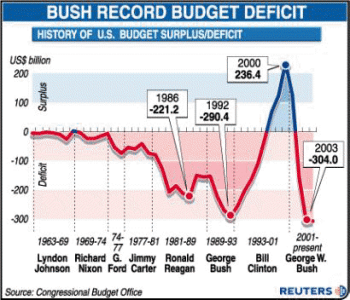
The federal government's spending oscillated over the subsequent decades, running a surplus in the good years and a deficit in the bad ones, until the early 1980s. President Ronald Reagan's economic and foreign policies — tax cuts combined with substantial increases in Cold War–era defense spending — led to a string of deficits that averaged $206 billion a year between 1983 and 1992. The balanced-budget acts of 1990 and 1997 helped reverse this unprecedented level of peacetime spending, and in 1998 the U.S. recorded its first budget surplus in nearly 20 years.
Read more: http://www.time.com/time/nation/article/0,8599,1918390,00.html#ixzz16clNBfhH
It was signed into law by President George H. W. Bush on November 5, 1990, counter to his 1988 campaign promise not to raise taxes. This became an issue in the presidential election of 1992.
You can repeat your 'liberals are fiscally responsible' BS as long as you like, but the current president's (and democratic congress') trillion dollar deficit begs to differ.
You really think the budget was actually balanced?


This year's federal deficit is the result of declining revenue — people are making less money so they're paying less in taxes — and increased spending. So far, the government has spent $530 billion more this year than it did last year, a number that includes $169 billion for the Troubled Asset Relief Program (TARP), $125 billion for the American Recovery and Reinvestment Act and $83 billion to bail out Fannie Mae and Freddie Mac. And that doesn't even account for the spending scheduled for next year. Add to this the projected $1 trillion price tag of Obama's proposed health-care plan and things begin to look pretty expensive.
Read more: http://www.time.com/time/nation/article/0,8599,1918390,00.html#ixzz16cpITZR5
The White House and the Congressional Budget Office will both release their financial budget estimates on Aug. 25 and there's good news and bad news. The good news is that the Obama Administration has scaled back its estimate of this year's budget deficit to an estimated $1.58 trillion (down from $1.84 trillion in May). The bad news is that this is by far the largest budget shortfall in U.S. history — nearly $900 billion more than last year's deficit — and it accounts for 11.2% of GDP, the largest percentage since 1945. It's more money than we have circulating in actual currency and if added to the national debt, it will raise the tally by 13%. (To understand debt vs. deficit, think of a credit card: debt is the outstanding balance on the card while the deficit is the amount added each fiscal year.) At this rate, the Administration estimates that the U.S. could face a cumulative $9 trillion in deficits over the next decade — $2 trillion more than previously thought.
Read more: http://www.time.com/time/nation/article/0,8599,1918390,00.html#ixzz16cpakHYE

And if Clinton didn't have a Republican Congress to hold his feet to the fire,there would have been NO surplus,either.The point Mazda makes is crystal clear...but common sense evades the vast majority of our liberal posters and rabid lefties in general,substituted by self righteousness and reflexive,unyielding ideological zealotry(thought only the idiot moron evil ones on the right were like that,when in truth they're mirror opposites of the other).Laughable. Just simply laughable. Balanced budgets and fiscal responsibility have never been a tenet of liberalism. Ever.
If he is balancing the budget how come ebby body keeps talking about the greatest deficit ever in the 9 trillion range over the next ten years?
Wouldn't balanced ...by your self described Clinton success story..... mean that we don't have a deficit......?
You do realize that without adding to the deficit, we would be in another great depression? The entire American banking system would have collapsed, along with General Motors, Chrysler, and the many, many companies which supply parts to the automotive industry.
You do realize that that collapse of the American economy was because of the misguided policies of a conservative?
You do realize that the liberals who are attempting to dig us out of this mess are attempting to balance the budget within 6 years, and that the conservative element in congress is attempting to stop this?
You don't seem to understand the difference between deficit and budget - they are NOT the same thing. I may own a $100,000 house but only make $25,000 per year. The fact that I have debt does not mean that my annual budget is not balanced.
In light of the collapse of Fannie and Freddie, both John McCain and Barack Obama now criticize the risk-tolerant regulatory regime that produced the current crisis. But Sen. McCain's criticisms are at least credible, since he has been pointing to systemic risks in the mortgage market and trying to do something about them for years. In contrast, Sen. Obama's conversion as a financial reformer marks a reversal from his actions in previous years, when he did nothing to disturb the status quo. The first head of Mr. Obama's vice-presidential search committee, Jim Johnson, a former chairman of Fannie Mae, was the one who announced Fannie's original affordable-housing program in 1991 -- just as Congress was taking up the first GSE regulatory legislation.
In 2005, the Senate Banking Committee, then under Republican control, adopted a strong reform bill, introduced by Republican Sens. Elizabeth Dole, John Sununu and Chuck Hagel, and supported by then chairman Richard Shelby. The bill prohibited the GSEs from holding portfolios, and gave their regulator prudential authority (such as setting capital requirements) roughly equivalent to a bank regulator. In light of the current financial crisis, this bill was probably the most important piece of financial regulation before Congress in 2005 and 2006. All the Republicans on the Committee supported the bill, and all the Democrats voted against it. Mr. McCain endorsed the legislation in a speech on the Senate floor. Mr. Obama, like all other Democrats, remained silent.
If the Democrats had let the 2005 legislation come to a vote, the huge growth in the subprime and Alt-A loan portfolios of Fannie and Freddie could not have occurred, and the scale of the financial meltdown would have been substantially less. The same politicians who today decry the lack of intervention to stop excess risk taking in 2005-2006 were the ones who blocked the only legislative effort that could have stopped it.
You do realize that without adding to the deficit, we would be in another great depression? The entire American banking system would have collapsed, along with General Motors, Chrysler, and the many, many companies which supply parts to the automotive industry. Not to mention the collapse which would have occurred in the insurance and other industries.
You do realize that that collapse of the American economy was because of the misguided policies of a conservative?
You do realize that the liberals who are attempting to dig us out of this mess are attempting to balance the budget within 6 years, and that the [


We want to make America live up to its grandest ideals,not remake society into a socialist paradise.The values we are fighting for now IS American at its best.
SO if liberal democrats are the savior then why did they stop the only effort that was designed to reign in Freddie and Fannie?
I feel that the lax rules adopted over the last five Presidents are the aggravating factors. Nothing so huge as to bring about the collapse of the US economy was undertaken in a single session.
Please feel free not to rewrite history. I feel that the lax rules adopted over the last five Presidents are the aggravating factors. Nothing so huge as to bring about the collapse of the US economy was undertaken in a single session.
My understanding is that the threat of the banking system collapsing was largely prevented by TARP the program passed by Bush before Obama even came in office.